
Stranded Nigerian Man Spent 80 Days Sleeping At Abuja Airport After Ethiopian Airlines Dispute, Lost Egypt Job
Stranded Nigerian Man Spent 80 Days Sleeping At Abuja Airport After Ethiopian Airlines Dispute, Lost Egypt Job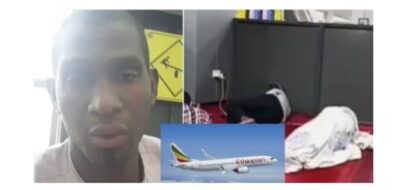
Today, he is homeless, taking refuge in a mosque in Utako, Abuja. He is also struggling with microloan debts and grieving the loss of his job in Egypt.

Abdullahi Salisu, a native of Kano Municipal in Kano State, spent more than two and a half months living in the departure hall of the Nnamdi Azikiwe International Airport (NAIA), Abuja.
During that period, he slept on cold airport chairs, bathed in public restrooms, and watched hundreds of passengers depart for destinations around the world while his own future remained trapped in a frustrating bureaucratic limbo.
Today, he is homeless, taking refuge in a mosque in Utako, Abuja. He is also struggling with microloan debts and grieving the loss of his job in Egypt.
He blames his ordeal on what he describes as a deceptive ticketing system operated by Ethiopian Airlines, as well as the alleged failure of the Nigerian Civil Aviation Authority (NCAA) to enforce consumer protection regulations.
Speaking exclusively to SaharaReporters, Salisu recounted a harrowing ordeal that began as a routine return journey but spiralled into a devastating chain of events marked by job loss, theft, financial hardship, and what he alleges was institutional negligence.
The Ill-Fated Journey
Salisu, who worked at Crispy Chicken Restaurant in Nazlet El Batran, Giza, Egypt, had booked a return flight from Abuja to Cairo via Addis Ababa with Ethiopian Airlines for June 29, 2026. According to him, his troubles began when he attempted to manage his booking through the airline’s official mobile application.
Documents obtained by SaharaReporters show a stark discrepancy between what the airline’s app displayed and what the airline’s customer service later claimed. In an email dated July 14, 2026, Ethiopian Airlines’ reservation team informed Salisu that his ticket was “non-refundable” and that he would need to pay a change fee and fare difference to alter his travel date.
However, Salisu insists this contradicts the airline’s own app. He provided SaharaReporters with screenshots and a screen recording of the Ethiopian Airlines booking app, which clearly displays “REFUNDABLE” in large green text, alongside an option for “Refund Protection”.
“When I tried to fill out the refund form online, the system gave me an error saying, ‘We cannot process refunds for your currency and country selection,’ and the email confirmation kept failing, saying the emails did not match,” Salisu told SaharaReporters.
“I eventually went to the airport on the day of my flight. The airline staff told me there were no economy seats available and that I would have to buy a business class ticket to fly.”
Salisu claims he checked the airline’s app on his phone while standing at the airport and saw numerous empty economy seats on the very flight he was denied boarding. When he presented this to the airline staff, they allegedly dismissed his evidence, claiming their internal system was different from the public app.
The failure to board on June 29 was not just an inconvenience; it was a death sentence for his livelihood. Salisu had a strict deadline to return to his workplace.
SaharaReporters obtained a translated copy of an email from the Human Resources Management of Crispy Chicken Restaurant, dated during his stranding, which explicitly warned him: “The deadline for returning to work has passed… the company has given you a final deadline to return, which is: September 1, 2026. If you do not return by this date, your employment will be terminated.”
Salisu forwarded this email to the airline and the NCAA, begging for intervention, but he was left stranded at the airport. For 80 days, from late June until mid-September, he lived in the airport terminal.
“The psychological trauma was unbearable,” Salisu recounted. “I was begging, surviving on the kindness of strangers and airport staff. I had no money for a new ticket because the airline was holding my funds and refusing to refund me.”
‘Ejected, Robbed, And Left Homeless’
On September 15, 2026, Salisu was forcefully ejected from the airport. Having lost his job, his only means of survival was gone. His nightmare worsened three days later on September 18, when he was robbed in Abuja.
“My phone and my trolley case were stolen,” he said. “I lost everything.”
SaharaReporters verified the loss of his device, a Galaxy A07, through Google’s “Find My Device” records, which show the phone as “Marked as lost” with location unavailable.
With his life in ruins, Salisu turned to micro-lending apps to survive, accumulating debts with OPay and EaseMoni to feed himself. Financial records provided to SaharaReporters show a trail of small emergency loans ranging from ₦2,000 to ₦10,000 taken between July 31 and October 23, 2026.
NCAA’s Intervention and the Compensation Battle
As his situation became increasingly desperate, Salisu’s case caught the attention of the media, eventually reaching the NCAA. Michael Achimugu, the Director of Consumer Protection and Public Affairs at the NCAA, intervened.
In a series of WhatsApp messages and phone calls reviewed by SaharaReporters, Achimugu facilitated the re-issuance of Salisu’s ticket for November 6, 2026. However, a bitter dispute erupted over Salisu’s demand for a refund and statutory compensation for the 80 days he was stranded, citing the Nigerian Civil Aviation Regulations (Nig CARs 2023) and the Civil Aviation Act 2022.
In the WhatsApp exchanges, Salisu argued that Ethiopian Airlines misrepresented the refundability of his ticket. He cited CARs Part 19.7 (Deceptive Practices), 19.8.1(ii) (30% International Compensation), and 19.9.1.2 (14-day refund rule). He also argued that the NCAA is legally obligated to enforce these regulations.
Achimugu, however, pushed back forcefully. In the chat, he accused Salisu of failing to secure a visa (which Salisu denies, stating he had an “Ok to Board” clearance), paying for refund protection without reading the terms, and staying at the airport unnecessarily.
“By the airline’s policy, you are not entitled to a refund. The resolution I got for you was a huge favour as well,” Achimugu wrote in one of the exchanges. He further sent a screenshot of the airline’s internal system, claiming it marked Salisu’s original ticket as “NON-REFUNDABLE.”
Salisu maintains that the NCAA Director acted as an advocate for the airline rather than a regulator.
“He defended Ethiopian Airlines,” Salisu told SaharaReporters.
“He kept saying my ticket was non-refundable, but I showed him the video of their app showing ‘REFUNDABLE.’ He ignored it and just gave me a re-issued ticket for November 6, without addressing the damages I suffered – my stolen property, my lost job, and the 80 days I spent homeless at the airport.”
A Litany of Institutional Failures
Salisu’s quest for justice has been met with closed doors across multiple Nigerian institutions. He filed complaints with the National Human Rights Commission (NHRC) under Complaint No. C/2026/ESCR/1823/HQ, which he claims was closed without notifying him. He filed with the Federal Competition and Consumer Protection Commission (FCCPC) under Complaint No. FC-05514, which has seen no progress.
He also filed multiple complaints with the Presidential Enabling Business Environment Council (PEBEC) under REP-251026-003 and REP-251026-004, which remain unreviewed.
Furthermore, he alleged that the Nigerian Television Authority (NTA) interviewed him and collected his documents but later refused to air the story. When he reported the NTA’s negligence to their SERVICOM unit, he alleged that the Head of Department harassed him and had security throw him out.
Today, Abdullahi Salisu is a broken man. He currently sleeps at the Utako Mosque in Abuja, relying on the charity of worshippers. He is holding onto a flight ticket for November 6, 2026, but he has no job to return to in Egypt, no money to pay off his accumulating loan debts, and no phone or luggage.
Salisu is demanding that the NCAA enforce the law, compel Ethiopian Airlines to issue a full refund, and pay the 30% compensation mandated by CARs 2023 for international flights, arguing that the airline’s deceptive app interface and denial of boarding caused his catastrophic losses.
“I am not asking for a favour,” Salisu told SaharaReporters. “I am asking for the law to be enforced. Their app lied to me, their staff stranded me, and the NCAA protected them. I want justice.”
Efforts by SaharaReporters to get a reaction from Ethiopian Airlines and the Nigerian Civil Aviation Authority (NCAA) regarding the allegations of app misrepresentation and regulatory negligence were unsuccessful as at the time of filing this report.
Emails and messages to NCAA’s Michael Achimugu were not returned, and the airline’s reservation desk did not respond to inquiries as at the time of filing this report.
