

Two F!refighting Helicopters C0llide Mid-Air While Battling Greece Wildf!res
Two Firefighting Helicopters Collide Mid-Air While Battling Greece Wildfires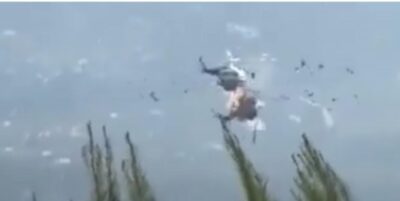
The two helicopters reportedly flew at low altitude before the rotor blades of one aircraft struck the other.
Two firefighting helicopters collided on Sunday while battling a massive wildfire in Greece, as authorities struggled to contain fast-moving blazes that have destroyed more than 100 homes northwest of Athens and triggered fresh evacuations on the tourist island of Kefalonia.
The mid-air collision occurred during an aerial firefighting operation in the Psatha area of the Attica region, west of the Greek capital, according to the country’s fire service, according to NBC News.
The two helicopters reportedly flew at low altitude before the rotor blades of one aircraft struck the other.
One helicopter reportedly crashed and burst into flames, while the second aircraft released its load of water and continued flying. The authenticity of the footage has not been independently verified.
Government officials said the crew members from one helicopter were found alive and safe, with emergency medical teams dispatched to the scene. Search-and-rescue teams were also deployed after locating the second aircraft.
The collision came as Greece intensified efforts to contain one of its most destructive wildfire outbreaks this year.
Although powerful winds that initially fuelled the inferno near Porto Germeno on the Gulf of Corinth had eased, firefighters continued battling flames that spread across mountainous terrain toward the settlement of Veniza and a nearby military firing range, where unexploded ordnance reportedly caught fire.
Emergency responders concentrated on preventing the blaze from reaching the coastal town of Megara, home to about 30,000 residents.
Prime Minister Kyriakos Mitsotakis acknowledged the scale of the disaster, saying the severity of the weather conditions had stretched emergency response capabilities beyond their limits.
“There are moments when the force of nature and the intensity of weather conditions exceed all human planning and every operational capability,” Mitsotakis said in his weekly address.
Authorities also issued emergency evacuation alerts for several communities in western Attica, including an industrial zone close to Megara.
Residents in affected villages joined firefighters in efforts to stop the advancing flames.
“The fire has been burning since last night. It is certain that they cannot have forces everywhere. We as residents are doing everything we can,” 61-year-old Tasos Tzempelikos said as he and his son poured water on burning vegetation near their home.
Local media outlet Protothema reported that more than 10,000 hectares of land may already have been destroyed, with emergency crews racing to stop the fire from reaching densely populated coastal areas.
Elsewhere, authorities ordered overnight evacuations in several communities on the Ionian island of Kefalonia after another wildfire erupted in the Pastra area in the island’s south.
The fires in Greece are part of a wider environmental crisis affecting Europe this summer.
After enduring prolonged heatwaves and exceptionally dry conditions, several countries have battled devastating wildfires that scientists say have been intensified by climate change.
In France, officials reported that major fires in the Gironde and Var regions had largely been brought under control, with only isolated flare-ups recorded.
Spain also reported improvements after destructive fires scorched vast areas over the past week, although firefighters continued tackling isolated reignitions.
Meanwhile, in Spain’s western province of Caceres, nearly 800 residents who had been evacuated after a forest fire broke out on Saturday were allowed to return home on Sunday but were instructed to remain indoors while emergency crews continued firefighting operations.
The prolonged drought has also caused severe water shortages across parts of Europe.
Water levels in major rivers, including the Danube and the Rhine, have dropped dramatically, disrupting transport, tourism and electricity generation.
Hungary is facing one of its worst water crises in decades after historically low Danube levels forced the temporary shutdown of the country’s only nuclear power plant for the first time in more than 40 years.
Authorities have also imposed water-use restrictions in more than 100 towns and villages.
Neighbouring Serbia has also reported record-low Danube water levels, reducing the output of its largest hydropower station to just 20% of normal capacity, according to the country’s energy ministry.