Sunny Ukachukwu Advocates Global Partnerships, Local Manufacturing for Sustainable Prosthetics and Orthotics in Africa
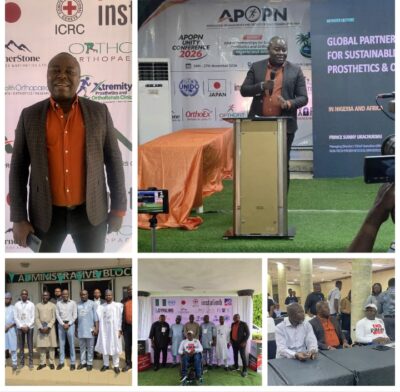
Sunny Ukachukwu Advocates Global Partnerships, Local Manufacturing for Sustainable Prosthetics and Orthotics in Africa
…..Says Africa Must Move from Dependency to Innovation in Prosthetics and Orthotics….
The Managing Director and Chief Executive Officer of Sun-Tech Prosthetics & Orthotics Ltd, Abuja, Prince Sunny Ukachukwu, has called for stronger global partnerships, increased investment in local manufacturing, professional capacity development and sustainable healthcare financing to improve access to prosthetic and orthotic services in Nigeria and across Africa.
Ukachukwu made the call while delivering a keynote lecture titled “Global Partnership for Sustainable Prosthetics and Orthotics in Nigeria and Africa,” where he emphasised the need for African countries to move beyond donor-dependent interventions and embrace strategic collaborations capable of strengthening local institutions, advancing technological innovation and building sustainable rehabilitation systems.
He stressed that the future of prosthetics and orthotics in Africa must be driven by local expertise, research, innovation and effective government policies, noting that international partnerships should focus on transferring knowledge, developing local capacity and creating solutions that will continue to benefit patients long after external partners have completed their interventions.
Full details of the lecture read;
A KEYNOTE LECTURE ON THE “GLOBAL PARTNERSHIP FOR SUSTAINABLE PROSTHETICS AND ORTHOTICS IN NIGERIA AND AFRICA”
The Registrar, Medical Rehabilitation Therapists Board of Nigeria (MRTB),
The President, Association of Prosthetics and Orthotics Practitioners of Nigeria (APOPN), Head of Institutions,
Academicians,
Prosthetists,
Orthotists,
Healthcare Professionals,
Guests,
Ladies and Gentlemen.
It is both an immense privilege and a profound professional honor to stand before you today at this landmark conference.
We gather under a theme that is timely and essential to the future of physical rehabilitation and human dignity in our continent: “Global Partnership for Sustainable Prosthetics and Orthotics (P&O) in Nigeria and Africa”.
INTRODUCTION
The Global Partnership for Sustainable Prosthetics and Orthotics in Nigeria and Africa centers on transforming mobility devices from scarce, donor-dependent amenities into locally driven, accessible, and resilient pillars of healthcare.
Rather than viewing prosthetics and orthotics merely through the lens of short-term charity or imported medical hardware, a sustainable global partnership framework weaves together international expertise, local clinical capacity, and national policy.
THE REALITY OF MOBILITY AND HUMAN DIGNITY
Mobility is not merely a matter of biomechanics; it is a fundamental human right. It determines whether a child can attend school, whether an adult can provide for their family, and whether an older person can age with dignity.
Yet across Nigeria and the wider African continent, millions of people who need assistive technology, particularly prostheses and orthoses, remain excluded from these basic opportunities.
Statistics from the World Health Organization (WHO) consistently show that global access to assistive technology is shockingly low, often under 10% in low-and middle-income countries (LMICs). Behind these statistics are real people: survivors of road traffic crashes, victims of conflict, individuals managing diabetic complications, and children born with congenital limb differences.
That tells us something very important: the problem is bigger than individual practitioners. It is a system problem and system problems require partnerships
and collaboration
I would like to start with a simple question. When we say “global partnership,” what exactly are we talking about? Is it bringing technology from America, Europe, or Asia into Africa? Is it receiving funding from international organizations? Is it donating prosthetic limbs to people who need them or sending our professionals abroad for training?
Yes!! These can all be partnerships. But the bigger question is: How sustainable are these partnerships?
SUSTAINABILITY
To me, it’s simple. Sustainability means starting today what we can continue tomorrow.
A patient receives a prosthesis today and months later, the socket no longer fits. What happens?
The child wearing an orthosis grows,
A prosthetic foot gets damaged,
A patient needs a new liner. What happens?
A professional needs advanced training. Where does that training come from?
These are the realities we need to consider. Prosthetics and orthotics are not one -time services. They are a journey involving Assessment, Prescription, Fabrication, Fitting, training, Followup, adjustment, repair, replacing components, and sometimes starting the process all over again. So, when we talk about sustainability, we have to think about the entire patient journey, not just the moment when the device is delivered.
Sometimes we become so fascinated by technology that we forget why it exists. We talk about carbon fiber, microprocessor knees, advanced prosthetic feet, 3D printing, Digital scanning, Artificial Intelligence (A.I.), Smart devices, and other exciting technologies.
What is the worth of the most advanced prosthesis if a professional cannot repair it? What is the value of a sophisticated orthosis if the patient cannot return for a proper follow-up? What is the value of a device if it does not fit the patient’s lifestyle?
The best technology is not always the most expensive technology. It is the technology that is appropriate for the person, the environment, and system support.
THE CHALLENGES IMPEDING SUSTAINABILITY
1. The Resource Gap and Import Dependency: Most raw materials, components, and advanced technologies are imported from the Global North. This makes high-quality devices extremely high and leaves them vulnerable to foreign-exchange fluctuations and supply-chain shocks.
2. Workforce Deficits: There is a severe shortage of certified prosthetists and orthotists relative to the population. Training institutions need modernization, increased funding and expanded curriculum to meet contemporary clinical standards.
3. Fragmented Health Infrastructure: P&O care is frequently treated as an afterthought in national health planning rather than an integrated component of Universal Health Coverage (UHC).
GLOBAL PARTNERSHIP
True sustainability cannot be achieved through intermittent philanthropy or container-load charity drops, which often deliver inappropriate technology that local technicians cannot repair. Sustainable development requires a shift towards co-creation and local capacity building, moving from Charity drops to Collaboration and equal partnership.
Below are some of the areas we can partner;
A. Academic and Technical Knowledge Transfer.
Partnerships between African universities and global P&O institutions must go beyond student exchanges to include curriculum co-development and joint research.
We must leverage digital health and e-learning platforms to address immediate training gaps, equipping local clinicians with advanced alignment, fabrication, and patient-management techniques.
B. Localizing Manufacturing and Innovation.
Global partnerships must support local enterprise. We must champion local component manufacturing using context-appropriate technologies, such as appropriate-technology plastics, lower-cost dynamic components, and vetted 3D -printing applications suited to tropical climates.
By collaborating with international engineering bodies, we can build labs to design and test durable, low-cost solutions tailored to rugged terrain and local environmental conditions.
C. Integrating P&O into Universal Health Coverage (UHC)
Government and international bodies must work together to include assistive health devices in national health insurance schemes, such as Nigeria’s National Health Insurance Authority (NHIA) framework. Without financial risk protection, out-of-pocket payments will continue to keep vulnerable people from accessing care.
We do not simply need more prosthetic limbs and orthoses. We need stronger systems, better training for our professionals, better facilities, reliable materials, access to components, local manufacturing, research, financing, insurance coverage, and support from government and global partners.
PARTNERSHIP VERSUS DEPENDENCY
This is where I believe we need to rethink our approach. International partnership should not create dependency. If a foreign organization comes into Nigeria, provides a service, and leaves, that is assistance, but if the organization comes, trains local professionals, strengthens local institutions and clinical research, co-develop local manufacturing, and helps establish a system that continues after it leaves, that is partnership.
We should move from donation to capacity building, from short-term projects to long-term systems, from importing solutions to developing and adapting solutions, and from doing things for Africa to doing things with Africa. So, rather than asking International partners, “What can you bring to us?” we should ask, “What can we build together?” This should be the new mindset.
INVESTING IN OUR PEOPLE: THE MOST IMPORTANT RESOURCE
We can acquire the most advanced machines in the world, but without competent professionals, those machines cannot deliver their full potential. Technology cannot replace clinical judgment. A digital scanner needs someone who understands what to scan and why. A CAD system needs someone who understands anatomy, biomechanics, and clinical prescription. A 3D printer can manufacture a device, but a qualified professional must determine whether that device is clinically appropriate. A sophisticated knee joint still requires proper prescription, alignment, fitting, rehabilitation, and follow-up. This is why investing in human resources must remain a central pillar of sustainable P&O services.
We need stronger academic programs, modernized training facilities, clinical mentorship, continuing professional development, international professional exchange, research opportunities, engineering and technology collaboration, leadership development, and improved professional working conditions.
Training alone is not enough. we must also retain our professionals and build institutions and industries where they can grow, innovate, teach, conduct research, and contribute meaningfully to national development. Our professional associations, training institutions, employers, and regulatory bodies all have responsibilities in achieving this.
MANUFACTURING LOCALLY
This is an area we need to take more seriously. We cannot remain only as consumers of prosthetics and orthotics technology: We must increasingly become innovators and manufacturers. That does not mean we must manufacture everything locally, that is not realistic. But let’s ask ourselves this: how can we produce more components locally? Can we improve local fabrication, develop better materials, strengthen repair and maintenance? Can our universities work with industry to develop new products? Can Prosthetists and Orthotists collaborate with engineers, polymer and textile technologists to locally produce modular components? Absolutely yes!
This is where global partnership can have a powerful impact. International companies do not have to come here to sell products. They can partner to build capacity, train people and transfer knowledge as seen in the collaboration between UNIDO, Insta Limb and MRTB in developing local production, support research, and strengthen supply chains. That partnership creates lasting value.
FURTHERMORE, the Government, Industries, Professional associations, Universities and international organizations cannot solve the challenges of sustainability in isolation. We need everybody around the same table.
STRATEGIC ROADMAP FOR NIGERIA AND AFRICA: THE WAY FORWARD
Conferences build awareness and spark ideas, but the true value lies in what happens afterward. To turn this conference’s vision into reality, I propose the following strategic pillars for action:
1. Establish a Pan-African P&O Taskforce:
Build a unified network of national associations, including those representing prosthetists and orthotists in Nigeria, international societies, and ministries of Health, to harmonize standards, certification, and policy advocacy.
2. Develop a National P&O Manufacturing and Innovation Program:
Link Nigerian manufacturers with P&O professionals and engineering institutions. Assess local capacity, identify components that can be safely produced, and scale from achievable products to advanced technologies.
3. Create a P&O Research, Testing, and Innovation Network:
Connect universities, hospitals, manufacturers, and professional institutions to support materials, structural, and fatigue testing: product development; digital fabrication; clinical evaluation; and collaborative research.
4. Strengthen National Data and Evidence-Based Advocacy:
Collect reliable data on service demand, workforce distribution, device costs, patient outcomes, and unmet needs. A national registry and regular assessments can guide planning, attract investment, and track progress.
5. Advocate for Sustainable Healthcare Financing:
The association of Prosthetics and Orthotics Practitioners in Nigeria and its partners should work with government and health financing agencies to secure coverage for P&O services and devices, so patients do not bear the full cost of essential rehabilitation.
6. Ensure Patient and Disability Inclusion:
Persons with disabilities must help shape their care, Incorporate their experiences and feedback to build an accessible, inclusive, responsive, and accountable P&O system.
7. Forge Public-Private Partnerships (PPP):
Bring together government, global partners, private technology innovators, and professionals to build regional production and maintenance hubs.
Let us make these actions measurable priorities, with responsible institutions, timelines, and progress indicators, not just conference recommendations.
CONCLUSION
The future of prosthetics and orthotics in Africa must be more ambitious.
We should build a future where a patient does not have to wait indefinitely for an imported component. A place where our universities does not only teach the principles of prosthetics and orthotics technologies but also participate in developing them, where local manufacturers produce quality-assured components, where our professionals have access to modern training, research, and career opportunities, where insurance and public financing support access to essential rehabilitation services, where people with disabilities are not excluded because of the cost or unavailability of assistive technology: A Country that exports knowledge, expertise, and innovative solutions to the rest of the world.
This vision is achievable, but it will not happen overnight. It requires a deliberate commitment to education, research, investment, manufacturing, policy development, and international cooperation.
Nigeria and other African countries with their population, professional institutions, universities, and industries, has an opportunity to play a significant role in this transformation,
But that opportunity comes with responsibility. We must be willing to invest in ourselves, collaborate across disciplines, and develop solutions that respond to the needs of the people.
Thank you for your attention.
PRINCE SUNNY UKACHUKWU.
THE MANAGING DIRECTOR/CHIEF EXECUTIVE OFFICER, SUN-TECH PROSTHETICS & ORTHOTICS LTD, ABUJA, NIGERIA.