
Pipeline Billions Exposed: N2.1 Trillion Deal, Tantita–Manroy Money Trail And The Question—Why Is The Niger Delta Still Poor?
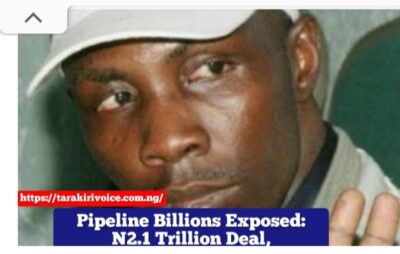 Pipeline Billions Exposed: N2.1 Trillion Deal, Tantita–Manroy Money Trail And The Question—Why Is The Niger Delta Still Poor?
Fresh questions are emerging over the controversial pipeline surveillance contracts in the Niger Delta, following explosive allegations by activist and journalist Fejiro Oliver that billions of naira may be flowing to companies operating behind the scenes as monitors of contractors engaged in pipeline security.
Oliver, who has repeatedly raised questions over the financial structure of the pipeline surveillance arrangement, says his latest investigation is focused not only on the companies publicly associated with the contracts but also on entities allegedly receiving substantial payments for monitoring the principal contractors.
At the centre of the new allegations is Manroy Global Services Limited, which Oliver claims operates under the Ocean Wave group and is controlled by businessman Peter Omoh Dunia, popularly known as Peter Black.
According to Oliver, Manroy allegedly receives approximately N100 billion-equivalent in annual payments—a figure he describes as payment for monitoring pipeline surveillance contractors.
However, the allegation requires independent verification, particularly regarding the exact contractual basis, annual value and scope of any monitoring arrangement involving Manroy.
“Who Is Really Eating The Pipeline Surveillance Money?”
Oliver argues that public attention has largely focused on Tantita Security Services and its principal figure, Government Ekpemupolo, popularly known as Tompolo, while insufficient attention has been paid to other companies allegedly benefiting from the same pipeline-security ecosystem.
He said his investigation began after questioning why the Niger Delta remains economically distressed despite the enormous sums allegedly being spent on pipeline surveillance.
According to him, the original pipeline surveillance arrangement contained a lesser-known component involving a company allegedly tasked with monitoring contractors and submitting reports on their activities.
Oliver alleges that Manroy Global Services Limited occupies that role and has received substantial payments from Tantita.
The activist further alleged that an Urhobo businessman, Chief Idama Amurum, serves as managing director of the company while Peter Black remains chairman.
These claims have not been independently established by Tarakirivoice, and the parties named have the right of reply.Read Local News
What The Supplied Bank Statement Shows
Oliver also supplied what he described as a USD corporate domiciliary account statement for Manroy Global Services Limited at Fidelity Bank.
The document identifies the account as belonging to Manroy Global Services Limited, with an address in Warri, Delta State.
Among the transactions visible in the supplied statement are several entries described as transfers from Tantita Security Services Nigeria Limited.
One transaction shows a payment of $171,000, while other entries include payments to entities identified in the statement as Maro Kana Enterprises, Loyal Multicy Ventures, and other beneficiaries.Shop African Art
The statement also contains repeated transactions described as transfers from Tantita, including entries dated around November and December 2023 and January 2024.
Importantly, the existence of these banking entries, by itself, does not establish that the payments were illegal, improper or connected to a particular government contract. The contractual purpose of each payment would need to be established through the underlying agreements, invoices, certificates or other supporting documents.
The Maro Kana Connection
Oliver has drawn particular attention to transactions involving Maro Kana Enterprises, alleging a connection between the company and Christian Ashaka, whom he identifies as a close associate of Tompolo and a political candidate in Isoko.
The supplied bank statement indeed contains entries referencing Maro Kana Enterprises/Consultancy Services, including a transaction of $52,000
But whether that company is owned or controlled by the person named by Oliver, and whether the payment was connected to pipeline surveillance activities, requires documentary confirmation.
That distinction is critical.
A bank transaction can establish that money moved from one account to another; it does not, on its own, establish the purpose of the transaction or wrongdoing.
Oliver: “It Was Not N2.7 Trillion For PINL”
Oliver also sought to correct what he described as misinformation surrounding the value of the pipeline surveillance contracts.
He rejected claims that Osahon Okunbo’s PINL received N2.7 trillion, insisting that the documents in his possession show a different distribution of the contracts.
According to Oliver, the pipeline surveillance arrangement involved multiple companies and corridors, including Tantita Security Services Nigeria Limited, Maton Engineering and PINL.Shop African Art
He claimed Tantita’s annual allocation was approximately N2.1 trillion, while PINL received less than N1 trillion and operated with numerous subcontractors.
These figures remain allegations contained in Oliver’s account and should be verified against the original government contracts, payment records and appropriation or procurement documents.
“The Real Amount Was Hidden From Nigerians”
Oliver further claimed that the public previously believed the pipeline surveillance contract was worth approximately N48 billion annually.
He said he later obtained contractual documents which, according to him, revealed that the actual financial commitment was vastly larger.
He credited that disclosure with triggering wider public controversy and eventually attracting the attention of other Niger Delta stakeholders, including Asari Dokubo.
Oliver insists that his present campaign is not intended to destroy the pipeline surveillance arrangement but to expose what he believes are leakages and ensure that the economic benefits of the contract remain within the Niger Delta.
The Bigger Question: Where Is The Money Going?
The controversy raises a broader question that goes beyond the personalities involved:
How much money has the Federal Government actually paid for pipeline surveillance, which companies received the money, what services were delivered, and how much ultimately reached communities in the Niger Delta?
If monitoring companies are being paid hundreds of millions of dollars or billions of naira, Nigerians deserve to know:Shop African Art
– Who awarded the monitoring contracts?
– What is the precise value of each contract?
– What services are the monitoring companies required to provide?
– How are their performance reports verified?
– Who approves their invoices?
– How much has been paid since the commencement of the contracts?
– What percentage goes to subcontractors?
– Are payments made directly by government agencies or through the principal contractors?
– What independent audits have been conducted?
– Have the monitoring companies actually conducted the inspections for which they were allegedly engaged?
These are legitimate public-interest questions, particularly because the contracts involve public funds and the protection of critical national infrastructure.
A Fight Over Billions In The Niger Delta
The pipeline surveillance controversy has increasingly become a battle over who controls one of the Niger Delta’s largest streams of government expenditure.
Tantita has become the most visible name associated with the Western corridor, while other contractors and subcontractors operate within the wider arrangement.
Oliver now says the next phase of his investigation will focus on alleged financial movements involving Peter Black and Manroy Global Services, including claims concerning transfers allegedly made outside Nigeria
He has promised to publish what he describes as a breakdown of funds allegedly transferred to Ghana.
Those claims also require documentary scrutiny before conclusions can be reached.
The Questions Authorities Must Answer
With billions of naira reportedly involved, the Federal Government, the Nigerian National Petroleum Company Limited (NNPCL) and relevant security and procurement authorities should be able to provide Nigerians with a transparent account of the pipeline surveillance programme.Shop African Art
The public deserves to know the original contract values, payment schedules, beneficiaries, monitoring arrangements, subcontractors and audit reports.
The central issue should not simply be whether Tantita, PINL, Maton or another company is receiving the money.
The bigger question is.
Who ultimately benefits from the billions allocated for protecting Nigeria’s pipelines—and what does the Niger Delta receive in return?
Until the underlying contracts and payment records are made available for independent scrutiny, allegations of billions being diverted, hidden or paid for questionable services will continue to fuel suspicion and public anger across the region.
Tarakirivoice will continue to follow the money.Read Local News
Editor’s Note: The allegations concerning Manroy Global Services Limited, Peter Black, Chief Idama Amurum, Maro Kana Enterprises and other individuals/entities in this report are attributed to Fejiro Oliver and documents supplied by him. Tarakirivoice has not independently established criminal wrongdoing by any person or company mentioned. The parties concerned should be given an opportunity to respond, and the original contracts, invoices, bank records and government payment records should be independently examined.
Manroy Global Services N2.1 Trillion Pipeline Contract Niger Delta Billion Niger Delta pipeline surveillance Pipeline Surveillance Money Trail Tantita Security Services Tompolo pipeline contract