
In April, Tinubu promised Plateau ‘never again’. Months later, more than 100 people are de∆d
In April, Tinubu promised Plateau ‘never again’. Months later, more than 100 people are dead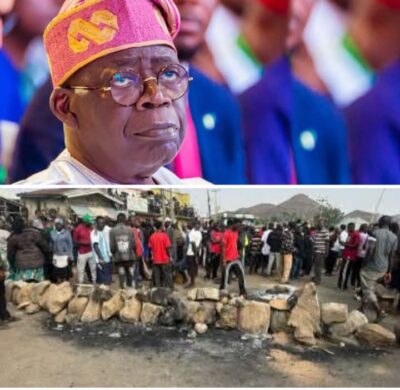
The holes left by bullets that riddled the doors of Eze Chidubem’s* chemist and provision store in March are still there, seven months after the incident. When gunshots rang in the air in the Angwan Rukuba community in Jos, Plateau state, residents thought it was officials of the National Drug Law Enforcement Agency (NDLEA) on a raid. Chiduben, who had run the store for over two decades, thought so, too, until a bullet hit the leg of the customer he was attending to.

“It was terrible,” Chidubem told TheCable, hissing through his teeth.
“I don’t even know how to describe it. It happened as if fowl were more valuable than human lives.
“My shop was a pool of blood. The people who did this thing are animals.”
It was Palm Sunday.
Some armed men riding on motorcycles invaded the Gari Ya Waye area of Angwan Rukuba, Jos North, on the evening of March 29 and shot sporadically at people initially before making targeted attacks on homes and shops by banging and forcing doors open.
Angwan Rukuba residents protesting at the scene of the March 29 attack | Photo: HumAngle
“All of this, everything happened within 15 minutes,” Chidubem said.
By the time the attack was over, more than ten people had been killed, and many others had been injured. In the days that followed, the death toll rose to 33, as some of the injured died in the hospital.
Chiduben said that escaping unhurt remains a “miracle” to him. According to him, the customer he was attending to and another girl who ran into his shop to take cover were both shot.
He typically held the door ajar with a stone, but that day, he said it was divine intervention that he entered the shop and started praying without restraining the door.
‘THIS EXPERIENCE WILL NOT REPEAT ITSELF’ – DID IT?
President Bola Tinubu being briefed by Caleb Muftwang, governor of Plateau, on the Sunday evening attack at Angwan Rukuba in Jos north LGA
Three days after the attack, President Bola Tinubu visited Plateau to condole with the victims.
Addressing residents, community leaders and government officials, Tinubu acknowledged the pain of the killings and offered a direct assurance.
Tinubu, who met with the victims at Yakubu Gowon Airport in Plateau, promised them that such an incident would not happen again.
“There is nothing I can give you, whether money in billions, but console you and promise you that this experience will not repeat itself,” Tinubu said.
The president also announced plans to strengthen security surveillance in the area, including installing streetlights and cameras to help law enforcement identify perpetrators. He also assured the residents that the perpetrators of the attack will be found and brought to book.
But less than 24 hours after the president’s visit, another attack was reported in Plateau, and several others after that.
While Angwan Rukuba has remained peaceful since then, checks by TheCable show there have been at least 29 attacks that led to the death of over 100 people across several communities in the state since the president’s promise.
TIMELINE: A WAVE OF DEADLY ATTACKS ON PLATEAU
APRIL 3
Barely hours after the president left Plateau state, gunmen ambushed a group of about 15 youths returning from a mining site in the Nyango Gyel community, Jos South LGA, killing at least three people and injuring another. The attack reportedly occurred around 7 pm.
APRIL 6
Less than 78 hours later, gunmen launched a pre-dawn attack on Pwomol village in Heipang district of Barkin Ladi LGA, killing three people.
APRIL 20
At least six people were killed in separate attacks on Shonun community in Riyom LGA and Hurum in Gashish district of Barkin Ladi LGA. Several others were also injured.
APRIL 26
Gunmen attacked Gako village in Riyom LGA at about 11pm, killing a pastor, his wife and their two children.
MAY 3
At least five people were killed when gunmen ambushed residents in Fan District of Barkin Ladi LGA on the evening of May 3.
The victims were reportedly returning home at about 9pm when the attackers opened fire. Four died at the scene, while another died later in hospital.
MAY 5
Gunmen attacked Nding Susut community in Fan District of Barkin Ladi LGA, killing five residents, including four women and a nine-year-old boy. Three other women sustained injuries.
MAY 31
At least eight people were killed and 10 others injured when gunmen attacked Gwon-Ajang village in Foron District of Barkin Ladi LGA during a birthday celebration.
Residents said the attackers opened fire on villagers gathered for the event.
JUNE 10–11
The Berom Youth Moulders Association (BYM) said armed men invaded Sol village in the Ta-Hoss community of Riyom LGA on June 10, killing two residents identified as Davou Dalyop Patu, 48, and Dalyop Zaram, 38.
According to the group, another resident, Toma Chuwang, 55, was killed at a mining site in Bangai, Riyom LGA, the following morning while the funeral procession for the two deceased residents was ongoing.
JUNE 16
Three security operatives — two soldiers and one policeman — were killed during an attack on the National Institute for Policy and Strategic Studies (NIPSS) in Kuru.
JUNE 20
At least 20 people were killed in separate attacks on Kawel and Kopkon communities in Mushere district of Bokkos LGA.
Eighteen people were confirmed dead shortly after the attacks, while two others later died in hospital.
AUGUST 16
Several residents were killed when armed men attacked settlements in Jwak Maitumbi community, Mangu LGA. The attackers also destroyed about 45 residential shelters and large quantities of crops.
AUGUST 18
Gunmen attacked Bim-Pier community in Kombun District of Mangu LGA, killing at least 23 people, mostly women and children, in their sleep.
The incident was reportedly a reprisal for the attack on Jwak Maitumbi community less than 48 hours earlier. Several other residents were injured.
SEPTEMBER 13
Armed men opened fire on a vehicle at Dungus community in Jos South LGA at about 9:40pm, killing six passengers.
In a separate attack, gunmen raided Vodni in Pushit District, killing two people and injuring four others.
SEPTEMBER 19–20
Gunmen killed at least nine people in a series of attacks on residents and travellers across Barkin Ladi, Riyom and neighbouring communities.
Five people were shot dead while travelling to Gana-Ropp on the night of September 19. A woman was also killed at Baten Wereng in Riyom LGA, while another person died at Ratyidi in Fan District.
A separate attack on Sunday morning claimed the lives of two people, including a pastor on his way to church in Dorowa Babuje.
SEPTEMBER 20
At least five Fulani men were reportedly killed when suspected Berom militias attacked their vehicle in Barkin Ladi LGA
Zagazola Makama reported that the victims were travelling to a market in Jos South when gunmen ambushed their vehicle near a security checkpoint.
SEPTEMBER 22
Five people, including a police officer, were killed in separate attacks in Barkin Ladi and Mangu LGAs.
The incidents occurred despite a dusk-to-dawn curfew imposed by the state government on the affected areas.
SEPTEMBER 24–26
The Berom Youth Moulders Association (BYM) reported a series of killings in Barkin Ladi LGA.
According to the group, Phillip Luka, 25, and Sunday John, 34, were killed on Thursday at a mining site in Kworos Gangare.
Two other people were killed at Nghar, Exland, in Gashish District, while three residents died in an attack at Gassa, Barkin Ladi LGA. The victims were identified as Ishaya Pam Dung, 47; Barnabas Gyang Jack, 23; and Manasseh Luka Mushwer, 26.
The group said the attacks occurred despite the 6pm to 6am curfew imposed on Barkin Ladi, Bokkos and Mangu LGAs.
SEPTEMBER 26
Five miners were reportedly killed and two others injured when gunmen attacked a mining site in Marit village, Barkin Ladi LGA.
SEPTEMBER 29
Three women were reportedly killed and another person injured when gunmen attacked a mining site in Rakum community, Barkin Ladi LGA.
OCTOBER 4
One person was killed and seven others injured after gunmen opened fire on a vehicle conveying Fulani traders along the Bukuru Expressway in Jos South LGA. The incident reportedly occurred at about 4:30pm.
In another incident, gunmen shot seven passengers near the Total Roundabout in Bukuru, Jos South LGA, at about 6:30 pm.
The passengers were travelling in an open-body vehicle from the Kara Bukuru livestock market to Rafin Bauna village in Bassa LGA.
Zagazola Makama, a counter-insurgency publication, reported that 20 people were aboard the vehicle. Citing the driver and a survivor identified as Murtala Isa Ibrahim, the publication said seven passengers were hit by gunfire.
OCTOBER 8
Abdulrahman Auwal, a mobile police officer, was killed in a machete attack along Kwi Road in Barkin Ladi LGA.
OCTOBER 17
Four people were killed when suspected bandits attacked Shurum village in Barkin Ladi LGA at about 1 am.
OCTOBER 23
Seven vigilantes keeping watch over Dorowa Babuje community in Barkin Ladi LGA were killed after gunmen opened fire on them at about 11pm.
Four of the vigilantes died at the scene, while three others, among six who sustained injuries, later died in hospital.
OCTOBER 27
Six people were killed when gunmen attacked Gero community in Jos South LGA.
OCTOBER 29
At least four people were killed when gunmen attacked Sabon Angwa community, around Bet/Zat in Barkin Ladi LGA, on Thursday night.
OCTOBER 31
Gunmen attacked soldiers attached to Operation Enduring Peace (OPEP) at a checkpoint in Riyom LGA, killing one soldier and carting away two weapons.
The attack occurred at the Sopp checkpoint, where troops deployed at Ungwan Boka came under fire.
‘DON’T WAIT ON GOVERNMENT’: RESIDENTS QUESTION TINUBU’S SECURITY PROMISE
For Chidubem, Tinubu’s assurance that the attacks would cease offered no reassurance. He questioned why the president had stopped at the airport instead of visiting the community if he felt the area was safe.
Although no attack has been recorded in Angwan Rukuba since Tinubu’s visit, Chidubem said residents remain gripped by fear and have little confidence that the violence has been contained.
“It will never happen again? Has it not continued happening in other communities in Plateau?” he asked.
“The attacks haven’t stopped; even last week, there was an attack. My only advice is if you have your way, protect yourself, don’t wait on government.”
Saheed Owonikoko, a conflict researcher and lecturer at the Centre for Peace and Security Studies, Modibbo Adama University, Adamawa, questioned the credibility of Tinubu’s assurance that the attacks would cease, arguing that the president’s failure to visit the community undermined the message.
He noted that Caleb Mutfwang, Plateau governor, had visited the area in an armoured vehicle, while Tinubu stopped at the airport and invited affected residents to meet him there.
“If the president, who has a lot of security details, is afraid to go to that area, do you think people will hold anything that he is saying very seriously? I don’t think so,” Owonikoko said.
Owonikoko argued that verbal assurances could not resolve a security crisis without concrete action, describing the president’s promise as potentially more political than practical.
“An ordinary word proclamation does not solve a security crisis. You have to take concrete steps,” he said.
“If you were going to do something, you didn’t really need to make a statement; people will just see action.”
LIVING WITH THE AFTERMATH, WAITING FOR RELIEF
The morning after the attack, Chidubem returned to his shop, despite the trauma of the previous night. Bullet holes still mark its burglary-proof bars, which he has yet to find the time or money to repair.
“I saw hell, I saw hell. The trauma held me for more than two weeks. The next day, we all bounced back to our shops. If you don’t open, what will you eat? Who will feed you?” he told TheCable.
When Tinubu visited Plateau, he approved N2 billion in relief support for victims of the attack.
He met with a 32-member delegation from Plateau at the State House in Abuja. He asked political, traditional and community leaders to review previous government white papers on the state’s security crises and produce practical recommendations for ending the recurring violence.
Chidubem said he had received no relief materials from either the state or federal government. The only assistance he knew of, he said, was the payment of hospital bills for a woman who ran into his shop after being shot. She received no other support.
He said the government’s failure to visit the community had deepened residents’ sense of abandonment.
“My anger is that the government has not shown any concern. They should have come to the community to know what really happened. That would have brought some relief to the people and showed that they have respect for human life. The president came and stopped at the airport,” he said.
Enoch Garba, secretary of the Angwan Rukuba Youth Forum, told TheCable that while normal activities had resumed, residents remained traumatised by the attack and easily startled by sudden sounds.
Garba also said residents were unhappy that promises made by Tinubu during his visit had yet to materialise, adding that there had been little or no engagement with the community by government officials at any level.
“The people have that in mind; there is anger in the hearts of residents,” Garba said.
While acknowledging that some streetlights had been installed around the area where the attack occurred, Garba said the intervention was inadequate, as several parts of the community remained poorly lit.
He also called for the replacement of a faulty electricity transformer, explaining that the remaining transformer was struggling to serve the community after the electricity distribution company removed the damaged one.
GOVERNMENT SAYS SECURITY MEASURES HAVE BEEN STRENGTHENED
Joyce Ramnap, Plateau commissioner for information, said the state government had installed CCTV-equipped streetlights and strengthened surveillance around the site of the Angwan Rukuba attack.
She described attacks across the state as largely unprovoked, saying perpetrators often targeted vulnerable communities and places least expected to come under attack.
“The state government is not resting on its oars to ensure that Plateau is safe for everyone within and around the state,” Ramnap told TheCable in a telephone conversation.
On relief for Angwan Rukuba victims, Ramnap referred TheCable to the federal ministry of humanitarian affairs, saying she believed the funds were domiciled there.
She highlighted the N1 billion pledged by Remi Tinubu, first lady, for victims of attacks in Mangu and Bokkos in 2025, saying disbursement could take time because of the verification and needs-assessment process.
Officials, she said, had to visit affected communities, collect data and consult local leaders and government representatives to establish an accurate list of households requiring support.
“Even when funds are released, you have to do a lot: data, needs assessment. You can’t just start sharing money,” she said.
Ramnap added that Plateau’s ministry of humanitarian affairs was only about six weeks old and still finding its footing.
Commenting on the prosecution of suspects linked to attacks in the state, the commissioner said the government wanted justice served but suggested that security concerns informed the decision to keep proceedings from the public.
She cited an earlier court appearance that she said nearly triggered another security incident.
“Plateau state government is interested in the outcome of that prosecution process because we cannot continue this way. We really want to see that justice is served at the end of the day,” she said.
POLITICS, WEAK SECURITY RESPONSE KEEPING PLATEAU IN CONFLICT CYCLE
Owonikoko said the politicisation of ethnic and religious identities is one of the factors sustaining the violence in Plateau.
He said politicians had repeatedly exploited divisions between communities, making farmer-herder disputes more volatile because they often overlap with religious, ethnic and livelihood differences.
Owonikoko also pointed to what he called a “conflict trap”, in which unresolved violence becomes a recurring cycle of attacks, reprisals and counter-reprisals, reinforced by weak state intervention.
He also called for the decentralisation of security, arguing that local governments should have greater responsibility and capacity to respond to threats within their communities.
“We have to decentralise security platforms. I am of the opinion that even local government needs to have police,” he said, adding that grassroots responses could be more effective than relying solely on federal intervention.
Beyond security, Owonikoko said the government’s failure to protect communities and deliver promised humanitarian assistance could further erode public trust.
He argued that when people are left without protection or justice, some may turn to self-help or groups they believe can address their grievances.
Citing findings from a 2023 United Nations Development Programme (UNDP) report on why people join insurgent groups, he pointed to perceived injustice and the failure of the state to protect citizens as factors that can drive people towards alternative forms of justice.
He also questioned whether the suspects being prosecuted over the attacks were the only people responsible, urging investigators to examine possible networks of support behind the violence.
Owonikoko said the justice system’s failure to meet people’s expectations had contributed to the prevalence of self-help, warning that lasting peace would remain elusive without accountability and effective state intervention.
Editor’s note: Name with asterisk (*) is a pseudonym used to protect the identity of the subject.
Credit X The Cable
