
2027: How Tinubu sacrificed Wike’s vendetta for Rivers’ stability
2027: How Tinubu sacrificed Wike’s vendetta for Rivers’ stability
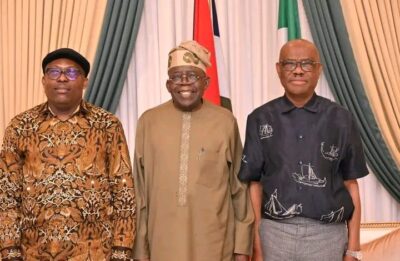
In the highly combustive arena of Nigerian politics, where loyalty is often a tradable currency and alliances shift like the sands of the Niger Delta, President Bola Ahmed Tinubu has finally dropped the gavel. In a move that has sent shockwaves through the corridors of power and the leadership of the “Rainbow Coalition”, from Abuja to Port Harcourt, the President and the national leadership of the All Progressives Congress, APC, have officially signaled that Governor Siminalayi Fubara is their man for 2027, a highly credible source has told The Neighbourhood Newspaper.
The decision is more than a mere endorsement, but is a calculated checkmate that effectively leaves the Minister of the Federal Capital Territory, Nyesom Wike, stranded on a political island of his own making.
The stability doctrine
Sources within the Presidency suggest that the “Tinubu-Fubara Pact” was born out of a cold, hard realisation that Rivers State is too volatile for a protracted proxy war. While Wike’s push and shove tactics aimed to dismantle Fubara’s burgeoning structure, the APC national leadership reached a pragmatic consensus. Replacing a sitting governor who has successfully migrated his organic support into the APC fold would not just be a political hiccup, it would be a full-scale cardiac arrest for the party’s 2027 ambitions in the South-South.
By settling for Fubara, Tinubu has chosen the path of institutional preservation over personal patronage. The President’s electoral fortunes in Rivers, a state that remains the crown jewel of the region’s voting bloc, are now tied to the stability Fubara provides.
The failed siege: Wike’s waning influence
For months, the FCT Minister maintained a relentless siege on the Rivers State Government House. From legislative stalemates to high-octane rhetoric at commissioning ceremonies, the strategy was clear: make the state ungovernable and prove that Fubara was a political lightweight, a total sophomore incapable of running the state.
However, the bold decision from Nigeria’s Presidential Villa suggests that Wike’s script has been discarded. Despite his efforts to deny Fubara the ticket and cast him as a temporary placeholder, the APC National Chairman and Secretary have instead affirmed Fubara as the undisputed leader of the party in Rivers.
”Politics is about numbers and peace,” a high-ranking APC source noted. “You cannot burn down the house just to smoke out one person when the President needs that house intact for his own re-election.”
A strategic realignment
The indictment on Wike’s strategy is subtle but stinging. While the Minister remains a vital cog in the federal cabinet, his attempts to maintain a two-state grip, ruling Abuja while dictating to Rivers, have been checked by his own principal.
Tinubu’s move highlights a shift in the “Renewed Hope” playbook:
Prioritizing incumbency: The APC is leveraging Fubara’s current momentum rather than risking a fractured primary.
Neutralising the opposition: By absorbing Fubara and his structure, the APC has effectively decapitated the PDP’s remnants in the state.
Securing the coastal road: With Fubara’s recent vocal support for Tinubu’s second term and his focus on infrastructure, the alignment is now ideological as much as it is tactical.
The road ahead
As Governor Fubara consolidates his grip, the narrative in Port Harcourt has shifted. The political hiccups Wike predicted have been replaced by a quiet, yet firm, transition of power. Fubara, once seen as a protege in the shadows, has emerged as a centrepiece of APC’s national strategy.
For Nyesom Wike, the message from the Villa is clear: Stability is the new priority. The Minister may still command the airwaves, but in the boardroom where the 2027 maps are being drawn, it is Governor Siminalayi Fubara whose name is written in ink.
Analysis: This development marks the end of the “Godfather era” in Rivers politics, as the Presidency opts for a direct relationship with the state’s chief executive, effectively bypassing the traditional middlemen of power.