
Tinubu Defends Increasing Hardship In Nigeria, Blames US-Iran-Israel War For Economic Fallout
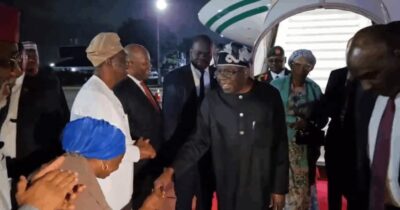
Tinubu Defends Increasing Hardship In Nigeria, Blames US-Iran-Israel War For Economic Fallout
Speaking at the 4th Elective National Convention of the All Progressives Congress (APC) held at Eagles Square in Abuja, Tinubu also dismissed sustained criticism from opposition political parties over the Electoral Act 2026, describing their attacks as a “disservice” to Nigerians.
President Bola Tinubu on Saturday mounted a robust defence of his administration’s poor economic reforms amid growing public discontent over increasing hardship, poverty, high cost of living, and insecurity in the country, insisting that current hardships faced by Nigerians are necessary “sacrifices” that will ultimately lead to national prosperity.
Speaking at the 4th Elective National Convention of the All Progressives Congress (APC) held at Eagles Square in Abuja, Tinubu also dismissed sustained criticism from opposition political parties over the Electoral Act 2026, describing their attacks as a “disservice” to Nigerians.
In a speech that combined self-congratulation, warnings against internal party divisions, and a call for unity, the President painted a picture of a country on the path to recovery despite widespread economic strain.
“The sacrifices of today are laying the foundation for Nigeria’s prosperity tomorrow,” Tinubu said, defending controversial policy decisions including subsidy removal and fiscal reforms that have triggered inflation and hardship across the country.
The President insisted that his administration has made “notable strides” since assuming office in 2023, citing infrastructure projects, tax reforms, and what he described as improving macroeconomic indicators.
According to him, “Our stock market is booming, and listed companies are recording mega profits. Our GDP is growing. We have successively recorded trade surpluses. Inflation has declined steadily for eight consecutive months to 14.45%, while food prices are easing.”
He further claimed that investor confidence had rebounded significantly, noting that Nigeria’s Eurobond issuance was oversubscribed by 400% and that the country had exited the Financial Action Task Force (FATF) grey list.
However, these claims come amid persistent complaints from Nigerians over rising living costs, food insecurity, and worsening poverty levels, raising questions about the disconnect between official economic data and lived realities.
Tinubu attributed part of Nigeria’s economic challenges to external shocks, including what he described as an “unanticipated blowout arising from the US-Israeli-Iranian War,” suggesting that global instability had compounded domestic difficulties.
Despite this, he maintained that his government has remained focused on stabilising the economy and steering the country away from what he termed “wasteful subsidies” and “dysfunctional priorities.”
“No nation rises by hiding from the truth. No economy grows by sustaining wasteful subsidies or dysfunctional priorities,” he said.
In a direct swipe at opposition parties, Tinubu rejected criticisms of the Electoral Act 2026, insisting that the law underwent due legislative process and reflects national consensus.
“The constant attacks by opposition groups on the Electoral Act 2026 are a disservice to the Nigerian people,” he stated.
He added that the Act was passed by the National Assembly in accordance with the 1999 Constitution and forms part of efforts to strengthen Nigeria’s democratic system.
At the same time, Tinubu attempted to position himself as a democrat open to dissent, saying, “We do not seek a one-party state. Democracy thrives on vibrant and healthy competition.”
In what appeared to be a strategic outreach, Tinubu addressed young Nigerians and women, promising increased inclusion in governance and party structures.
“You are not only the future of Nigeria. You are our hope for a more glorious and assured future,” he told youths, while assuring women that his administration would “open wider spaces” for their participation in leadership.
Critics, however, have often accused Nigerian political leaders of making similar promises without concrete implementation.
Tinubu highlighted what he described as unprecedented growth within the APC, celebrating the deflection of governors, lawmakers, and political actors from other parties to the APC in large numbers.
He argued that this trend reflects Nigerians’ trust in the APC, though opposition parties have alleged that such defections are often driven by political survival rather than ideological alignment.
Despite his optimistic tone, Tinubu acknowledged persistent structural challenges, particularly in the electricity sector, including debts owed to generation companies and outdated transmission infrastructure.
He revealed plans to establish a Grid Asset Management Company (GAMCO), which he said would inject about 1,600 megawatts into the national grid.