
School Certificates, Clothes, Food and Business Goods All Gone as Kogi Teacher Begs for Help After Fir£ D£stroys Home
School Certificates, Clothes, Food and Business Goods All Gone as Kogi Teacher Begs for Help After Fire Destroys Home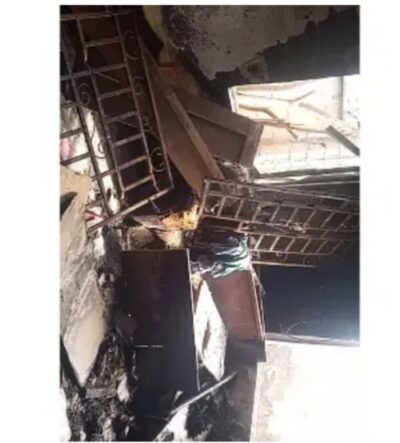
A middle-aged school teacher and single mother of seven, Hajia Aisha Kende Dailla, has been rendered homeless after a devastating fire destroyed her three-bedroom apartment in Lokoja, Kogi State. The incident occurred at about 3 p.m. on Friday, August 28, 2026, at First 200 Units, along Mallam Hassan Road, near Wada Footballers Camp, Lokoja. The fire reportedly started shortly after electricity supply was restored to the area following a three-day blackout. The apartment was completely destroyed despite efforts by residents and officials of the Federal Fire Service to put out the inferno.

Recounting her ordeal, Dailla, a teacher and indigene of Lokoja Local Government Area, said the fire started from the ceiling shortly after power was restored. She attributed the incident to what she described as a high-voltage surge. According to her, the fire destroyed virtually everything in the apartment, including vital documents, educational certificates, clothing and personal belongings of her five children and two other children under her care. “I lost everything I have worked for over the years within a few minutes. My children and I are now homeless, with no food, no clothes and no means of survival,” she said. The distraught mother added that goods she had purchased on credit for her small-scale trading business were also destroyed, worsening her financial difficulties.
Dailla said she and the children had since been struggling to secure accommodation, food and other basic necessities. She appealed to the Kogi State Government, individuals, corporate organisations and other well-meaning Nigerians to come to the family’s aid. “I am calling on the Kogi State Government under the leadership of Governor Ahmed Usman Ododo, as well as kind-hearted Nigerians, to come to my aid in this moment of despair,” she pleaded. The affected family is currently in need of shelter, food, clothing, household items and financial assistance to begin rebuilding their lives following the devastating incident.
The tragedy has once again exposed the deadly consequences of Nigeria’s unstable electricity supply, particularly the phenomenon of power surges that occur when electricity is restored after an outage. Fire outbreaks linked to electrical surges have become a recurring nightmare in Nigerian communities, with the Federal Fire Service repeatedly warning against the dangers of electrical overloading and surge-related fires. In Lagos, the State Emergency Management Agency has linked multiple fire outbreaks to electrical surges, noting that such incidents are common when electricity is suddenly restored, often causing sparks that ignite fires. Similar incidents have been reported in Kwara, Sokoto, and Anambra states, where power surges following the restoration of electricity have destroyed properties and claimed lives.
For Dailla, the disaster struck just days after she had endured a three-day blackout, a hardship that millions of Nigerians face regularly. The restoration of power, which should have brought relief, instead brought ruin. The fire consumed not only her home but also her children’s educational certificates, documents that are irreplaceable and essential for their future. It destroyed the goods she had acquired on credit for her trading business, leaving her with debts she cannot pay and no means to earn a living. It stripped her family of their clothing, their food, and their sense of security.
The response from the authorities has been muted. As of the time of this report, there has been no public statement from the Kogi State Government or the National Emergency Management Agency regarding the incident. This silence is particularly troubling given that Governor Ahmed Usman Ododo has previously pledged support for victims of fire incidents in the state. In August 2026, after a fire gutted the GSM village in Lokoja, the governor pledged support for the victims. In September 2026, the Kogi State Government handed over a renovated house to another fire victim, Mrs. Caro Ashemi Asala, whose home was destroyed by fire. Those precedents offer a glimmer of hope that Dailla and her children may receive similar assistance, but hope is not a substitute for action.
The broader issue of fire safety in Nigeria cannot be ignored. The country’s fire service infrastructure remains woefully inadequate, and building standards are often poorly enforced. Many residential buildings lack basic fire safety measures such as smoke detectors, fire extinguishers, and emergency exits. Electrical wiring in many homes is outdated and unable to handle the voltage fluctuations that are common on the national grid. When power surges occur, the result is often catastrophic. The Federal Fire Service has consistently raised the alarm, but its warnings have not translated into meaningful policy changes or enforcement.
Dailla’s story is a stark reminder of the human cost of these systemic failures. She is not a statistic. She is a mother who worked for years to build a life for her children, only to watch it burn in minutes. Her seven children, five of her own and two others under her care, are now homeless, hungry, and without the basic necessities of life. They need shelter, food, clothing, and the means to return to school. They need help.
The family’s immediate needs are urgent, but so is the need for accountability and reform. The Kogi State Government must investigate the cause of the fire and determine whether the power surge was the result of negligence on the part of the electricity distribution company. The government must also take steps to ensure that other families do not suffer the same fate, by investing in fire safety education, enforcing building codes, and holding utility companies accountable for voltage fluctuations that damage property and endanger lives.
For now, Dailla and her children are left to rely on the kindness of strangers. Their appeal is simple: they need help to survive. The Kogi State Government, NEMA, corporate organisations, and well-meaning Nigerians have a duty to respond. The question is whether they will. For a family that has already lost everything, the answer cannot come soon enough.