
Opposition Parties Reject N200million Fees For Campaign Billboard In Abia, Anambra, Others
Opposition Parties Reject N200million Fees For Campaign Billboard In Abia, Anambra, Others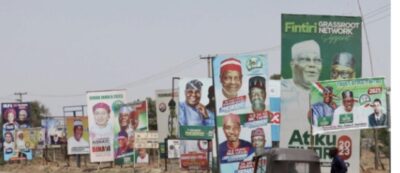
The development comes barely a week before the official commencement of election rallies, which reported that several states had introduced new campaign guidelines, permits and levies for political parties.

Opposition political parties have kicked against campaign billboard fees running into hundreds of millions of naira imposed by some state governments ahead of the 2027 general elections.
The fees, which affect candidates seeking various elective positions, have been introduced in states including Abia, Anambra, Ebonyi and Enugu, with opposition parties accusing the governments of creating financial barriers to political campaigns.
The development comes barely a week before the official commencement of election rallies, which reported that several states had introduced new campaign guidelines, permits and levies for political parties.
In Abia State, the Abia State Structure for Signage and Advertising Agency (ABSSAA) fixed the campaign advertising permit fee for presidential candidates at N200 million and N150 million for governorship candidates.
Senatorial candidates are required to pay N100 million, while House of Representatives and State House of Assembly candidates are to pay N50 million and N20 million respectively.
ABSSAA’s Head of Department, Strategy, Innovation and Design, Ndubuisi Nwaogwugwu, said the approved schedule applies to candidates of all political parties during the campaign period.
In Anambra State, the Anambra State Signage and Advertisement Agency (ANSAA) set the permit fee for presidential candidates at N50 million and N20 million for senatorial candidates.
Discover more
Nigerian news analysis
Journalism training courses
Nigerian political news
House of Representatives candidates are to pay N5 million, while State House of Assembly candidates are required to pay N1.5 million. Local government chairmanship and councillorship candidates are to pay N2.5 million and N100,000 respectively.
Candidates in the state are also required to obtain approval before erecting billboards, mounting banners or pasting posters in public spaces. The government has prohibited campaign materials on bridge pillars, government buildings, healthcare facilities and educational institutions.
Discover more
Newspaper advertising space
Breaking news alerts
Newspapers
In Enugu State, the government imposed a N150 million fee on candidates seeking to use campaign materials, billboards or branded campaign vehicles.
The policy is being implemented through the Enugu State Structure for Signage and Advertisement Agency, which the state government said was aimed at regulating outdoor advertising, protecting public infrastructure and improving environmental standards.
A team of lawyers led by Ben Okolo has approached the court seeking to stop the implementation of the fees in Enugu State. The lawyers are asking the court to declare the mandatory advertisement charges unconstitutional, arguing that they could restrict political participation.
The Peoples Democratic Party (PDP) in Abia State also condemned the fees, with its Publicity Secretary, Jude Udeachara, describing the charges as excessive and punitive.
Udeachara argued that the Abia fees raised concerns over the campaign expenditure limits contained in the Electoral Act 2026. He noted that the law places the spending limit for presidential candidates at N10 billion and N3 billion for governorship candidates.
The PDP said the N20 million charge for State House of Assembly candidates alone represents a significant portion of the N100 million expenditure limit prescribed for the position.
The African Democratic Congress (ADC) Chairman in Abia State, Kalu Kalu, said the party would comply if the fees were supported by existing state law, but argued that any charge without a legal basis should be withdrawn.
In Bauchi State, the Peoples Redemption Party (PRP) accused the state government of applying campaign restrictions selectively.
PRP State Chairman, Abdurrahman Yusuf Muazu, alleged that campaign materials linked to the ruling Allied Peoples Movement remained on public facilities despite an earlier directive ordering political parties to remove such materials.
The party called on the Independent National Electoral Commission (INEC) to intervene, citing provisions of the Electoral Act which regulate campaign activities and the use of public resources.
Other opposition figures have also criticised the restrictions.
An ADC senatorial candidate in Enugu State, Ogochukwu Onyema, accused the authorities of using the measures to frustrate opposition parties, while PDP National Vice Chairman in the zone, Ray Nnaji, alleged that some state governments were restricting opposition parties from accessing public facilities and campaign venues.
However, the state governments have maintained that the measures are intended to regulate outdoor advertising, prevent the defacement of public infrastructure and enforce existing signage regulations.
With political parties preparing for the 2027 elections, the campaign permit fees have now become another point of contention between opposition parties and state authorities.
The legal challenges and calls for INEC intervention are expected to determine whether the disputed charges will remain in force as political campaigns intensify.
