
Obasanjo turned against Tinubu for not backing daughter’s gov bid – Fayose
Obasanjo turned against Tinubu for not backing daughter’s gov bid – Fayose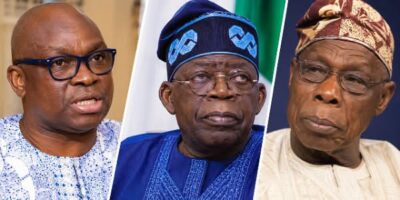
Former Ekiti State Governor, Ayodele Fayose, has alleged that former President Olusegun Obasanjo turned against President Bola Tinubu after his alleged attempt to secure the President’s support for his daughter, Iyabo Obasanjo, to become governor of Ogun State failed.

Fayose claimed that Obasanjo approached former Ogun State Governor Chief Segun Osoba to help him appeal to Tinubu over his daughter’s governorship ambition.
He alleged that Obasanjo’s request partly led to the warm reception he accorded Tinubu during the President’s visit to Ogun State and his subsequent positive remarks about the administration.
The former governor, who spoke during an interview on national television and was monitored by our reporter, claimed that the former President changed his position when his expectations were not met.
Giving details of the alleged disagreement between Obasanjo and Tinubu, Fayose said the former President had enlisted Osoba’s assistance to secure the President’s intervention in his daughter’s political ambition.
“Let me tell you something people may not want to hear. Obasanjo went to Chief Segun Osoba to help him appeal to President Tinubu for certain things, especially in making his daughter (Iyabo Obasanjo) governor in Ogun State.
“That was part of the reason he welcomed Tinubu during the President’s visit to Ogun State and spoke glowingly about him. But when things did not work out as expected, he remembered what Osoba had written about him in his memoirs years ago and decided to respond”, he said.
Fayose further added, “My point is that you cannot be seeking assistance from somebody behind the scenes and then turn around to attack the same person publicly because your expectations were not met,” he said.
The Ex-governor said that Nigerians were giving the former leader too much attention, insisting that his interventions were often driven by his desire to remain politically relevant.
“We are overrating Obasanjo. That is the truth. We are managing Obasanjo’s style. Nobody gets it done better than Obasanjo. In life, if anybody wants to talk, it is either Obasanjo or nobody,” Fayose said.
He added, “I know him. I served under him as governor, and I understand his character. Obasanjo still wants attention, and he sees no good in anybody.”
Fayose recalled that Obasanjo had criticised successive administrations after leaving office, including those of the late President Umaru Musa Yar’Adua and former President Goodluck Jonathan.
According to him, Obasanjo’s relationship with Jonathan deteriorated after the former President allegedly became uncomfortable with the latter’s decision to stop seeking his approval on government affairs.
“He criticised Yar’Adua, he criticised Jonathan and eventually made himself an enemy of Jonathan because the moment Jonathan stopped seeking his permission on everything, he became uncomfortable,” he said.
Fayose noted that he was not surprised by Obasanjo’s continued criticism of Tinubu, noting that the former President had maintained a similar attitude towards successive administrations.
“I do not expect him to stop criticising people. But there are certain things about his interventions that people should understand,” Fayose said.
On whether Obasanjo had the moral right to criticise Tinubu’s administration, Fayose acknowledged that criticism was necessary in a democracy but argued that it should be accompanied by alternative solutions.
“Criticism is good. I criticise people, but you must equally provide solutions, not just run your mouth,” he said.
He maintained that Obasanjo’s former position as President did not give him exclusive ownership of national discourse or make his views superior to those of other Nigerians.
“You cannot criticise because you have a personal need or because you are a former President. You are no longer the controller of the country.
“Everybody has a view, and your vote is one man’s vote. We should listen to people, but we should also be able to distinguish constructive criticism from personal grievances,” Fayose added.
He also dismissed suggestions that Obasanjo’s criticism could significantly determine Nigerians’ voting decisions in the 2027 presidential election.
Fayose questioned the former President’s current political followership, arguing that the influence of a politician who had left the electoral battlefield should not be equated with that of an active contestant.
“How many people does Obasanjo have physically following him? Let us be realistic. He is a former President, and I am not undermining him, but you cannot compare the followership of somebody who is actively contesting an election with that of somebody who has left the political battlefield,” Fayose said.
Reflecting on his own political experience, he said politicians enjoyed greater visibility and mobilisation when they were actively seeking electoral mandates.
“When I was contesting elections, I was everywhere because I had the people with me. The moment you leave the contest, another set of political stars emerges,” he said.
Fayose, however, acknowledged Obasanjo’s place in Nigeria’s political history, saying his contributions would be remembered regardless of his present political influence.
“People will remember you, but do not tell me that you still have the same followership as somebody who is on the ballot. That is life.
“Let people speak. They will be remembered in history for whatever contributions they have made,” he added.
