Motorists stranded as colonial-era Kwara-Oyo link bridge collapses
Motorists stranded as colonial-era Kwara-Oyo link bridge collapses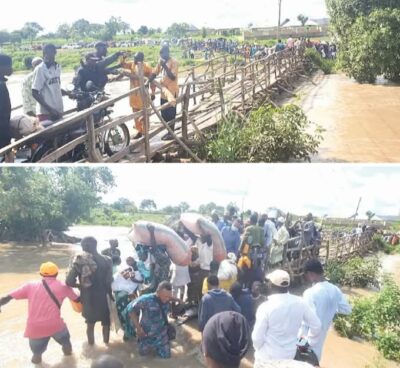
In this report, TOHEEB OMOTAYO writes about the hardship faced by commuters in Ilorin, Kwara State after the collapse of the Kwara-Oyo link bridge

At the Oko-Olowo end of the Ilorin–Igbeti Federal Highway, muddy floodwater has swallowed parts of the road, leaving stranded vehicles on one side and weary passengers picking their way across a narrow wooden bridge to reach the other.
For commercial drivers who depend on the route linking Kwara State to Oyo State for their daily income, the collapse of the Moro Bridge is no longer just an infrastructure problem. It has become a daily struggle for survival, with persistent flooding cutting off vehicular movement and leaving drivers, traders and passengers to contend with a treacherous crossing.
Where vehicles once moved freely between the two states, commuters now wade through murky water, balance bags and sacks on their heads, and squeeze across a makeshift bridge of timber poles and planks, while transport operators watch their earnings disappear.
During a visit on Friday, Saturday PUNCH found the main crossing around the collapsed bridge in a sorry state, with high, muddy floodwater spreading across the surrounding ground and swallowing parts of the access points.
With the main route cut off, residents and commuters turned to a narrow wooden footbridge made from timber poles and planks. Pedestrians, motorcyclists and travellers picked their way across the rickety structure, some clutching bags and sacks, while others struggled to balance heavier loads.
The makeshift bridge had no visible structural reinforcement, guardrails or safety barriers. Beneath it, muddy water churned through the flooded section, while travellers approaching from either side paused to search for what appeared to be safer points of passage.
In some places, there was no bridge to rely on. Travellers waded through deep, fast-moving, murky water to get to the other side, while others lifted their motorcycles and belongings above the water or helped fellow passengers across.
The difficult crossing has also opened up a small source of income for some young people in the community. Among them is a minor identified as Khalid, who helps commuters carry their belongings across the flooded section for a small fee.
“I cannot just stand by and watch people struggle with their loads. I help them carry the items across and they give me between N100 and N200,” he said.
But while the flooded crossing has created a small livelihood for some, it has wiped out the earnings of others.
For transport operators, the collapse of the bridge and the persistent flooding have turned a familiar route into an economic burden.
The Chairman of the Road Transport Employers Association of Nigeria in Oko-Olowo and the state chairman of the association’s task force, Solihu Alade, said transporters had spent heavily trying to keep the road passable, only for the latest flood to undo their efforts.
He said the situation had become particularly difficult because commercial driving was his major source of livelihood and that of many other operators who depended on the route.
“We have spent heavily over the past five days trying to make the road motorable, but the hardship has continued to worsen. The water has overflowed again and all those efforts have become fruitless,” Alade said.
He urged the state and Federal Governments to find a way of controlling the volume and direction of water flowing towards the temporary crossing, noting that simply providing an alternative passage would not solve the problem if floodwater continued to overwhelm it.
“What the government needs to do is control the water coming towards the alternative structure. There should be a proper water-control system that will allow the water to flow freely under the bridge instead of spreading across the road,” Alade said.
He said two vehicles were already stranded around the affected section, expressing concern that they could be swept away if the water level increased.
“This has happened several times. At one point, a whole vehicle carrying heavy loads was submerged by the water. Some of the vehicles that get damaged are eventually sold because the owners can no longer afford to repair them,” Alade lamented.
For Alade and other commercial drivers, the collapse has effectively cut off the source of income on which they depend.
“Driving is my main source of income. When the road is blocked like this, I cannot work. Vehicles coming from Alapa and Mandala are stranded and cannot cross to Oko-Olowo,” he said.
Alade also recalled that after the original bridge collapsed, the government provided a container structure as a temporary crossing, but said the intervention was later overwhelmed by flooding.
See more Punch stories on Google.
“When the bridge first collapsed, the government brought a container bridge as a temporary solution. Unfortunately, the flood later came and washed it away.
“We have spent over N600,000 on granite, wood and other materials just to create access. Transporters have been contributing to keep the road usable, but the situation is beyond what we can handle ourselves.
“Vehicles coming from Baruten, Kaiama, Igbeti and other areas can no longer come through normally. Many of them are now parked at the motor park, and the economic impact is becoming very serious,” he said.
At the Oko-Olowo motor park, other commercial drivers painted a similar picture of a route that has become increasingly difficult to navigate.
“There is no road at all. We cannot cross to the communities linking Kwara and Oyo. The collapse has affected our businesses badly, and we need the government to do something urgently,” one of the drivers said.
Another driver, who identified himself simply as Abdullateef, said the disruption had forced some passengers to abandon conventional transportation and attempt the crossing on foot.
“You can see people walking towards the river. If the bridge were functioning, many of these people would have entered vehicles and travelled normally. Now they have to walk to the river, cross through the makeshift bridge and then board another vehicle on the other side.
“Some people become afraid when they get there and simply turn back. They would rather abandon the journey than risk crossing through the water,” he said.
But the hardship does not end with transport operators. For residents of Alapa and surrounding communities, the damaged crossing has become an obstacle to farming, trading and other daily activities.
A resident of Alapa community, Jamiu Oluwapelumi, said the prolonged disruption had affected farmers, traders and other residents who relied on the road for their daily activities.
“The government needs to assist us because this river has already caused us so much hardship and has wasted many lives. Movement through this area is no longer peaceful,” he pleaded.
Oluwapelumi said farmers were finding it difficult to reach their farms, while traders were also struggling to move their goods.
“Our farmers cannot easily get to their farms, and traders are also affected because the movement of goods and people has become very difficult.
“After the bridge collapsed, a small alternative bridge was constructed and people were able to use it for some time. But the heavy flood eventually washed it away and it became inaccessible,” Oluwapelumi added.
He said the current wooden crossing was largely a community effort intended to provide pedestrians with some form of access.
“What we have now is another makeshift bridge built by members of the community. It is mainly being used by people on foot because it cannot provide the kind of access that vehicles need,” he added.
Another commuter, Sheu Muhammed, said residents feared that government intervention could be delayed until the rainy season was over.
Stranded motorists and pedestrians
“The government may be waiting for the rain to stop before taking further action, but our concern is that people are suffering now. We need something to be done while the problem is still affecting us,” he said.
For Damilola Kolawole, a commercial motorcyclist, the disruption has hit directly at his source of income.
“This has seriously affected my riding business because it is my only source of income. I cannot carry passengers through this route as I used to. People are no longer patronising riders on the Oko-Olowo and Mandala route. Vehicles coming from Oyo cannot enter Kwara normally, just as vehicles from Kwara cannot move into Oyo through this route again,” he said.
A bridge under pressure
This development is the most recent chapter in a long-running problem surrounding the Moro Bridge, a colonial-era Bailey bridge that has served as an important link between Kwara and Oyo states.
The bridge has undergone rehabilitation interventions over the years because of its deteriorating condition.
In September 2024, the Kwara State Government announced an immediate intervention following concerns over the condition of the structure, describing the work as a stop-gap measure pending the construction of a new concrete bridge by the Federal Government.
The situation deteriorated further on April 30, 2026, when the bridge collapsed after a heavy-duty truck reportedly passed over the ageing structure.
The incident disrupted vehicular movement and left commuters stranded along the important interstate route.
Following the collapse, the state government announced traffic diversion measures and said engineers had been mobilised to work on alternative routes.
The government also maintained that the bridge was a federal facility and that a new Moro Bridge was being constructed close to the collapsed structure.
The emergency intervention, however, soon came under pressure from the rainy season.
On May 18, heavy flooding submerged the collapsed bridge area after the Moro River overflowed its banks, trapping vehicles and leaving commuters struggling to navigate the flooded passage.
The PUNCH reported at the time that some vehicles were partially submerged, while stranded commuters sought ways to cross the affected section.
The state government also clarified in May that it had spent N27m on its most recent palliative intervention on the federal bridge, rather than the N1.2bn being circulated in some claims.
The Ministry of Works said the intervention was intended to temporarily restore the bridge to use while the Federal Government proceeded with the construction of a new one.
By June, the hardship had become severe for transport unions to publicly demand urgent action from both the federal and state government.
The Kwara chapters of the National Union of Road Transport Workers and the Road Transport Employers Association of Nigeria appealed to President Bola Tinubu and Governor AbdulRahman AbdulRazaq to expedite the reconstruction of the collapsed Moro and Ohan bridges, saying the situation was affecting transport workers, traders and other residents.
The unions said transport operators were losing income during periods of heavy rainfall because alternative routes became difficult or impossible to use, while vehicles could become trapped around flooded sections.
They also said their members had contributed money towards making portions of the affected road passable, underscoring the extent to which transport operators had become involved in maintaining access along the route.
In July, the Kwara State Government announced the completion of a bypass intended to provide temporary access around the collapsed bridge while construction of the new Moro Bridge and rehabilitation of the Ilorin–Igbeti Federal Highway continued.
During an inspection of the bypass, the Permanent Secretary of the Ministry of Works, Anthony Abu, described the route as a temporary intervention and advised articulated truck operators not to use it because it was not designed to accommodate heavy-duty vehicles.
But the latest flooding shows that the alternative route has not ended the difficulties confronting residents and transport operators.
At the affected section, commuters now face a choice between turning back, wading through floodwater or relying on the narrow wooden footbridge constructed locally.
For those carrying goods, the journey has become even more physically demanding. Passengers and traders balance sacks and luggage on their heads as they negotiate the improvised crossing, while others rely on young men such as Khalid to help carry their belongings across.
For commercial drivers, however, the central concern remains the loss of their daily income.
Alade said transport operators could no longer continue bearing the financial burden of repeatedly repairing or creating temporary access routes.
“We are transport workers, not road contractors. We have done everything within our capacity to keep the road open, but the government needs to provide a lasting solution.
“What we need now is an intervention that will address both the road and the water. If the water continues to flow across the access route, whatever temporary structure is provided will continue to face the same problem,” Alade said.
As the rains continue, residents and transport operators remain concerned that each fresh downpour could further worsen the already difficult crossing.