
MATTERS ARISING: How Wike’s rainbow coalition may upend APC governors’ succession plans
MATTERS ARISING: How Wike’s rainbow coalition may upend APC governors’ succession plans
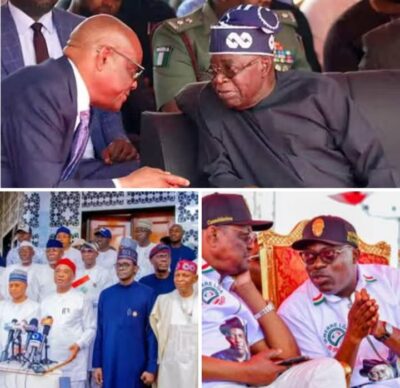
On May 29, 2023, when Nyesom Wike, former governor of Rivers, handed over power to Siminalayi Fubara, his successor, he left the government house but retained significant influence over the state’s political structure.
His allies dominated the state house of assembly, providing him with a formidable instrument of influence, enough to control the state machinery.
The pillars he erected would prove consequential when his relationship with Fubara deteriorated.
The ensuing confrontation between Wike and Fubara, followed by repeated impeachment attempts by the state legislature against the Rivers governor, demonstrated Fubara’s vulnerability.
As the 2027 elections gain steam, Wike, the minister of the Federal Capital Territory (FCT), appears to be pursuing a broader political strategy through the controversial “rainbow coalition”.
Although he has consistently presented the alliance as a vehicle for mobilising support for Tinubu’s re-election, TheCable understands that its potential implication for Rivers politics is the preservation of his influence over the state.
Sources told TheCable that Wike is not merely positioning himself to help determine who occupies the presidency; he is also seeking to remain a decisive force in determining who governs Rivers and who represents the state in the parliament.
It is an alliance through which Wike seeks to consolidate his political influence beyond 2027.
In January 2026, when he formally announced the idea of the rainbow coalition at a stakeholders’ event in Asari-Toru LGA of Rivers state, Wike said all the political parties in the state were now part of the coalition, an initiative he said is under the “renewed hope family” to support Tinubu.
“In Rivers, we don’t have any party now. What we have is the renewed hope family. It’s a rainbow coalition. If you don’t belong to this family, then forget it. After delivering President Tinubu, this family will produce everything as far as the state is concerned — governorship and assembly seats,” Wike said.
In September, he said the alliance had no specific affiliation with the All Progressives Congress (APC) and rejected the suggestion that his support for Tinubu meant the Peoples Democratic Party (PDP) would abandon its candidates in governorship and legislative elections.
Wike cited the 2023 elections to argue that Nigerian voters can choose candidates from different parties for different offices on the same election day, adding that supporting Tinubu does not oblige him or his political allies to back other APC candidates.
His allies are positioned across the APC and PDP, while his political network extends into the governorship, state assembly and national assembly contests.
THE LESSON FROM THE RIVERS POLITICAL CRISIS
The feud between Wike and Fubara is a starting point for understanding the calculations behind the rainbow coalition.
Wike was instrumental in Fubara’s emergence as governor in 2023. Yet the transfer of executive power did not amount to a corresponding transfer of political control.
The former governor retained influence over a significant number of lawmakers, commissioners, and other appointees in Fubara’s cabinet. The state’s legislature became a theatre in the struggle.
Lawmakers aligned with Wike repeatedly confronted Fubara’s administration, with impeachment proceedings initiated against the governor on multiple occasions.
The crisis eventually escalated into a state of emergency, which Tinubu declared in March 2025, during which the governor and other elected officials were suspended for six months.
The emergency rule ended in September 2025, with Fubara returning to office. But the underlying struggle over political influence persisted. In January 2026, the assembly again initiated impeachment proceedings against Fubara before suspending them following further reconciliation efforts.
The political conflict culminated in Fubara subsequently dropping his re-election bid and withdrawing from the APC governorship primary, a decision he publicly attributed to the need for peace and stability.
For Wike, the episode reinforced the importance of building a political arrangement anchored in loyalty. He seemingly won the fight against Fubara because his supporters dominated the state assembly.
WIKE’S STRATEGY FOR CONTROL OF RIVERS POLITICAL STRUCTURE
Nyesom Wike
Wike has been on a collision course with some APC governors over his rainbow coalition
Rivers has 32 state assembly seats, 13 house of representatives seats and three senate seats. Together, these constitute 48 legislative positions across the state and federal levels.
Wike’s political calculations appear to extend across this entire landscape.
His network includes APC-aligned politicians contesting the house of representatives seats across Rivers’ federal constituencies, alongside PDP-aligned allies seeking representation in some of the same constituencies. The senate contests also feature politicians from both parties identified with his camp.
At the state level, the assembly remains important because of the lessons from the confrontation with Fubara.
The strategy of this arrangement lies in the leverage they could provide for Wike if they win their elections and remain politically aligned with him.
A governor needs the assembly to pass budgets, approve legislation and perform other constitutional functions. A governor facing a hostile legislature can encounter serious obstacles to governing.
The Wike-Fubara crisis shows how such a confrontation can become a prolonged struggle over the exercise of executive authority.
If Wike can maintain substantial influence over the next assembly, he could preserve an important source of political leverage regardless of who occupies government house.
The same strategy applies to the national assembly. Senators and members of the house of representatives provide access to federal legislative politics, national party negotiations and networks.
Under Wike’s plan for senate, the APC would take Rivers east and Rivers west, while the PDP would have Rivers south east. For the house of representatives, his allies have picked tickets for both the APC and the PDP.
The same consideration applies to the governorship contest. Kingsley Chinda, identified with the APC, is among the politicians associated with Wike’s political calculations, alongside Sam Ejekwu of the PDP and Chima Boms of the Labour Party.
WHY APC GOVERNORS ARE AGAINST WIKE’S RAINBOW COALITION
APC governors
In September, the Progressive Governors Forum (PGF) said it won’t endorse any “alliance or political arrangements that could undermine” Tinubu’s re-election bid or the party’s candidates in the 2027 elections.
Across the country, the former Rivers governor is using the rainbow coalition strategy to team up with aggrieved APC members and opposition to challenge the political calculations of sitting APC governors.
In Kwara, for instance, Wike has aligned with Busola Saraki, former senate president, in backing Kale Kawu as the PDP’s governorship candidate. Kawu’s emergence and growing political profile could complicate the calculations of AbdulRahman AbdulRazaq, the state governor, whose preferred successor is Yakubu Salihu-Danladi.
A similar dynamic is emerging in Ogun.
The PDP faction associated with Wike, which is recognised by the Independent National Electoral Commission, produced Ladi Adebutu as its governorship candidate.
Adebutu is a formidable political figure in the state, and his candidacy could complicate Dapo Abiodun’s preferred succession plan, Solomon Olamilekan Adeola.
In Imo, Wike has reportedly thrown his weight behind Samuel Anyanwu, national secretary of the PDP, ahead of the November 2027 governorship election, putting him on a collision course with Hope Uzodimma, governor of Imo.
Political pundits say the rainbow coalition is more than an alliance for mobilising support for Tinubu; it is providing Wike with a network through which he can maintain relationships with politicians across party lines and intervene in political contests in different states.
‘RAINBOW COALITION COULD TRIGGER POLITICAL CRISIS’
The implications of Wike’s political strategy, however, extend beyond the contests for elective positions.
Franklyn Isong, director of the Centre for Human Rights and Accountability Network, said the rainbow coalition could reproduce the kind of political crisis that engulfed Rivers, where Wike’s influence over the state assembly became a major factor in his protracted conflict with Fubara.
Isong also said the arrangement could confuse voters at the elections, who would be asked to support Tinubu under the APC while backing candidates from other parties in governorship and legislative elections.