

LEGACY IS NOT OWNERSHIP: A RESPONSE TO FORMER GOVERNOR AYODELE FAYOSE’S REMARK ON PROF. KOLAPO OLUSOLA-ELEKA
 LEGACY IS NOT OWNERSHIP: A RESPONSE TO FORMER GOVERNOR AYODELE FAYOSE’S REMARK ON PROF. KOLAPO OLUSOLA-ELEKA
We have taken note of the statement made by former Governor of Ekiti State, Mr. Ayodele Fayose, during the commissioning of projects named in his honour by the administration of Governor Biodun Abayomi Oyebanji, wherein he stated that “If Eleka that I sponsored in 2018 had won, he would have repaid me with evil.” As a former Governor whose contributions to the democratic development of Ekiti State remain part of our political history, Mr. Fayose is unquestionably entitled to his views. However, when such views touch on the character and integrity of another public servant, they deserve to be examined through the enduring standards of fairness, evidence, and democratic principle.
The issue before the people of Ekiti is not whether Mr. Fayose supported Prof. Kolapo Olusola-Eleka. History clearly records that he did. The real issue is whether political sponsorship should be interpreted as permanent ownership of another leader’s conscience, judgment, or constitutional responsibility. In every constitutional democracy, the answer must be an unequivocal no. That principle lies at the heart of this response.
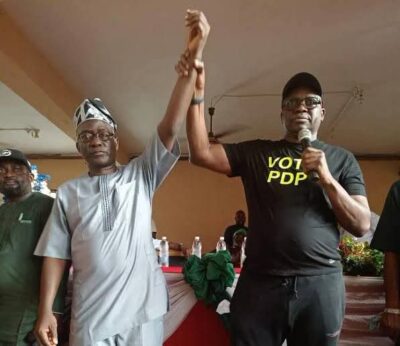
Former Governor Ayodele Fayose occupies a significant place in the political evolution of Ekiti State. His administration marked an important chapter in the state’s democratic journey, and his decision to appoint Prof. Kolapo Olusola-Eleka as Deputy Governor before presenting him as his preferred successor in the 2018 governorship election remains one of the defining political decisions of that era. That history deserves recognition because it reflected Mr. Fayose’s own public confidence in Prof. Eleka’s competence, intellect, loyalty, integrity, and capacity to lead.
It is precisely because of that history that the recent remark invites thoughtful reflection. If Prof. Kolapo Olusola-Eleka was considered worthy of serving as Deputy Governor, worthy of carrying the banner of continuity in 2018, and worthy of being presented to the people of Ekiti State as the preferred candidate to consolidate the achievements of that administration, then it is only reasonable to ask what objective facts now support the conclusion that he would have repaid such confidence with “evil.” The historical facts surrounding 2018 remain unchanged. What has changed is the opinion now expressed years after those events.
It is neither unusual nor unhealthy for political relationships to evolve over time. Democracies are strengthened when leaders are free to agree on some issues and disagree on others. Differences in political judgment, governance philosophy, or personal perspective are natural features of democratic life. However, where such differences arise, they should be evaluated on the basis of demonstrable conduct and verifiable facts, not on predictions about events that never occurred. Democratic maturity demands that we distinguish between what history records and what imagination supposes.
Prof. Kolapo Olusola-Eleka never occupied the office of Governor of Ekiti State. Consequently, no one can honestly state, as a matter of fact, how he would have governed or managed political relationships in that office. To pronounce judgment on actions that never occurred is to replace evidence with speculation and history with hypothesis. Such conclusions may generate political debate, but they cannot be presented as established truth.
There can be no dispute that political mentorship is one of the enduring pillars of representative democracy. Every experienced leader who identifies, encourages, and supports another individual for higher responsibility contributes to the strengthening of democratic leadership. Mr. Fayose’s role in Prof. Eleka’s political journey deserves acknowledgement and appreciation. History should always recognise those who create opportunities for others to serve.
Yet, gratitude must never be confused with ownership. Political sponsorship is an opportunity for service, not a perpetual claim over another person’s conscience or constitutional responsibility. Once the people freely confer a democratic mandate, public office belongs to the citizens alone. No governor is elected to protect the expectations of a political benefactor ahead of the interests of the people. Every elected leader is duty-bound to uphold the Constitution, protect the public interest, and govern with fairness, courage, and integrity.
This is the very essence of constitutional democracy. Every governor swears allegiance to the Constitution of the Federal Republic of Nigeria, not to an individual. Where personal expectations and constitutional obligations appear to conflict, the Constitution must always prevail. That is not an act of disloyalty; it is the highest expression of democratic fidelity.
To govern independently is not to govern ungratefully. Independence is not rebellion. It is not hostility. It is not betrayal. Rather, it is the inevitable responsibility that accompanies every constitutional office. A leader can remain grateful to those who supported his emergence while exercising independent judgment in the discharge of public responsibilities. Gratitude and constitutional responsibility are not opposing virtues; together, they define responsible leadership.
Prof. Kolapo Olusola-Eleka’s public record offers no factual basis for the allegation now advanced against him. Throughout his tenure as Deputy Governor, he was widely regarded as a disciplined scholar, a refined administrator, and a public servant whose conduct reflected humility, civility, moderation, and intellectual excellence. Following the 2018 governorship election, he continued to participate peacefully in the democratic process with dignity and restraint. Those observable facts deserve greater weight than hypothetical predictions.
The occasion on which the statement was made equally calls for reflection. A ceremony convened to commission public projects and celebrate the contributions of a former Governor should inspire conversations about service, continuity, institutional development, and the future of Ekiti State. Such occasions achieve their highest purpose when they unite rather than divide, and when they elevate democratic discourse above unresolved political grievances.
Ekiti State proudly bears the title of the Fountain of Knowledge. That distinction imposes a collective responsibility upon all who have had the privilege of leading the state to promote reason over resentment, evidence over conjecture, and enlightened debate over speculative accusations. Our democracy grows stronger when political disagreements remain anchored in facts and mutual respect.
History consistently teaches that the greatest mentors are remembered not because those they nurtured remained permanently under their influence, but because they produced leaders capable of exercising wisdom, moral courage, and independent judgment. Leadership that seeks perpetual control over successors diminishes its own legacy, while leadership that encourages principled independence secures an enduring place in history.
This moment should therefore serve not as an opportunity to reopen old political divisions, but as an invitation to reaffirm the democratic values that unite the people of Ekiti State. Political relationships may evolve, opinions may differ, and perspectives may change. Yet our commitment to truth, fairness, constitutional governance, and respect for one another must remain constant.
In the final analysis, former Governor Mr. Ayodele Fayose’s place in the political history of Ekiti State is secure, just as Prof. Kolapo Olusola-Eleka’s reputation should continue to be assessed on the basis of his demonstrated character, public service, and commitment to democratic ideals. These truths are not mutually exclusive. A mature democracy is strengthened when it honours the contributions of former leaders while ensuring that fairness and objectivity remain the standard by which every public servant is judged.
The enduring lesson for every democracy is simple. Mentors deserve gratitude. Institutions deserve loyalty. The Constitution deserves obedience. Above all, the people deserve leaders whose highest allegiance is to the public good. That is the standard by which history ultimately judges both mentors and protégés alike. Legacy is not ownership. Legacy is the enduring influence of character, vision, integrity, and principle, an influence that empowers others to serve freely, faithfully, and honourably.
~Prof. Olusola Eleka media group