
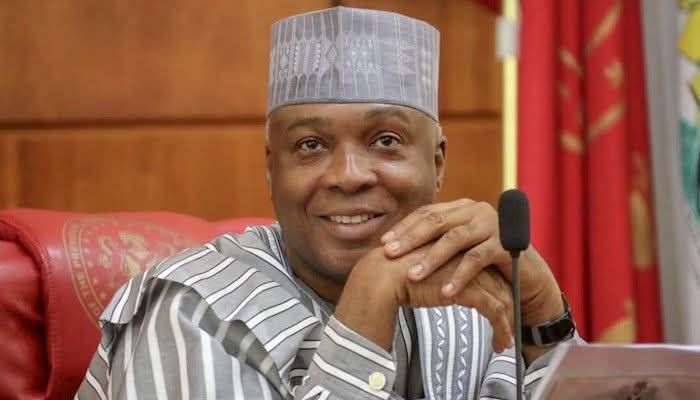
Kwara 2027: APC rift opens fresh political space for Saraki, PDP
Kwara 2027: APC rift opens fresh political space for Saraki, PDP
The Kwara State All Progressives Congress’s internal revolt has opened a political window for the Peoples Democratic Party to plot a return to power after seven years in opposition. DARE AKOGUN examines the possibility of the elite realignment translating into votes to overturn the political order created by the 2019 ‘O to ge’ movement
In Kwara politics, a few political slogans have carried the emotional and political weight of O to ge (enough is enough). The movement was more than an electoral slogan. It was a political coalition of groups and individuals united by a common objective: ending what they described as the prolonged political dominance of the former senate president, Bukola Saraki. It ushered in the reign of the All Progressives Congress in 2019.
However, seven years after that political earthquake, a warning of outrage against the APC is becoming difficult to ignore. Some of the forces that helped build the coalition that defeated the PDP political establishment are now quarrelling with the political structure that emerged from the revolution.
Watching closely from the opposition is the man whose political structure was the principal target of that O To Ge movement, Saraki. The PDP is rebuilding its structure around the former Kwara State governor and has authorised him to engage aggrieved members of the APC and other political stakeholders ahead of the 2027 governorship election.
The development has acquired greater significance against the backdrop of the disagreement between the APC leadership and a group of politicians initially known as the G15, which has now rebranded as The Otoge Progressives.
The first concrete test of that rebellion came on August 20, when the Senator representing Kwara Central at the National Assembly and a leading voice in the G15/TOP Saliu Mustapha, formally resigned from the APC and picked up the PDP senatorial ticket for Kwara Central.
Mustapha said the decision followed weeks of consultations with stakeholders, supporters and constituents across Kwara Central, and was necessitated by “recent developments within the party in the state.”
With Mustapha now carrying the PDP ticket in the district, the opposition has a candidate with name recognition and an existing political structure to test whether elite defections can indeed move votes at the grassroots.
In Kwara South, Hon. Saheed Popoola a former ally of Governor Abdulrahman Abdulrazaq and ex-member of the Kwara State House of Assembly will contest on the PDP platform.
Also in Kwara North, the party has picked Kolo Jiya, who flew the NNPP senatorial flag in 2023 and only recently defected from the APC. The nominations reflect the PDP’s strategy of leveraging recent APC defectors to challenge the ruling party’s dominance across the state
From G15 to TOP
The current disagreement within the APC did not emerge overnight. In June 2026, a group of APC governorship aspirants and prominent party figures publicly raised concerns about the direction and management of the party’s internal affairs.
The group eventually became known as G-10, then G-15. Its prominent members include senators Saliu Mustapha and Yahaya Oloriegbe, Yahaya Seriki-Gambari, Bashir Bolarinwa and Dele Belgore, among others.
At a stakeholders’ town hall meeting in Ilorin, the group’s convener, Ibrahim Oloriegbe, said, “This change reflects the remarkable growth of our movement and our unwavering commitment to preserving the ideals that inspired the historic Ótógémovement of 2019: internal democracy, inclusiveness, fairness, accountability and people-centred leadership.”
The PDP’s opportunity and its caution
The PDP is clearly interested in the opening, but the opposition party also understands that relying solely on APC disunity could be dangerous. PDP, according to its publicity secretary in the state, Olusegun Adewara, is expecting the APC’s internal disagreement to deliver Government House to it. The PDP’s task is to present itself as a credible alternative rather than merely exploit the ruling party’s difficulties.
“Elections are not won by the weakness of your opponent alone; they are won by the strength of your own organisation, your message, your candidates’ connection with the people and, most importantly, the all-round leadership failure of the current administration,” Adewara said.
While describing Saraki as an important pillar of the Kwara PDP, Adewara stressed that the 2027 election should not be reduced to the former senate president’s political return.
“2027 is about the future of Kwara; how to secure the state from the grips of bandits and kidnappers, not merely the return of an individual or political structure,” he said.
A former Kwara APC Publicity Secretary, Tajudeen Aro, also told Sunday PUNCH that the divisions could provide the opposition with a pathway back to Government House if a significant number of the aggrieved politicians eventually align with the PDP.
“It may not be possible to move with the whole lot of G15, but the majority of all of them will share the same vision. That vision is the removal of AbdulRazaq from Government House,” he said.
He also believes Saraki remains a central figure in the emerging opposition calculation.
“Saraki has been steadfast with PDP and very calculative. He knew the importance of home-based politics, and he is playing along,” Aro said.
APC dismisses threat
However, the ruling party is reluctant to accept the interpretation that the G15 or TOP could pose an electoral threat to it.
The Senior Special Assistant to the Kwara State Governor on Party Affairs, Mashood Alaka, told Sunday PUNCH that the disagreement remained an internal matter that could be resolved.
“I would not describe the G15 as a crisis or a threat to the Kwara APC. I believe the situation is an internal political disagreement that can be managed within the family of the party,” he said.
To him, APC has strong grassroots structures across the state and would approach the 2027 election from a position of strength. He referenced political leaders, ward structures, supporters and a large number of people who he said were satisfied with the direction of the government.
But he acknowledged the need to engage the aggrieved party members because he believes dialogue is always welcome in politics and the APC is a family. “When there are disagreements among members, the appropriate response is to sit down, talk and find common ground,” he said.
While Alaka recommends reconciliation, he warned that such a move should not be interpreted as evidence of weakness.
Another APC chieftain, Sodiq Adio, while speaking to Sunday PUNCH, was even more dismissive as he described the controversy surrounding the G-15 as “mere white noise.”
He questioned the electoral value of the G-15 members, saying, “If you examine their political weight individually, only a handful can lay claim to any verifiable record of a strong grassroots base.”
Numbers beneath the politics
The electoral figures provide perhaps the clearest warning against simplistic conclusions. The APC’s 2019 margin was 216,792 votes. By 2023, it had fallen to 117,934. That is a contraction of 98,858 votes, though the party still won all 16 LGAs.
But several individual margins also narrowed. In Ilorin West, the APC’s advantage fell from 29,704 votes in 2019 to 14,096 in 2023. In Edu, it dropped from 20,631 to 5,080. In Ilorin East, the margin declined from 20,633 to 9,425. In Offa, it fell from 17,702 to 7,991.
None of these figures represents a PDP victory, but collectively, they show that the political wall built in 2019 was not impenetrable four years later. That is the statistical bridge between the “O To Ge” earthquake and the 2027 question. The APC cannot simply assume that its 2019 margin remains intact.
At the same time, the PDP cannot conclude that a shrinking APC margin means that victory is already within reach.
Saraki’s dilemma
Sunday PUNCH notes that Saraki has something few opposition politicians possess – extensive knowledge of Kwara’s political geography and a political network built over decades. He also understands the importance of elite alliances, but his greatest asset can simultaneously be his greatest liability.
There is little doubt that the G15/TOP crisis has created a political opening for Saraki. It gives the PDP access to politicians who once stood on the opposite side of the political divide. It also allows the opposition to challenge the narrative that the “O To Ge” coalition remains intact.
But Saraki and the PDP can harvest politicians without necessarily harvesting their votes. The party can harvest political structures without automatically inheriting the voters attached to them and exploit the APC’s shrinking electoral margin without assuming that the margin will disappear in 2027.
A PDP House of Representatives aspirant, Titilope Joseph, believes the party must develop a new political proposition, though Saraki is “a rallying political figure in Kwara.”
In his view, the political realities of 2027 will not be the same as those of 2019. The party cannot simply ask voters who participated in O To Ge to return because the APC has disappointed them. PDP must also explain why returning to the party will not amount to returning to the political past.
However, a political analyst, Adebayo Abubakar, cautioned against assuming that the movement of political elites automatically produces a corresponding movement of voters. He believes Kwara’s political history provides enough evidence to make that caution relevant. Politicians have repeatedly changed alliances, platforms and political relationships.
He also questioned the depth of the grassroots influence claimed by some G15 members, arguing that the political weight of members of the group was uneven and that their structures should not be treated as a single electoral bloc.
“The majority of them call themselves grassroots mobilisers, whereas the majority of them have grass without roots, while those who have roots do not have grass.
“The number of those aspirants remains unknown. So, counting them now in the way you count the likes of Saliu Mustapha, BOB, or some others who have been around for quite some time, it will be statistically lopsided. They don’t carry equal degree of popularity among the voters,” he said.
However, Sunday PUNCH notes that the ruling party is weaker electorally than it was in 2019, but it remains the dominant political structure. The G15/TOP has created political noise and potentially a serious coalition opportunity, but its capacity to transfer votes remains untested.
The ultimate question is therefore not whether “O To Ge” can be reversed. It is whether the political coalition that produced it has fulfilled the expectations that gave birth to it and whether voters, seven years later, believe the alternative on offer represents a genuine new beginning or merely another rotation of the state’s political elite.