
First black woman emerges governor in United States
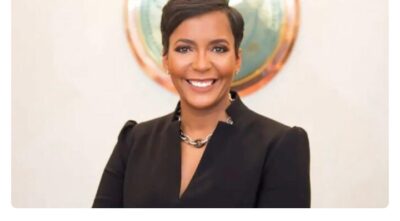
First black woman emerges governor in United States
Democrat Keisha Lance Bottoms has made history in the United States after winning Georgia’s gubernatorial election, becoming the first Black woman elected governor of a US state.

Bottoms defeated Republican businessman Rick Jackson in the November 3 election, according to media projections, ending more than two decades of Republican control of the governor’s office in Georgia, our heritage Reporter online reports.
Her victory also makes her the first woman and first Black person to govern the southern state, marking a significant milestone in the representation of women and Black Americans in the country’s political leadership.
The 56-year-old former mayor of Atlanta will succeed Republican Governor Brian Kemp, who is leaving office after completing two consecutive terms and is constitutionally barred from seeking another consecutive term.
The victory is also a major development in Georgia politics, where Republicans have controlled the governorship since 2003, when Sonny Perdue became the first Republican elected to the office since Reconstruction.
From Atlanta mayor to Georgia governor
Bottoms served as mayor of Atlanta from 2018 to 2022, having previously been a member of the Atlanta City Council.
Her tenure as mayor coincided with some of the most challenging periods in recent American history, including the COVID-19 pandemic, protests over police brutality and debates about public safety and crime.
She later joined the administration of former President Joe Biden, serving as director of the White House Office of Public Engagement and as a senior adviser.
Her political experience and national profile helped position her for the Georgia gubernatorial contest, although her record as Atlanta mayor became a major issue during the campaign.
Republican supporters questioned her handling of crime and public safety during her time in office, while Bottoms defended her administration’s record and highlighted efforts to support residents and businesses.
Her victory came after she secured the Democratic nomination in May, defeating other contenders without requiring a runoff.
Campaign focused on cost of living, healthcare
During the campaign, Bottoms placed considerable emphasis on economic concerns affecting Georgia residents, including the rising cost of living, access to healthcare, affordable housing and voting rights.
She promised to pursue policies aimed at reducing financial pressure on families and expanding access to healthcare, including Medicaid expansion under the Affordable Care Act.
Her campaign also addressed economic opportunities and the need to protect voting rights, issues that featured prominently in the wider political debate ahead of the midterm elections.
Her Republican opponent, Rick Jackson, a billionaire healthcare executive and founder of Jackson Healthcare, presented himself as a political outsider.
Jackson campaigned on economic development, tax cuts, public safety and reducing government regulation. He also received the endorsement of President Donald Trump, who campaigned alongside him in Georgia during the closing stages of the election.
However, the Republican candidate was unable to secure the governorship, despite his substantial financial resources and the support of the outgoing administration’s political allies.
Bottoms also received support from prominent Democratic figures, including former President Barack Obama and Democratic Senator Jon Ossoff.
Obama campaigned for her in Georgia shortly before Election Day, while Ossoff appeared alongside her during the campaign as Democrats sought to consolidate support across the state.
The result further reinforces Georgia’s importance as a battleground in American politics. Although Donald Trump carried the state in the 2024 presidential election, Democrats have maintained a competitive presence through their statewide and federal election victories in recent years.
Bottoms’ victory also follows the unsuccessful gubernatorial campaigns of fellow Democrat Stacey Abrams, who lost to Kemp in 2018 and 2022.
Abrams’ campaigns helped expand Democratic mobilisation and build a coalition of voters that has remained influential in Georgia’s political landscape.
Historic breakthrough for Black women
Bottoms’ election represents a breakthrough for Black women in American politics, who have historically been underrepresented in the country’s highest elected executive offices.
Although Black women have served in Congress, state legislatures, local government and other influential public positions, none had previously been elected governor of a US state.
Her victory therefore breaks a longstanding barrier in American political representation and gives her a place in the country’s political history.
She will, however, take office in a politically challenging environment. While she has won the governorship, Republicans are expected to retain control of Georgia’s state legislature, meaning her administration may have to negotiate with lawmakers from the opposing party to advance parts of her agenda.
The outcome also carries national political implications for Trump and the Republican Party, particularly because Jackson had the president’s endorsement.
Bottoms’ victory, alongside other Democratic gains in the November 3 midterm elections, adds to the changing political landscape ahead of the 2028 presidential contest.
She is expected to assume office in January 2027, becoming Georgia’s 84th governor and the first Black woman elected to lead a US state.
