
ATIKU’S DEMAGOGUERY IN THE FACE OF TINUBU’S LOGICAL POLICIES
 STATEHOUSE PRESS RELEASE
ATIKU’S DEMAGOGUERY IN THE FACE OF TINUBU’S LOGICAL POLICIES
By Sunday Dare
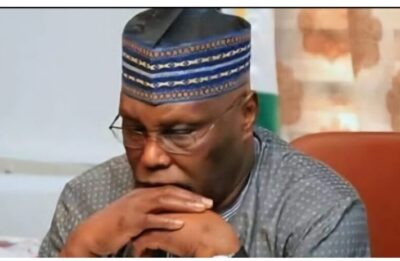
Former Vice President Atiku Abubakar’s recent press conference in Abuja—where he attacked NNPC Retail’s 30-day discount on petrol price and a modulation framework—is a seminal example of shallow, election-laced demagoguery.
Atiku “Kachalla”, totally unplugged from global realities and consumed by an unbridled lust for power, is a Lone Ranger.
In the United Kingdom, because the international oil market affects local pump prices, Prime Minister Andy Burnham offered Britons a Google Maps link to find the best gas prices. Google Maps’ Fuel Prices feature helps drivers compare near-real-time petrol and diesel prices at local forecourts.
In America, President Trump signed an executive order titled “Emergency Tax Relief on Diesel Fuel” on October 5, 2026 and announced a diesel supply deal with Russia, not minding if it derails his avowed commitment to end the Russia-Ukraine war.
In close to 10 other countries, leaders are employing various means to provide relief for citizens. But in Nigeria, a President offers the same, and a misguided presidential candidate chooses to dance on the sufferings of Nigerians and exploit it for political gains.
For decades, political opportunism in Nigeria has relied on a single, toxic formula: exploit temporary transitional discomfort, appeal to emotional cynicism, and promise mathematically impossible quick fixes to a sophisticated electorate.
Calling a calibrated, multi-layered economic stabilisation strategy a “panic-driven gimmick” reveals more than partisan bitterness; it exposes a profound, structural ignorance of global energy dynamics, fiscal mechanics, and the plain arithmetic of modern Nigeria.
Atiku’s soundbite-driven critique relies on emotional bait, trying to buy future votes with cheap sentimental appeals while ignoring the structural rot that President Tinubu’s administration has systematically dismantled over the last three years.
Atiku’s attempt to position himself as the “smart student” teaching economic policy falls apart under even light scrutiny.
First, it is sheer absurdity that a man who graduated from a school of hygiene dares to call a first-class accounting graduate a dull student.
Second, Atiku’s proposal for a blanket “production subsidy” is not an alternative economic model—it is a dangerous mathematical fantasy wrapped in political deceit.
Unhinged, Atiku Abubakar arrogantly claims that President Tinubu copied his economic homework while stripping away the core element that makes it work: the “production subsidy.”
But let us examine the actual numbers that Atiku deliberately conceals from the Nigerian public.
As Coordinating Minister of the Economy and Minister of Finance Taiwo Oyedele clearly articulated on Channels TV, Nigeria currently produces about 1.8 million barrels of crude oil per day (bpd) for a population of over 200 million people. Simplistic populists like Atiku deliberately deceive citizens by pretending that the Federal Government directly owns all 1.8 million barrels and can distribute or discount them at will.
Under complex Joint Ventures (JVs) and Production Sharing Contracts (PSCs) signed over decades, production costs, royalties, and profit-oil sharing ratios severely reduce the equity crude available to the state. After accounting for these statutory and contractual obligations, Nigeria has fewer than 700,000 barrels per day of unencumbered “free crude” to give away.
Mega-refineries like the Dangote Petroleum Refinery require immense daily feedstock that far exceeds what the state can freely provide without breaching existing international supply contracts or bankrupting national revenues.
Consequently, Dangote and other domestic refiners must supplement local supplies by importing crude from international markets.
To propose a blanket “targeted production subsidy” on crude without the physical, unencumbered volume to back it up is pure economic illiteracy. It invites the very opacity, fraudulent round-tripping, and fiscal haemorrhage that crippled Nigeria for decades under the old subsidy regime.
Compare Nigeria’s numbers with those of other global oil producers. The United States produces over 10 million barrels per day for 330 million people, yet sells petroleum strictly at market-determined prices. Qatar holds some of the world’s largest gas reserves for under 500,000 citizens, yet had to cut energy subsidies significantly to maintain long-term fiscal health.
As Minister Oyedele noted, comparing local crude allocation to local agricultural produce like garri or cassava—a misleading analogy popularised by media commentary—is a fundamental misrepresentation of global commodity markets and contractual energy economics. For Atiku to suggest that Nigeria can fund unlimited production subsidies without bankrupting the state is either financially reckless or fundamentally dishonest.
*Price Modulation vs Subsidy Restoration: Unpacking the 30-Day Strategy*
Atiku’s attempt to frame NNPC Retail’s decision to forgo its profit margin as a “return to the fuel subsidy” is a deliberate mischaracterisation designed to mislead the public and incite public dissatisfaction. First, NNPC had offered the discount to celebrate the 66th Independence anniversary. It merely offered to extend the discount by another 30 days.
The administration’s intervention is a market-smoothing price modulation framework, not a return to unbudgeted federal spending. When NNPC Retail agrees to sell fuel at landing cost for 30 days during an unprecedented global crude price spike, it is not writing checks to opaque import cartels. It is leveraging its corporate balance sheet to absorb short-term global volatility, backed directly by President Bola Ahmed Tinubu.
Furthermore, the Federal Government’s negotiation of an interim N1,350 per litre ceiling on ex-gantry costs is a structural shock absorber, not price control. Under this framework, refiners and importers absorb short-term cost spikes above the ceiling and recover those costs later when global crude prices cool or local exchange rates adjust. N1,400 today and N1,400 tomorrow provides far greater economic stability than N1,500 today and N1,300 tomorrow.
Rapid, erratic price swings trigger immediate, panic-driven hikes in commercial transport fares that rarely decrease even when fuel prices drop. The ceiling protects commuters from permanent hikes in transport prices. The ceiling is reviewed transparently every month based on published cost audits, preventing the hidden accumulation of opaque state liabilities.
*Structural Solutions: The Administration’s Multi-Pronged Economic Approach*
While critics offer cheap soundbites, the Tinubu administration has deployed concrete, structural policies across the entire energy and economic value chain by establishing a state-backed strategic energy reserve to release refined products whenever global supply disruptions or private hoarding threaten price stability—securing long-term supply without fixing market prices.
President Tinubu’s administration is rapidly expanding Compressed Natural Gas (CNG) infrastructure in partnership with state governments. At 60-70% cheaper than premium motor spirit (PMS), CNG offers a permanent structural alternative for commercial transporters.
The government has secured domestic refining operations through naira-for-crude arrangements to insulate pump prices from foreign exchange volatility. It has introduced windfall taxes on energy operators that attempt to gouge consumers during crises, explicitly earmarking the revenue for transport vouchers and minimum-wage support.
President Tinubu’s government is already enforcing the 2025 tax reform laws to dismantle illegal road levies and using NIPOST digital address codes to reduce freight and food distribution costs drastically.
*The Record Speaks: Concrete Dividends of the Tinubu Reforms Since 2023*
Atiku’s narrative asks Nigerians to forget the unsustainable fiscal precipice the nation faced before May 2023. The courageous removal of the toxic fuel subsidy and the unification of the distorted foreign exchange market were not choices of convenience; they were surgical interventions required to save the Nigerian economy from total collapse.
Despite global headwinds, these foundational reforms have delivered dividends across multiple sectors. The multi-trillion-naira drain that starved state governments of capital for education, healthcare, and infrastructure has permanently stopped.
Nigeria’s wealth now goes directly to the 36 states and local governments. They now receive record federal allocations through FAAC, unlike in the past, when corrupt fuel-smuggling syndicates benefited.
Second, the government eliminated multi-day fuel queues. For decades, Nigerians spent days sleeping at filling stations due to artificial scarcity, hoarding, and unpaid subsidy claims. Today, despite global energy shocks, fuel queues have been eradicated nationwide because market forces drive supply.
The dangerous gap between the official and parallel exchange rates—which let well-connected political elites collect official dollars cheaply and sell them on the black market for instant billions—has been eliminated. The administration has curtailed currency round-tripping, restoring international confidence in Nigeria’s financial systems.
Third, direct social safety nets and wage support. Rather than subsidising the fuel tanks of wealthy SUV owners, the administration redirected funds into direct cash transfers for millions of vulnerable households, subsidised credit funds for micro and small enterprises, and enhanced wage awards for civil servants.
Fourth is infrastructure expansion and energy independence. By operationalising local refining through naira-crude agreements and launching massive national infrastructure projects—such as the Lagos-Calabar Coastal Highway, Sokoto-Badagry Superhighway, and nationwide rail networks—Nigeria is building the physical backbone required for single-digit inflation and sustained industrial growth.
*Sophistication Over Demagoguery*
Atiku Abubakar’s attempt to equate complex economic governance with an exam paper copied by a “dull student” insults the Nigerian electorate. Nigerians understand that chronic economic ailments built over thirty years cannot be cured by populist slogans or 30-day electioneering promises.
The alternative Atiku offers—resurrecting opaque subsidy regimes under the guise of “production subsidies” without the crude volumes to back them—is the exact road to ruin that almost brought Nigeria to its knees before May 2023. It represents the old way of doing business: short-term palliative bribes funded by unsustainable national debt, leading directly to scarcity, currency collapse, and fiscal bankruptcy.
President Bola Ahmed Tinubu’s administration has chosen the hard, courageous, and necessary path. By coupling market deregulation with targeted price-smoothing mechanisms, strategic reserves, rapid CNG rollout, and disciplined fiscal management, the administration is laying a permanent foundation for sustainable prosperity.
The Nigerian electorate is far too sophisticated to trade long-term national economic security for Atiku’s shallow, short-term demagoguery.
Dr Sunday Dare is Special Adviser to the President on Media and Public Communications
October 11, 2026