
Army Tells Court How It Uncovered ‘Coup Plot To Overthrow Tinubu,’ Cites Financial Trails, Secret Meetings
Army Tells Court How It Uncovered ‘Coup Plot To Overthrow Tinubu,’ Cites Financial Trails, Secret Meetings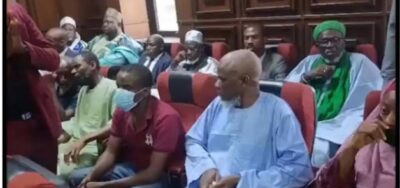
The witness appeared as the fourth prosecution witness in the trial of six defendants facing a 13-count charge bordering on treason, terrorism, and money laundering in suit number FHC/ABJ/CR/206/2026.
The Nigerian Army on Wednesday told the Federal High Court in Abuja that it uncovered what it described as a credible and elaborate plot to overthrow the administration of President Bola Ahmed Tinubu through a coup d’état, detailing allegations of planned assassinations, covert meetings, and suspicious financial transactions running into hundreds of millions of naira.
Testifying before the court, a masked operative of the Nigerian Army Corps of Military Police (NACMP), identified only as “AAA,” revealed that the military launched an extensive investigation after receiving intelligence that a network of serving and retired security personnel, alongside civilians, were conspiring to violently topple the democratically elected government.
The witness appeared as the fourth prosecution witness in the trial of six defendants facing a 13-count charge bordering on treason, terrorism, and money laundering in suit number FHC/ABJ/CR/206/2026, according to Vanguard.
Those standing trial include retired Major General Mohammed Ibrahim Gana; retired Naval Captain Erasmus Ochegobia Victor; serving Police Inspector Ahmed Ibrahim; and three civilians, identified as Zekeri Umoru, Bukar Kashim Goni, and Abdulkadir Sani.
Meanwhile, former Bayelsa State Governor and ex-Minister of State for Petroleum Resources, Timipre Sylva, was also named in the charge. Prosecutors told the court he is currently at large, having allegedly fled Nigeria before the plot was exposed.
Led in evidence by the Director of Public Prosecution of the Federation, Rotimi Oyedepo (SAN), the witness disclosed that the investigation began after the then Chief of Army Staff, General O. O. Oluyede, received intelligence implicating one Colonel Mohammed Alhassan Ma’aji and others.
According to him, the intelligence was analysed, processed and found to be credible, prompting immediate directives for a full-scale investigation.
He told the court that Colonel Ma’aji was subsequently arrested, during which operatives recovered a Samsung Galaxy phone and a jotter from his possession and residence.
What investigators allegedly found inside the jotter, the witness said, was deeply troubling.
“Inside the jotter, we found operational plans, names and designations of top members of the current administration, as well as officers marked for assassination during the execution of the coup,” the witness testified.
He added that the document also contained detailed proposals for political and structural changes to be implemented after the planned overthrow.
The court heard that forensic analysis of the recovered phone exposed what the Army described as “extensive coordination” between the alleged plotters.
“We found financial trails linking Colonel Ma’aji, former Governor Timipre Sylva, and some of the defendants before this court,” the witness said.
He further revealed that coded language was used among the conspirators to conceal communications.
“Inside the phone, we identified code words known among the plotters, including some of the defendants here. We also observed that monies were paid to several of them in pursuit of the coup plot,” the witness said.
A major highlight of the testimony was the alleged use of a company, Purple Wave, as a financial conduit for the operation.
According to the witness, records obtained from the Economic and Financial Crimes Commission showed a pattern of suspicious transactions between September and October 2025.
He listed multiple debits: September 19: N100 million and N50 million; September 22: N100 million and N50 million; September 24: N100 million and N50 million; September 26: N80 million; September 29: N70 million; September 30: N90 million and October 2: N90 million.
Although the transactions were labelled as payments for projects such as clearing of debris along the coastal corridor, the Army insisted they were diversionary descriptions.
Discover more
Politics
Journalism training course
Digital newspaper subscription
“Our investigation revealed the funds were not used for those purposes but were channelled towards executing the coup,” the witness said.
The court was also told that several clandestine meetings were held at locations in Abuja, including Green Land Apartment and BrookVille Hotel.
“At these meetings, they discussed negative things about the government and concluded there was a need for regime change,” the witness testified.
He alleged that the conspirators mapped out key targets, including military installations such as the Niger Barracks, and planned to seize major roads and infrastructure.
“They identified top government officials to be assassinated and assigned roles to various actors. They also shared appointments among themselves and discussed new agencies to be created after the coup,” the witness said.
In a further startling claim, the witness said some of the defendants engaged in consultation and divination as part of preparations.
“They received money for these purposes and even procured vehicles that were being retrofitted for kinetic operations,” he added.
During proceedings, the prosecution tendered documents, including hotel receipts and financial records, linking the accused to the alleged meetings.
Defence lawyers objected, arguing that the documents did not meet admissibility standards, but Justice Joyce Abdulmalik admitted them and marked them as exhibits, deferring detailed arguments to the final stage.
A flash drive containing audiovisual recordings of the defendants’ statements was also presented, though the defence challenged its admissibility on procedural grounds.
Justice Abdulmalik ordered the prosecution to serve all exhibits on the defence before any recordings could be played in open court.
Earlier, the court granted an application by the Federal Government to shield the identities of military witnesses, citing security concerns.
Relying on Section 232 of the Administration of Criminal Justice Act (ACJA), 2015, the prosecution argued that anonymity was necessary to protect witnesses from “unnecessary attack.”
While the defence did not oppose protective measures, they insisted on knowing the identities of witnesses to ensure a fair trial.
Justice Abdulmalik ruled in favour of the prosecution, stating that the sensitive and terrorism-related nature of the case justified the protection.
The Federal Government accuses the defendants of conspiring in September 2025 to levy war against the state and intimidate the President, an offence punishable under Section 37(2) of the Criminal Code.
They are also charged with failing to disclose intelligence about the alleged plot and providing support to its execution, alongside terrorism-related offences under the Terrorism (Prevention and Prohibition) Act, 2022.
All six defendants pleaded not guilty when arraigned on April 22 and were remanded in the custody of the Department of State Services (DSS).
The court has adjourned further hearing in the high-stakes case to May 4 and 5, as proceedings continue to unravel what prosecutors describe as one of the most serious threats to Nigeria’s democratic order in recent years.