Allegations of “40-Day PhD”: How a Cameroon University’s Rapid Doctorate Award to Nigerian Student Sparks Academic Integrity Debate
Allegations of “40-Day PhD”: How a Cameroon University’s Rapid Doctorate Award to Nigerian Student Sparks Academic Integrity Debate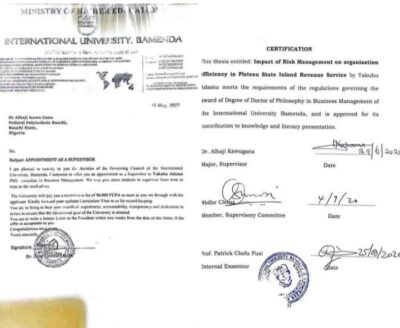
A controversial academic case involving a Cameroonian institution and a Nigerian PhD candidate has sparked renewed debate over the credibility of some doctoral programmes across West and Central Africa.
Reports indicate that International University, Bamenda, Cameroon, admitted a PhD student from Bauchi State, Nigeria, into its doctoral programme and appointed a supervisor from a polytechnic in Bauchi on May 18, 2020.
However, just 40 days later, on June 29, 2020, the same supervisor reportedly signed off on the candidate’s completed PhD thesis—raising serious questions about the duration, depth, and academic rigor of the programme.
According to the account, the university’s owner, Patrick Chefu Fusi, who passed away in 2022 at the age of 87, also signed as the external examiner for the thesis that same year, ultimately leading to the award of the doctoral degree.
The unusually short timeline between admission, supervision, and completion of a PhD has triggered widespread discussion about academic integrity and quality assurance in some private institutions operating across the region.
A traditional PhD programme typically requires years of research, coursework, fieldwork, publications, and peer review. The rapid completion in this case has therefore been described by critics as highly irregular and inconsistent with global academic standards.
While some defend flexible academic arrangements in private universities, others argue that such practices risk undermining the value of advanced degrees and weakening trust in higher education qualifications.
The case has also reignited broader conversations about the growing demand for academic titles and the pressure some individuals face to obtain doctoral degrees, sometimes regardless of academic rigor.
Observers note that in many professional and political spaces, the “Dr” title is often seen as a status symbol, fueling a surge in enrollment into programmes whose standards are sometimes questioned.
This development continues to raise concerns about the commercialization of education and the need for stronger regulatory oversight across institutions operating in the region.
While the facts surrounding this specific case remain based on reported accounts, it highlights a wider issue that continues to generate debate: the balance between access to higher education and the preservation of academic credibility.
As discussions continue, education stakeholders are being urged to strengthen quality control mechanisms to ensure that advanced degrees reflect genuine scholarship and research output.
What do you think—should PhD programmes be more strictly standardized globally, or is flexibility in some regions acceptable?