
Why and How the North Has Rejected Tinubu By Moses E Ochonu
Why and How the North Has Rejected Tinubu By Moses E Ochonu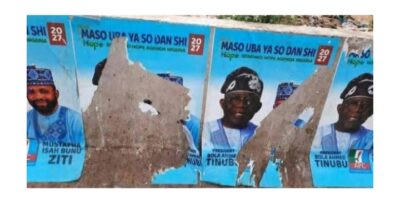
There is something cultural and religious about it. In the Muslim North, there is a binding religious injunction of fearing only God and not revering anyperson, no matter how powerful, to the point of suppressing your true feeling about them.

One thing about the Muslim north or what some people call the core north in Nigerian politics is that you’ll always know exactly where they stand in relation to the incumbent government/leader. If they like you, you’ll know. If they don’t, you’ll also know. There’s hardly a middle ground, an in-between.
If they move on from you, they’ve moved on from you.It is not that they’re politically fickle. No. Rather, they’re incapable of the chameleonic duplicity that’s the currency of politics elsewhere.
There is something cultural and religious about it. In the Muslim North, there is a binding religious injunction of fearing only God and not revering anyperson, no matter how powerful, to the point of suppressing your true feeling about them.
In other political environments, there is a hidden script and a public script. The first is the truth, the second the façade that lubricates politics and maintains political politeness.
That political performance is largely absent from the Muslim north partly because the culture in that region forbids self-censorship in the service of power and those who wield it. Therein lies the cultural element.
Truth-telling, especially in the political realm where unequal power can deter truthful expression, is a cultural imperative, a value to be consistently operationalized. This cultural commitment to speaking truth to and about power is encapsulated in a popular Hausa proverb that was immortalized in a famousHausa poem written by the Leftist intellectual, nationalist, and literary figure, Sa’adu Zungur. The saying “In zaka fadi, fadi gaskiya” translates as “if you are going to speak, speak the truth.”
The political significance of this Hausaphone proverb is that it dictates that power be held accountable through the ethos of truth-telling and honest critique. Political prevarication is discouraged.
There is also another element that makes the north more inclined to tell those in power what it is truly feeling about their failures. The north, being the least economically developed part of the country and the region with the highest concentration of poverty tends to feel the visceral pain of harmful government economic policy more than other regions. Extreme economic pain can embolden citizens with little to lose and it can catalyze the audacious political outspokenness that’s somewhat unique to the north.
So, to reiterate, the political, cultural, and religious alchemy of the north underpins the political ideal of communicating clearly and unequivocally about one’s political grievances, feelings, and frustrations regarding a political incumbent.
This culture of clarity and courageous truth-telling in politics means that the north will rarely leave a president and his ruling party guessing about where its political allegiance lies.
It means that, although there may be exceptions and outliers, the prevailing consensus will be known and the direction of politics at any given time will be discernible. There’s neither waffling nor fence-sitting with the Muslim north. And there’s no pretentious political platitudes with them either.
Once the northerners sour on a political leader, they’re loud, clear, and fearless in declaring it. And they don’t mind if other regions stay or move in a different direction.
And once the north moves, it usually moves as a bloc.
Even their traditional rulers and political elites have little choice but to align with or at least allow the new sentiment and preference to be fully expressed. They may not like it, but for their own political self-preservation, they get out of the way.
Tell me, in which other part of Nigeria would a prominent traditional ruler in the category of the Emir of Katsina look the ruling party’s presidential campaign delegation in the face and tell them to stop lying to Nigerians about hardship and insecurity?
In other parts of the country, the rulers would be thinking it, but they would not say it so directly and clearly. Platitudes would instead fill the air.
Some people may say that the bloc voting and related political tendencies of the north are a mark of unsophisticated political decision making or herd political mentality.
I say they’re a mark of political courage and the highest democratic instinct of speaking truth to power and letting your leaders know exactly what you think of their actions and inactions as they come to you seeking your support to stay in power.
Of course, there is a legitimate counterargument about how the north not only failed to loudly and unambiguously challenge former President Buhari but voted for him again in 2019 despite an abundance of evidence of his incompetence, chronic provincialism, poor economic management, and the rampant corruption in his administration.
In fact, the same Emir of Katsina who is now railing against hardship and insecurity under Tinubu once told Buhari that insecurity was the work of his enemies. He also suspended a Katsina titleholder who criticized the insecurity under Buhari. So, clearly there is hypocrisy and nepotistic selectivity involved in the current anti-Tinubu turn in the north.
Even so, the north’s exculpatory disposition towards Buhari and Buhari alone proves my point. One cannot and should not extrapolate the long leash given to Buhari by northerners as an indication of the overarching political attitude of the region. To do so would be to ignore one countervailing fact: Buhari enjoyed a mysterious, uncritical, and cultlike devotion among the northern masses. This affinity defies rational explanation, has no precedence or parallel in the politics of the region, and should thus be seen as an outlier, an atypical political relationship that does not reflect the way northerners typically relate and engage with power.
Buhari enjoyed such unprecedented and uncritical adulation that the political elites and traditional rulers of the north had to thread carefully if they didn’t want to be consumed by the passionate political emotions of the masses that Buhari had undeservedly but totally cornered for himself. That kept the elites relatively quiet about Buhari’s failures.
That political devotion frayed in the last years of Buhari’s presidency, and northerners began to openly and vehemently speak out against his administration and its many failures, but the truth is that even the prior political love affair ran contrary to the familiar political behavior of the region as no other politician had been able to command that level of support without earning or painstakingly cultivating it. Even Ahmadu Bello, arguably the most influential politician to ever emergefrom the region, never enjoyed the uncritical adulation that Buhari did. That phenomenon was thus an outlier.
Therefore, northerners’ eight-year fidelity to Buhari’s disastrous administration does not mitigate my simple point: that northerners’ willingness to take a clear political stance, even if it means swimming against the political tide, is unique in our country, exceptions aside. In no other region is this trait as fully realized as it is in the north, even if some examples abound in other parts of courageously clear collective and individual political stances.
My overarching point, to be clear is simple: the north has soured on Tinubu, and true to their character and cultural inclination, they have made it powerfully clear. I am not saying that this will result in or foreclose any electoral outcome next year.
Sometimes, the collective northern rejection or acceptance of a candidate translates or correlates to a particular electoral outcome and sometimes it doesn’t.And in each state of the core north, different electoral dynamics could impact on Tinubu’s electoral fate thereas political machines are mobilized or disabled in licit and illicit ways.
Besides, a lot goes into determining electoral outcomes in Nigeria other than the votes, feelings, andpreferences of voters. This is particularly true of the Tinubu administration, which is marked by an unprecedentedly total state capture, including a brazenexecutive control of INEC.
Because of the variables and factors that will shape the 2027 election, and because the north alone can neither reelect nor reject a candidate, Tinubu may win reelection. But regardless of what happens in the 2027 presidential election, the feeling in the north towards Tinubu at this moment is unmistakable: they have rejected the man they supported in 2023.
Professor Ochonu can be reached at meochonu@gmail.com
