APC PCC Women Empowerment Aligns with Agenda 2063 and Global Goals – Hon. Princess Gloria Akobundu
APC PCC Women Empowerment Aligns with Agenda 2063 and Global Goals – Hon. Princess Gloria Akobundu
urges Nigerian Women to vote Apc in January 2027 for consolidating of the ongoing Empowernment.
Hon. Princess Gloria Akobundu, PhD, fsi, a seasoned development expert, former National Coordinator and Chief Executive Officer of the African Union Development Agency–New Partnership for Africa’s Development (AUDA-NEPAD) Nigeria, and a key member of the All Progressives Congress Presidential Campaign Council (APC PCC) Women Mobilisation Wing, has described the ongoing mass empowerment of Nigerian women under the Renewed Hope Initiative by Her Excellency Senator Oluremi Tinubu as a strategic national effort that fully aligns with the African Union’s Agenda 2063 and the United Nations Sustainable Development Goals (SDGs).
Speaking against the backdrop of the APC Women Stakeholders’ Mobilisation and Empowerment Pre-Inaugural Summit held at the Bola Ahmed Tinubu International Conference Centre in Abuja, Akobundu said the First Lady’s deliberate focus on putting resources, skills, and economic tools in the hands of women represents far more than political mobilisation. She described it as a practical demonstration of continental and global development priorities that place women at the centre of sustainable growth, poverty reduction, and inclusive prosperity.
“When you empower a woman, you do not merely support an individual; you strengthen a household, stabilise a community, and accelerate the development of a nation,” Akobundu stated. “What Her Excellency Senator Oluremi Tinubu is doing through the Renewed Hope Initiative and the APC women mobilisation structures is precisely what Agenda 2063 and the global goals demand of African leadership, concrete action that translates policy into livelihood, dignity, and opportunity for millions of women.”
_Agenda 2063, the African Union’s long-term blueprint for the continent’s transformation, prioritises inclusive growth, gender equality, and the full participation of women in economic and political life as non-negotiable pillars of the “Africa We Want.” Similarly, the SDGs particularly Goal 5 on gender equality, Goal 1 on poverty eradication, Goal 4 on quality education, and Goal 8 on decent work and economic growth emphasise that no society can achieve sustainable development while half its population remains economically marginalised._
Akobundu, who during her tenure at AUDA-NEPAD drove programmes focused on youth and women empowerment, agricultural value chains, skills development, and grassroots governance across Nigeria’s 774 local government areas, said the current wave of empowerment activities under the First Lady continues that continental vision at the national level.
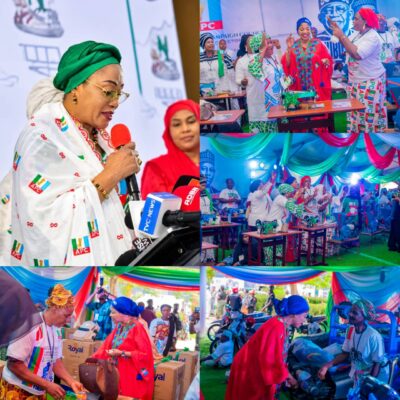
She noted that the distribution of productive assets including deep freezers, industrial grinding machines, generators, gas cookers, motorcycles, farm equipment, and cash grants to thousands of women across the six geopolitical zones directly addresses the economic inclusion agenda that both Agenda 2063 and the SDGs insist upon.
At the Abuja summit, more than 500 independent women support groups drawn from across the country formally collapsed into a unified structure under the APC PCC Women Wing. Organisers said the groups represent millions of women voters who have now endorsed the re-election of President Bola Ahmed Tinubu in 2027.
_The First Lady herself announced that the mobilisation would proceed under one banner: APC. She outlined plans for six zonal mega rallies culminating in a grand finale in Abuja, covering not only the presidency but also governorship, National Assembly, and State Assembly contests._
Akobundu fully backed the First Lady’s call for unity and continuity. “Nigeria is firmly on the path of renewed greatness,” she declared. “The reforms already underway in education financing through NELFUND, infrastructure expansion, consumer credit access via Credicorp, social protection, digital skills, and youth and women empowerment must be consolidated. Continuity is essential if we are to complete the transformation that has begun.”
She highlighted specific federal interventions that have begun to change the fortunes of ordinary Nigerian women and young people. The Nigerian Education Loan Fund, she noted, has opened tertiary education to students who previously had no realistic chance of attending university. Infrastructure projects spanning thousands of kilometres of highways are improving market access for women traders and farmers. Consumer credit schemes and digital skills programmes are expanding the productive capacity of households that have historically been locked out of formal finance.
As a former AUDA-NEPAD CEO who worked to domesticate continental frameworks in Nigeria, Akobundu stressed that the First Lady’s approach mirrors the African Union’s insistence on results rather than rhetoric.
_“Agenda 2063 is not a document to be quoted at conferences,” she said. “It is a call to action. It demands that African governments and leaders move from aspiration to implementation. What we are witnessing under the Renewed Hope Agenda particularly the deliberate targeting of women with tangible economic tools is implementation. It is the localisation of continental ambition.”_
_She urged women across all geopolitical zones, with particular emphasis on the South-East, to recognise the strategic importance of the moment. “Women are not merely voters; we are the backbone of families, the engines of informal economies, and the custodians of community stability. When we organise, when we speak with one voice, and when we demand continuity of programmes that put resources in our hands, we are not doing politics for its own sake. We are securing the future of our children and the prosperity of our nation.”_
Akobundu further linked the empowerment drive to the broader APC mobilisation target of tens of millions of women’s votes in 2027.
_She said the collapse of previously independent support groups into a single party structure eliminates fragmentation and creates a coherent platform for sustained grassroots engagement across communities, wards, local governments, and states._
The development expert, who also serves as Secretary of the APC PCC Faith-Based Mobilisation (Christians), called on women of faith and community leaders to ensure that the gains of empowerment are protected through political participation. “Empowerment without political voice is incomplete,” she said. “The ballot is the ultimate instrument through which we consolidate the progress already made and demand more.”
Observers familiar with Akobundu’s career note that her intervention carries particular weight because of her dual identity as both a continental development practitioner and a grassroots mobiliser. Having previously coordinated AUDA-NEPAD programmes that reached thousands of women and youths with skills training, agricultural support, and income-generation initiatives, she is positioned to assess the current national effort against established continental benchmarks.
_“This is not charity,” she concluded. “This is strategy. This is development. This is the practical expression of the Africa We Want – starting with the Nigerian woman who can now expand her business, educate her children, and stand tall in her community. When Nigerian women rise, Nigeria rises. And when Nigeria rises in partnership with the rest of the continent, Agenda 2063 moves from aspiration to reality.”_
As the APC PCC Women Mobilisation structures deepen their work across the federation, Akobundu’s message remains clear: the empowerment of hordes of Nigerian women under the leadership of Senator Oluremi Tinubu is not an isolated political gesture. It is a development intervention that sits squarely within the continental and global frameworks designed to leave no one behind.