
Supreme Court Judgment Triggers Disqualification Fears Among Parties
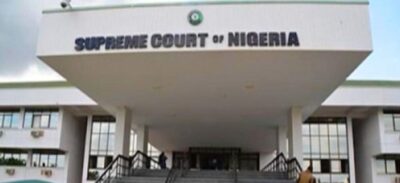
Supreme Court Judgment Triggers Disqualification Fears Among Parties
Supreme Court Bench (Nigeria)
…Anxiety As INEC Awaits Copy Of Judgment
…Group Writes INEC, Seeks Chinda’s Disqualification From Rivers Governorship Race
…INEC Must Remove Candidates Affected By Judgment — Adeyanju
The Supreme Court’s judgement restoring Sections 77(5), 77(6), 77(7), and 84(2) of the Electoral Act 2026 to the Independent National Electoral Commission (INEC) has triggered fresh anxiety among political parties ahead of the 2027 elections.
The sections deal with the parties’ mode of primary election and the exclusion of candidates whose names did not appear in the parties’ membership registers as of the time the primaries were conducted.
Fears have continued to mount, especially among governorship and legislative candidates who fell into that category over possible disqualification, as the judgment might have raised questions over their eligibility.
Not a few of the office seekers emerged as candidates of the various parties on the strength of an earlier judgment of the Court of Appeal, which stripped INEC of the powers over the contentious Sections 77(5), 77(6), 77(7), and 84(2) of the Electoral Act.
They were not captured in the registers of the respective parties in which they emerged as candidates.
Among the affected politicians are the All Progressives Congress (APC) governorship candidate in Rivers State, Kingsley Chinda; the Delta Central senatorial candidate of the Nigeria Democratic Congress (NDC), Ovie Omo-Agege; and the governorship candidate of the Peoples Democratic Party (PDP) in Gombe State, Isa Pantami, among many others.
The Court of Appeal had overturned an earlier judgment of a Federal High Court asking INEC to retain the powers to exercise control over the said provisions, following a case instituted against the electoral body by the Zenith Labour Party (ZLP).
The development has also placed INEC under increasing pressure, as parties and political groups await the electoral body’s interpretation and implementation of the judgment ahead of the elections.
At the centre of the controversy is the Rivers State governorship race, where a group has written to INEC demanding the disqualification of Chinda from the contest, citing the implications of the Supreme Court judgment.
The group, in its petition to the electoral commission, urged INEC to examine the judgment and determine whether Chinda and other candidates affected by the court’s pronouncement still meet the constitutional and statutory requirements to participate in the election.
It argued that INEC could not ignore the implications of a binding decision of the apex court, particularly where the judgment affects the eligibility of candidates already listed for an election.
In the petition, the Association of Legislative Drafting Practitioners (ALDRAP) asked INEC to disqualify Chinda and all APC candidates for the Rivers State House of Assembly.
The ALDRAP, through its Executive Secretary, Dr Tonye Clinton Jaja, stated in the petition, dated September 26, 2026, that the group had already filed a case with the Federal High Court, Abuja, seeking Chinda and others’ disqualification for allegedly meeting constitutional eligibility requirements.
Jaja listed INEC, Abdul Mahmud, the APC and its National Chairman, Chinda and Mariana Ajibola as respondents in the said case marked FHC/ABJ/CS/972/2026.
The petition has further heightened political tension in Rivers State, with parties and their supporters eagerly awaiting INEC’s decision on the matter.
“The electoral process must be guided by the law and candidates found to be affected by the Supreme Court judgment should not be allowed to remain on the ballot,” the group said.
Also, political activist and public affairs commentator, Deji Adeyanju, has joined the call on INEC to immediately review the status of all candidates affected by the judgment.
Adeyanju said the commission must ensure that candidates who no longer satisfy the legal requirements for participation are removed from the electoral process.
He said INEC had a responsibility to enforce the implications of the Supreme Court’s decision and prevent the participation of candidates whose eligibility had been invalidated by the judgment.
The controversy comes against the backdrop of heightened legal scrutiny of candidates and political parties as preparations for the elections intensify.
With INEC yet to receive and formally act on a Certified True Copy of the judgment, parties are watching closely for the commission’s next steps.
When asked by journalists on Thursday to comment on the implications of the judgment, INEC’s counsel, Alex Iziyon SAN, declined to comment, saying he could not speak on the judgment yet.
The development has also raised questions about whether the judgment could have wider implications beyond Rivers, Delta and Gombe States, particularly for candidates whose nomination, eligibility or participation may be affected by the issues determined by the Supreme Court.
As of Sunday, political parties were also said to be studying the judgment. The APC national leadership, which held a retreat in Maiduguri, Borno State, at the weekend, was said to have deliberated on the likely implications of the judgment but could not take any concrete decision without seeing a copy of the judgment.
For the electoral commission, the immediate challenge is expected to be determining the precise scope of the judgment and identifying the candidates, if any, whose participation is affected by its provisions.
Until the full text of the judgment is obtained and examined, however, the extent of its implications for the various candidates remains unclear.