Burkina Faso’s Traoré Claims Western Intelligence Offered Chemicals To Po!son Food Sent To Terrorist-Held Areas
Burkina Faso’s Traoré Claims Western Intelligence Offered Chemicals To Poison Food Sent To Terrorist-Held Areas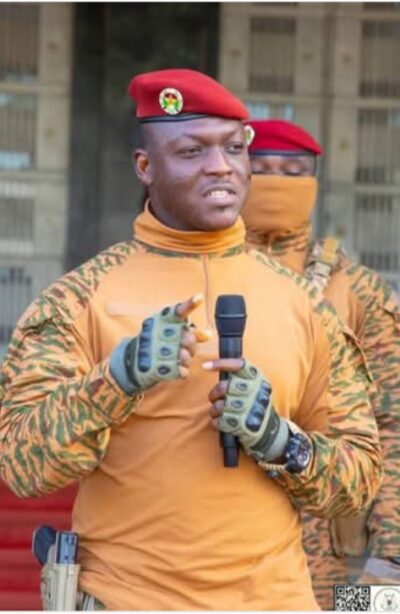
According to him, unnamed agents approached his government with four different products that could allegedly be mixed into food, beverages, milk, sugar, and cigarettes before being distributed to territories occupied by armed groups.
Captain Ibrahim Traoré, Burkina Faso’s military ruler, has claimed that operatives from a Western country’s intelligence service once proposed supplying his government with chemical substances to secretly contaminate food and drinks destined for areas controlled by terrorists, alleging the products were designed to weaken or permanently damage those who consumed them.
Traoré made the explosive claims while addressing members of the armed forces and residents of the Yaadga region, where he spoke at length about what he described as longstanding foreign attempts to undermine African countries through covert operations, economic dependence and psychological manipulation.
According to him, unnamed agents approached his government with four different products that could allegedly be mixed into food, beverages, milk, sugar, and cigarettes before being distributed to territories occupied by armed groups.
“One day, a kind of secret service from a Western country came to see me. They offered us four products to put in the food and send to the areas where there are terrorists,” Traoré said.
He alleged that one of the substances would gradually impair a person’s ability to think, another would reduce physical strength over time, while another was linked to insomnia and other health complications.
“These products are put in everything, in drinks, whether it is beer, sugar, cigarettes, in milk, it is put in everything,” he said.
“And one of the products, its job is to kill the brain. That is, so that the person can no longer think. It gradually makes him vulnerable, and after a few years, the ability to think, to do things, and one of the products, which is the physical ability.
“If the person was able to run 12 km after a few years, that would be maybe 6 km, 4 km, he becomes weak. The other is insomnia.”
The Burkina Faso military leader said his government rejected the proposal after questioning the visitors about the products and demanding to know whether they had previously been used elsewhere.
According to Traoré, the agents admitted the substances had already been deployed in parts of Africa and Asia, a response he said left him deeply disturbed.
“They told us they had already used it somewhere in Africa and somewhere in Asia,” he claimed, adding that the conversation reinforced his belief that foreign powers have long pursued covert methods to weaken African populations.
Traoré did not identify the Western country involved, provide evidence to support the allegation, or disclose when the purported meeting took place.
During the speech, he urged Burkinabè citizens to embrace locally produced goods, arguing that dependence on imported products exposes Africans to unknown risks.
Referring to previous international controversies involving food products marketed differently across regions, Traoré argued that Africans should prioritise domestic production and consumption.
He further claimed that Africa has historically been subjected to centuries of exploitation, citing the transatlantic slave trade and Arab slave trade as examples of prolonged oppression.
According to him, Africans continue to suffer from what he described as a “Stockholm syndrome,” alleging that many admire and depend on countries that historically exploited the continent rather than pursuing self-reliance.
Traoré also revisited historical episodes to support his argument, referring to the existence of “human zoos” in Europe and claiming that many Africans remain unfamiliar with such aspects of history.
The Burkina Faso leader further alleged that foreign actors continue to manipulate divisions across Africa by exploiting ethnic and religious differences to fuel instability.
He said such tactics remain among the greatest threats to African unity and sovereignty.
In another striking allegation, Traoré claimed that in 2023 he received a letter from a French national whom he identified only as “Daniel,” whom he later described as being associated with France’s external intelligence agency, the Directorate-General for External Security (DGSE).
Traoré said the man warned him that Africans would never understand or consistently support his political vision, drawing comparisons with the late revolutionary leader Thomas Sankara.
He said the individual allegedly predicted that foreign interests would continue working to destabilise Burkina Faso and provoke internal conflict.
Traoré further accused unnamed French diplomatic personnel and other foreign-linked actors of attempting to influence media narratives and public opinion with the objective of ending what he described as Burkina Faso’s revolution.
The Burkina Faso leader, however, did not present evidence to substantiate the allegations against the intelligence services, foreign governments, or diplomats.
His remarks come amid worsening diplomatic relations between Burkina Faso and several Western countries following his government’s military-led shift in foreign policy, expulsion of French troops, and growing security cooperation with Russia and fellow military-led governments in Mali and Niger.