
How Aiyedatiwa Is Fighting Too Many Battles with His Politics of Division.
How Aiyedatiwa Is Fighting Too Many Battles with His Politics of Division.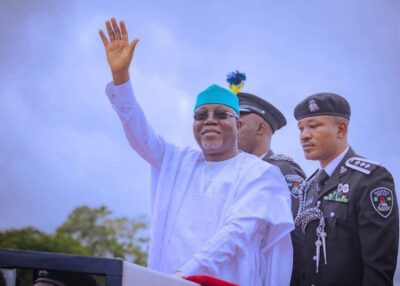
by Wale Obanigba, Esq.
Friday, May 8, 2026.
On May 1st, the Honourable Minister of Interior, Olubunmi Tunji-Ojo, celebrated his 44th birthday. Tributes poured in from across the country in honour of a man whose performance in office has earned national recognition. President Bola Tinubu issued an official statement celebrating the Minister for the tremendous impact he has made in the Ministry of Interior and his contributions to national development.
Curiously absent from the long list of goodwill messages was the Governor of the Minister’s home state, Lucky Aiyedatiwa. Under normal circumstances, that silence might have meant little. However, it becomes more significant when one recalls that on January 12th, during Governor Aiyedatiwa’s 61st birthday celebration, Olubunmi Tunji-Ojo publicly extended warm felicitations and goodwill to him. At this point, the Governor can hardly pretend otherwise.
This development immediately brought back memories of a piece I wrote on February 4th titled “A Show of Shame: When Pettiness Undermines State Dignity.” That article was prompted by the treatment allegedly meted out to the Minister during the grand finale of Ondo State’s 50th anniversary celebration, where he represented the President. Shockingly, no delegation of the state government was at the airport to receive him. Reports from the venue equally suggested a cold and hostile disposition towards the Minister throughout the event. At the time, many dismissed the concerns raised as political exaggeration. Recent events, however, appear to suggest otherwise.
Interestingly, during a recent media interview, Governor Lucky Aiyedatiwa denied any hostility towards the Minister. But leadership is judged not merely by words, but by actions and body language. Strangely, the actions coming from the government continue to point in a different direction. One is therefore compelled to ask: what exactly is the issue?
What makes the situation even more puzzling is that during Governor Aiyedatiwa’s difficult period as Deputy Governor, when moves were being made to remove him from office, Olubunmi Tunji-Ojo reportedly played a significant role in stalling those proceedings and stabilising the situation. If that was truly the case, what has changed so dramatically? Why has the relationship deteriorated into what now appears to be subtle political hostility and calculated distance?
Unfortunately, this trend goes beyond the Minister alone. Governor Aiyedatiwa appears to be fighting too many political battles at the same time, both within the APC and across the state. As I have consistently argued in recent weeks, the Governor’s style of politics is gradually creating avoidable divisions and internal resentment. How does a sitting governor end up having strained relationships with multiple political office holders at the national level simultaneously? That is not a sign of political strength, rather, it point to lack of capacity to manage contending interests within the system.
Recent developments within the APC further reinforce this concern. In a recent interview on Adaba FM, Senator Adeniyi Adegbonmire reportedly stated: “The NWC of our party has chosen direct primaries which are in accordance with the Electoral Act and Gov. Aiyedatiwa hasn’t called me to say that we now have a consensus candidate, so as far as I’m concerned the issue of consensus candidates are just rumours.” That statement speaks volumes about the growing cracks within the party structure in Ondo State.
In what increasingly appears to be a politics of divide and rule, the Governor is now setting brothers, political allies, and even communities against one another. In Akure, he is said to have endorsed Dr. Taiwo Fasoranti to contest against his own townsman, Senator Adeniyi Adegbonmire. In Ondo North, he reportedly backed Hon. Gbenga Elegbeleye from Ikare against another Ikare son, Senator Jide Ipinsagba. By encouraging people from the same towns and communities to challenge incumbent senators from those same areas, the Governor is inadvertently creating tension within families, friendships, and local political structures that ordinarily should remain united. Rather than building consensus and strengthening the party, these actions are deepening bitterness and widening internal fractures.
Ironically, the Governor’s approach is beginning to unite former political rivals against him. Stakeholders who once stood apart are now finding common ground in their dissatisfaction with the administration’s style of leadership and candidate selection process. Meanwhile, many members of the National Assembly, particularly in the House of Representatives, who ordinarily would have struggled to secure another term, are now emerging in strong positions to clinch APC tickets because of the internal confusion within the system.
Even in the selection of House of Assembly candidates, an area traditionally within the influence of a sitting governor, many critical stakeholders reportedly feel sidelined and ignored. There are already quiet discussions about sponsoring candidates on alternative political platforms to challenge the Governor’s preferred candidates in the elections ahead.
Perhaps the greatest saving grace for Governor Lucky Aiyedatiwa at the moment is the weakness of the opposition in Ondo State and Nigeria generally. But political history teaches that internal implosion is often more dangerous than external opposition. No administration can sustain itself for long on exclusion, resentment, and endless political battles.
Ondo State deserves leadership that unites, not one that deepens divisions. The politics of insecurity, selective loyalty, and avoidable conflict may serve temporary political interests, but they rarely end well. No state moves forward when its leaders spend more time fighting perceived enemies than building collective strength for development and progress.
If all these developments are carefully considered together, one uncomfortable conclusion becomes difficult to avoid. Governor Lucky Aiyedatiwa increasingly appears to lack the political depth and leadership capacity required to effectively manage the enormous responsibility that fate placed in his hands. That weakness is becoming more evident, both in his style of governance and in the way he approaches politics.
Wale Obanigba writes from Akure.