
Why Peter Obi Refused to Comment On Nasir El-rufai’s Detention
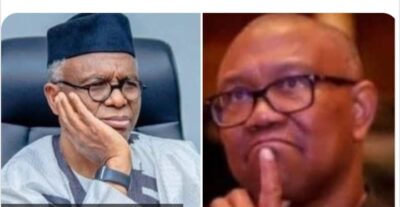
Why Peter Obi Refused to Comment On Nasir El-rufai’s Detention
Peter Obi has remained reticent on Nasir El-Rufai’s detention for a few strategic reasons.
February 25th, 2026, makes it 10 days since Nasir El-rufai honoured the invitation of the Economic and Financial Crime Commission (EFCC).
The former governor of Kaduna State faces parallel probes by Nigeria’s anti-graft agencies over alleged misappropriation of 432 billion naira during his governorship administration in Kaduna State from 2015 to 2023. He also faces a three count charge under the cybercrime act for his controversial statement on live tv in which he alleged that the phone conversations of national security adviser, Nuhu Ribadu was intercepted.
His media aide revealed that Nasir El-rufai was released by EFCC on administrative bail but was taken into custody by ICPC where he is currently being detained.
In view of Nasir El-rufai’s recent political alignment with Peter Obi under the coalition party –African Democratic Congress (ADC), one expects that Peter Obi, arguably one of the most popular faces of ADC, would have openly commented on Nasir El-rufai’s travail.
But Peter Obi has remained reticent– no tweet, public statement, or media interview even as Nasir El-rufai’s media aide claimed that the former governor suffered an episode and bled from his nose in ICPC custody.
Atiku like Peter Obi had been silent until his recent remark accusing the Nigeria’s authority of dictatorship, stating that Nasir El-rufai’s continued detention without a remanding order amounts to abuse of his fundamental rights
True, the total absence of commentary from Obi is not accidental and for people like me, it reflects calculated political positioning via multiple interlocking dimensions.
For example:
Preservation of the “Mr. Clean” brand and Anti-Corruption Crusader portfolio.
Obi’s political identity rests on demonstrated personal and administrative probity, you verify from the low-cost governance in Anambra, public declaration of assets, and consistent criticism of fiscal recklessness under successive APC administrations.
If you look at Peter Obi’s modus operandi, this El-Rufai’s case centers on allegations of massive public fund mismanagement during his Kaduna tenure.
Any expression of solidarity risks framing Obi as defending alleged graft, which would directly undermine the core promise he has taken from 2023 into the 2027 electoral cycle.
It could also be that Obi’s silence allows the El-Rufai saga to serve as a negative foil that implicitly reinforces Obi’s own narrative of transparency.
In Nigerian politics, where anti-corruption agencies are selectively weaponized, vocal defense of an opposition figure facing such quantum allegations carries asymmetric political reputational risk for someone whose brand is built on never having been invited by the EFCC.
The relationship between Obi and El-Rufai carries unresolved tension from 2013. Remember when El-Rufai said Obi ordered his detention in Anambra during an election-related visit, a serious claim that Peter Obi and Aisha Yesufu have repeatedly described as false and attributing it instead to the DSS. It was an episode that resurfaced publicly in 2022 during the presidential campaign.
Management of Coalition Politics and Southern Base Sentiments Ahead of 2027 is also very important. Nigeria’s opposition landscape is fluid, El-Rufai’s detention has already been described as crippling internal ADC cohesion.
Atiku’s vocal intervention fits his northern base and coalition-building style.
Peter Obi, however, must navigate a more delicate calculus.
The Core “Obidient” movement is disproportionately southern and urban youth-driven, with significant skepticism toward northern establishment figures perceived as having “APC baggage.”
For most of them, public solidarity with El-Rufai could alienate segments of this base that have explicitly warned against “unholy alliances” with politicians facing credible corruption questions.
Obi has shown willingness to speak forcefully on issues aligned with his brand (e.g. governance failures in education, or hardship policies).
His silence here might signal discernment: and in all fairness to him, not every opposition figure’s legal trouble requires his voice.
Although it might appear to you like Obi is letting the others fight in the mud while he tries to stay on the high ground.”
“In Nigeria, silence is a strategy.”