
Ruins of power: Inside the rotting estate of Western Nigeria’s last premier
Ruins of power: Inside the rotting estate of Western Nigeria’s last premier
DANIEL AYANTOYE examines the abandoned estate of Western Nigeria’s last premier, Samuel Ladoke Akintola, tracing the decay, looting, and fading legacy of Nigeria’s 13th Aare Ona Kakanfo, while exploring how the family and LAUTECH hope to restore the historic property
It was a busy Wednesday morning, on February 21, 2026, when this correspondent began the journey from Lagos to Ogbomoso, about 222 kilometres away.
The destination was the once-grand residence of Chief Samuel Ladoke Akintola, former Premier of Western Nigeria and the 13th Aare Ona Kakanfo of Yorubaland.
Akintola, a son of Ile Akinbola in Ogbomoso, built the estate at Oke-Ado, a place that once reverberated with power, politics and prestige. Today, the compound tells a very different story.
From the gate, reached around 4:35 pm after a traffic-clogged journey, decay announces itself. One of the twin entrance gates has been partly cut open by scavengers, leaving jagged metal edges that hint at the ruin within.
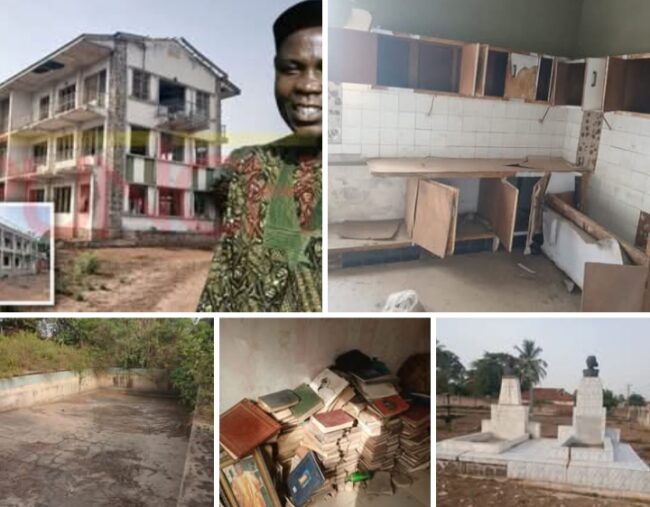
At a distance, one could see that the windows burglar-proof bars and louvres of most of the rooms in the two-storey building and another one-storey building in the compound had been removed.
The two-storey building had about 12 large rooms and six halls meant for meetings and gatherings, while the one-storey structure had six spacious rooms and two car parks attached to it.
The paint on the buildings has long faded, and the once-lush compound is now overrun by dirt and trees that have been cut down.
Fruit trees, ornamental plants and fountains that once beautified the environment have either been cut down or swallowed by neglect.
Inside the premises lie the tombs of the late premier, his wife, Faderera Aduke Akintola, and their son, Olatokunbo Akanni Akintola, who died before his father.
Behind the main building is an Olympic-size swimming pool. The water has long dried up, leaving behind a pit filled with dirt and debris.
All the pipes of the pool have been ripped out by scavengers while nearby, a small cassava farm now grows where leisure once reigned.
The roof and ceiling have also caved in at several points, leaving parts of the rooms exposed to the sky.
Moving through the rooms means pushing past thick shrubs and spider webs that grip to entrances and passages.
As Sunday PUNCH climbed towards the upper floor, a sense of fear crept in, heightened by the heavy silence, the stench of decay and the piles of dirt inside the rooms, as if something could suddenly emerge from the shadows of the abandoned rooms as he opens to see what is left of them.
Inside some of the rooms, broken picture frames, old photographs of Chief Akintola are scattered on the floor, some face down, others cracked.
Each step resounded with the crunch of broken glass, shattered picture frames and scattered debris, the sound ringing through the empty halls.
In one corner, a pile of books belonging to the late premier were dumped beside two wooden decrepitude chairs. In one of the the conference rooms, two big tables were covered in dust, as if waiting for hands that will never return.
The kitchens and toilets are now empty shells.
Water closets, fittings, even the burglar-proof bars and louvre windows have been stripped away, leaving only bare walls and gaping spaces.
The once-bright interiors now wear the dull colour of abandonment.
Yet, beneath the neglect, the structure still looks solid, built with materials that have withstood time, weather and plunder.
A security guard in the compound disclosed they work in shifts to ensure 24 hours security of the facility, but declined to speak further, saying he was not authorised to talk to the media.
What remains of Akintola’s estate is a haunting contrast to the life of the man who once lived there, a leader whose name still carries weight in Yoruba history.
Inside one of the Kitchens
The children
Samuel Ladoke Akintola, born in February 1910, was not just a former occupant of this now-dilapidated estate.
He was a distinguished lawyer, journalist, orator and politician who rose to become the second and last Premier of the old Western Region.
A founding father of modern Nigeria, Akintola was a towering figure of his time, whose voice once shaped politics and whose home once hosted power, culture and history.
He was assassinated during Nigeria’s first military coup on January 15, 1966, bringing a violent end to a life that had been devoted to public service.
Chief Akintola was survived by six children, three of whom are still alive.
They include a former Nigerian Ambassador to Hungary and one-time senatorial aspirant in Ogbomoso, Abayomi; a former minister of finance, Dr Bimbo; and a respected jurist of the Oyo State High Court, Justice Ladiran.
Three others, Omolade, Olatokunbo and Oladipupo, have since passed on. Their father’s once-proud home now stands in quiet ruin.
Protected by farmers
During Sunday PUNCH’s second visit to the estate on Thursday morning, a farmer found working in the compound shed light on how the once-grand property fell into the hands of scavengers.
Moses Adegoke, who said he had been farming on the land for about four years, said looters usually strike when the farmers are away.
“We are the ones giving the place small security when we are around to farm. But anytime we leave, we don’t know what happens. We will just come back and discover that something else is missing,” he said.
According to him, there was once a security guard at the residence, but the vastness of the compound made it impossible for one man to secure everything.
“Before the guard goes out and comes back, some people would have entered through the back fence and carried something away. Each time we return, we notice another burglary, another pipe removed. We are not happy because when we first came here, the house was not like this. Now, they have taken almost everything,” he added.
Adegoke said the scavengers usually gain access through the back fence and flee once they are sighted.
“When we shout, they will just jump the fence and run,” he added.
He noted that the situation only improved when security operatives from the state university named after the late premier began to patrol the area.
“It was when the Ladoke Akintola University of Technology guards started coming that we noticed nobody was entering the place again,” he said.
Olympic-size swimming pool
Before vandalisation started
In a 2010 interview with Daily Trust, a cousin of the late premier, Pa George Olayinka, who lived with the family since childhood, was referred to as the “maintainer” of the property.
He also worked as secretary to Akintola’s son, Abayomi.
According to him, Abayomi, the only child who followed his father’s political path, usually stayed in the house with his family whenever they visited Ogbomoso.
The residence then doubled as a political hub, hosting meetings and activities for the local governments in Ogbomoso.
To keep the property alive and useful, parts of the compound were converted into a nursery and primary school, while another section was turned into a small shopping complex rented out to members of the community.
Life, commerce and politics once flowed through the same corridors that are now choked with silence.
But Pa Olayinka, who was 73 at the time of that interview, has since passed away.
The political gatherings ended, the school closed, and gradually, the house slipped into abandonment.
How the house was abandoned – Neighbours
A neighbour, 54-year-old Bashiru Adisa, popularly called Baby Face, recalled how the once-busy home slowly emptied.
He said Abayomi continued his father’s tradition of supporting people in the community during the annual remembrance on January 15, drawing large crowds, until the activities stopped after the 50th anniversary.
“It was after they stopped it that things began to fall apart. When the place became idle, that was when scavengers started entering from the back.
“Nobody knew when they came. Bashorun Abayomi was trying. People used to gather in hundreds, just as we heard his father did in his time. Some people would receive N50,000, some N20,000. The compound was always alive,” Adisa said.
According to him, the looters slipped in through the Sabo axis at the back of the property.
For Mrs Bolanle Olanike, another neighbour, the abandonment also brought fear.
She said, “Before they cut the trees, the place was full of bush. At midnight, you would hear strange sounds of wild animals from the compound.”
A shop owner, Wahab Omotayo, looked beyond the decay and imagined a different future.
“The place was bushy before, but now that LAUTECH has taken over according to what we heard, I believe they can build hostels there. It will be helpful for everyone in the community,” he said.
Chief Akintola’s books
LAUTECH now responsible for the building – Family
Coordinator of the Samuel Ladoke Akintola Memorial Foundation, Yemi Adedokun, confirmed that the property had been handed over to the university.
Adedokun said, “The family repaired the house twice in the past, but eventually it was given to LAUTECH. Everything is now left to the management of the university to do the needful.
“We strongly believe in Chief Akintola’s legacy, and by the grace of God, we will be marking the 60th anniversary of his death on the 29th of this month.”
Why we didn’t move in after acquisition – LAUTECH VC
Explaining why the university has not yet moved into the premises, the Vice-Chancellor of LAUTECH, Prof Razaq Kalilu, in an interview with this correspondent, said the institution formally took over the estate in late 2024 through a lease agreement with the Akintola Foundation, represented by the children, Dr Bimbo and Ambassador Abayomi.
He said, “At first, the agreement was for 10 years. But when we inspected the place, we discovered that all fittings had been removed. What remained were just the walls. Then, we felt that spending huge funds to rehabilitate the building would not be worthwhile for a 10-year lease. The family then graciously extended it to 30 years.”
According to him, the university made provisions in its 2026 budget, which became operational in January, to begin renovating parts of the estate.
“If you visit the place now, you will see that we have deployed security personnel to prevent further vandalism and destruction. We will be moving the Institute of African Studies, which was established in 2024, to that place.
He added, “It’s saddening that everything there, including books that would be of value, has been carted away by some reckless people and that was before it was given to us.”