
17-Year-Old Girl Returns To Niger Mining Site Days After 37 Miners D!e In Custody, Says ‘I’m Not Afraid To D!e’
17-Year-Old Girl Returns To Niger Mining Site Days After 37 Miners Die In Custody, Says ‘I’m Not Afraid To Die’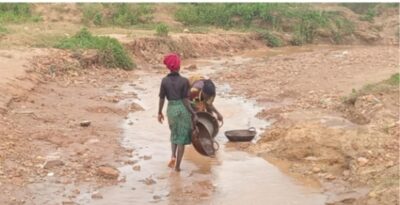
Speaking exclusively to SaharaReporters during a visit to the community, Zainab said security agents had continued to chase miners away from the site.

A17-year-old girl, identified as Zainab, has returned to a mining site in Niger State days after 37 suspected illegal miners died in the custody of the Nigeria Security and Civil Defence Corps (NSCDC), saying poverty has left her with little choice but to continue mining despite the danger.
Zainab, who was found at the mining site with two of her teenage sisters, told SaharaReporters that mining was how she survived and helped provide food for her aged parents.
She said the fear of arrest or even death could not stop her from returning because she had no other means of livelihood.
Speaking exclusively to SaharaReporters during a visit to the community, Zainab said security agents had continued to chase miners away from the site.
According to her, police officers had arrived shortly before SaharaReporters got there, forcing her and other miners to run into hiding.
“I don’t fear anything anymore. The highest thing they would do is to kill me, which they have done to some of my colleagues,” Zainab said.
“Even just before your arrival, the police came chasing us and we ran into hiding. And now we are here to continue again.”
MINING SITE
Asked why she would return to the same mining site after seeing what happened to other miners, the teenager said hunger and poverty were greater fears for her than arrest.
“What else do you want me to do? This is what I use to feed my aged parents. This is where I get what I eat and what I use to take care of myself,” she said.
“If I don’t come here, who will feed them? Who will take care of them?”
Zainab said she understood the risks associated with mining but insisted that people like her were being pushed into the trade because they had few opportunities to earn a living.
“We know that it is dangerous. We know that they can come and arrest us. We know that something can happen to us here,” she said.
“But if you don’t have anything, what do you expect the person to do? We have to eat. We have to survive.”
The teenager said the recent deaths had frightened many miners but had not eliminated the economic problems that brought them to the site in the first place.
“People are afraid. Everybody is afraid after what happened. But hunger is also there,” she said.
“The people who died had families. They were looking for what to eat. We are also looking for what to eat.”
She said she and her sisters returned to the mining site almost immediately after hearing that dozens of miners had died.
MINING SITE
“We came to the site even a day after the news broke of the death of the 37 miners,” she said.
“We heard what happened, but we still came because there is nothing else for us to do.”
Zainab said she was not returning because she considered the work safe, but because she had become accustomed to living with the risks associated with poverty.
“I’m not afraid of anything because I can only die once and nothing more,” she said.
“If I stay at home, there is no food. If I come here, there is danger. So what do I do?”
She said the presence of her two teenage sisters at the site was also a reflection of the difficult circumstances facing their family.
“They are my sisters. We came together because we have to survive together,” she said.
“We don’t have anybody giving us money. We have to find something to do.”
The teenager’s account highlights the difficult choices confronting poor residents who depend on artisanal and often unregulated mining for survival, even as authorities intensify efforts to shut down illegal mining operations.
MINING SITE
37 miners died after NSCDC raid
Zainab’s return comes days after the deaths of 37 suspected illegal miners arrested during NSCDC operations in Niger State.
The victims were among people arrested during enforcement operations around mining communities in the M.I. Wushishi and Lukoto areas of the state.
The deaths triggered public concern, particularly over reports that some of those arrested were teenagers.
Authorities have launched investigations into the circumstances surrounding the deaths, while the Federal Government suspended the NSCDC commandant in the state and constituted an investigative committee.
But while government agencies investigate the deaths, residents who depend on mining for their livelihoods continue to face a difficult choice: stay away from the mines and struggle to survive without income, or return to the sites despite the risks.
For Zainab, that choice has become painfully simple.
“I don’t want to die. Nobody wants to die,” she said. “But I cannot sit down and watch my parents suffer from hunger.”
“If there is another work, let them give us. If there is something we can do that will feed us, we will do it.” “We are not here because we want to die. We are here because we want to live.”
She said what she wanted most was an opportunity to earn a living without having to risk her life at a mining site.
“If they don’t want us to mine, they should give us another way to survive,” she said.
“We are ready to work. We are young. We can work. But where is the work?”
Zainab’s story underscores the human cost of poverty and the challenges facing government efforts to eradicate illegal mining in communities where the trade has become a means of survival for families with few economic alternatives.