
Senegal’s National Assembly President El Malick Ndiaye Resigns Amid Growing Political Crisis
Senegal’s National Assembly President El Malick Ndiaye Resigns Amid Growing Political Crisis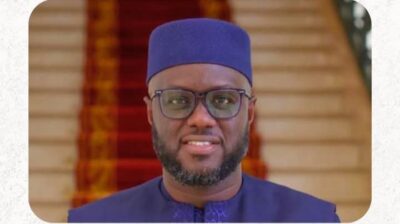
Ndiaye recounted that during his tenure, he worked with lawmakers and parliamentary officials to strengthen the Senegalese parliament through reforms centred on transparency, oversight, and modernisation.
The President of Senegal’s National Assembly, El Malick Ndiaye, has announced his resignation from office, saying the decision was taken after “deep reflection” and guided by his “supreme interest of the Nation.”
In a statement released on Sunday, May 24, 2026, Ndiaye said his resignation was motivated by “a personal choice” rooted in his understanding of public responsibility and state institutions.
“My dear compatriots, after deep reflection, matured in silence, responsibility, and the sense of the State, I have decided to resign from my position as President of the National Assembly of Senegal,” he stated.
“This decision stems from a personal choice, guided above all by my conception of institutions, public responsibility, and the supreme interest of the Nation.”
Ndiaye recounted that during his tenure, he worked with lawmakers and parliamentary officials to strengthen the Senegalese parliament through reforms centred on transparency, oversight, and modernisation.
“Since my election to the head of the National Assembly, I have devoted all my energy, alongside all the deputies and the parliamentary administration, to strengthening our institution, consolidating the principles of transparency, oversight, and modernisation, as well as enhancing the radiance of the Senegalese Parliament on national and international stages,” he said.
The former Speaker thanked members of both the ruling majority and the opposition, parliamentary staff, and the Senegalese people for their support during his time in office.
He also expressed appreciation to members and supporters of the ruling PASTEF party, under whose platform he emerged.
“I also wish to extend my most sincere thanks to the militants, leaders, and sympathisers of the PASTEF party, on whose list I was invested,” Ndiaye said.
“Their constant commitment, their fidelity to the ideals of transformation, and their trust have been for me a permanent source of strength, demand, and responsibility.”
Although Ndiaye did not disclose specific reasons for stepping down, he stressed the importance of preserving democratic stability, civil peace, and national unity in Senegal.
Meanwhile, his resignation comes amid ongoing political changes in Senegal following the rise of the Patriotes Africains du Sénégal pour le Travail (PASTEF), the political movement associated with President Bassirou Diomaye Faye and Prime Minister Ousmane Sonko, which swept to power after the country’s tense 2024 elections.
Ndiaye’s resignation also comes against the backdrop of a growing political crisis within the country’s ruling establishment, marked by a dramatic fallout between President Faye and Prime Minister Sonko.
Although Ndiaye did not directly mention the political tensions rocking the government, his departure follows months of internal disagreements within the ruling PASTEF movement, which swept to power after the 2024 elections.
The crisis escalated after President Faye dismissed Sonko and dissolved the government following a prolonged power struggle between the two longtime political allies.
The development marked a stunning breakdown in the alliance that brought both men to national prominence.
The tensions became increasingly public in recent months as both leaders exchanged criticisms over the handling of Senegal’s worsening economic situation and governance style.
During a parliamentary session shortly before his removal, Sonko openly faulted Faye’s approach to the country’s debt crisis, intensifying speculation about divisions at the top of government.
The political feud has unfolded as Senegal faces mounting economic difficulties.
The country’s debt burden has reportedly surged to more than 130 per cent of gross domestic product, placing heavy pressure on public finances and increasing scrutiny from international lenders.
The International Monetary Fund (IMF) also suspended a multi-billion-dollar financial support programme for Senegal amid concerns surrounding the country’s fiscal management and debt exposure.
Faye and Sonko had risen to power on a joint reform platform after defeating the political establishment linked to former President Macky Sall.
Their political partnership became symbolic during the 2024 elections after Sonko, barred from contesting due to a defamation conviction, endorsed Faye’s candidacy under the slogan, “Diomaye is Sonko, Sonko is Diomaye.”
Both men had been released from prison just days before the election campaign climaxed, eventually securing a historic electoral victory that energised many young Senegalese voters.
However, keeping the crisis off the reason for his resignation, Ndiaye said, “At the moment I leave this high office, I remain deeply convinced that the stability of our institutions, respect for republican dialogue, the preservation of civil peace, national cohesion, and the supreme interest of Senegal must remain, in all circumstances, our common compass.”
He noted that he would continue serving the country outside the office of the National Assembly president.
“I will continue, with the same commitment and the same fidelity to the Senegalese people, my action in service of our democracy, our Republic, and our collective ambition for Senegal,” Ndiaye added.