Peter Obi Faces ₦50 Billion Libel & Defamation Suit as Arabambi’s Lawyers Fire Pre-Action Notice
Peter Obi Faces ₦50 Billion Libel & Defamation Suit as Arabambi’s Lawyers Fire Pre-Action Notice
A fresh legal battle appears to be brewing between Labour Party chieftain Dr. Abayomi Arabambi and former presidential candidate Peter Gregory Obi, following a strongly worded demand letter over alleged defamatory remarks.
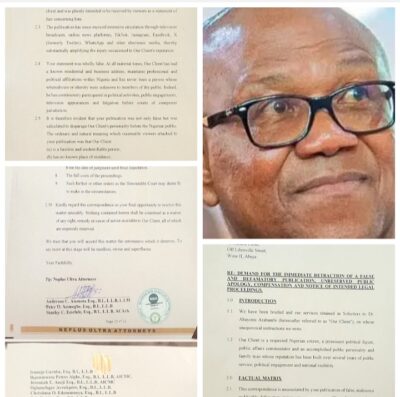
In the letter dated July 3, 2026 and released to Our Heritage Reporter online, Arabambi’s legal team accused Obi of making false and damaging statements during an interview on Nevon Media Podcast, claiming that Arabambi “does not have an address.”
The lawyers described the statement as malicious, defamatory and injurious to their client’s reputation, insisting that it portrayed him as a faceless individual lacking legitimacy and public standing.
They are demanding an immediate retraction, a public apology across multiple media platforms and newspapers, a written undertaking against further alleged defamatory remarks, and ₦50 billion in compensation, warning that court proceedings will commence if the demands are not met within seven days.
According to the document:
DR. ARABAMBI DEMAND LETTER TO PETER OBI
3rd July, 2026.
Mr. Peter Gregory Obi,
NDC National Secretariat,
4, Odonna Close,
Off Libreville Street, Wuse II,
Abuja.
RE: DEMAND FOR THE IMMEDIATE RETRACTION OF A FALSE AND DEFAMATORY PUBLICATION, UNRESERVED PUBLIC APOLOGY, COMPENSATION AND NOTICE OF INTENDED LEGAL PROCEEDINGS.
—
1.0 INTRODUCTION
1.1 We have been briefed and our services retained as Solicitors to Dr. Abayomi Arabambi (hereinafter referred to as “Our Client”), on whose unequivocal instructions we write.
1.2 Our Client is a respected Nigerian citizen, a prominent political figure, public affairs commentator and an accomplished public personality and family man whose reputation has been built over several years of public service, political engagement and national visibility.
—
2.0 FACTUAL MATRIX
2.1 This correspondence is necessitated by your publication of false, malicious and highly defamatory statements concerning our Client during a podcast interview granted by you on NEVON MEDIA PODCAST, which interview was thereafter extensively disseminated through electronic, print and social media platforms and consequently brought to the attention of millions of viewers within and outside the Federal Republic of Nigeria.
…ubijus ibi remedium
2.2 During the course of the said interview, you asserted, in substance and effect, that Our Client “does not have an address.” That statement was made in the course of commenting on legal proceedings not involving our client and was plainly intended to be received by viewers as a statement of fact concerning him.
2.3 The publication has since enjoyed extensive circulation through television broadcasts, online news platforms, TikTok, Instagram, Facebook, X (formerly Twitter), WhatsApp and other electronic media, thereby substantially amplifying the injury occasioned to Our Client’s reputation.
2.4 Your statement was wholly false. At all material times, Our Client has had a known residential and business address, maintains professional and political affiliations within Nigeria and has never been a person whose whereabouts or identity were unknown to members of the public. Indeed, he has continuously participated in political activities, public engagements, television appearances and litigation before courts of competent jurisdiction.
2.5 It is therefore evident that your publication was not only false but was calculated to disparage Our Client’s personality before the Nigerian public. The ordinary and natural meaning which reasonable viewers attached to your publication was that Our Client:
(a) is a faceless and unidentifiable person;
(b) has no known place of residence;
(c) lacks any legitimate standing in public life;
(d) is a person of doubtful identity;
(e) is unworthy of public confidence; and
(f) is undeserving of the esteem, confidence and respect hitherto enjoyed by him.
2.6 The law is settled beyond controversy that every citizen is entitled to the protection of his reputation, which the law regards as an invaluable asset. Reputation is a species of property which the law zealously protects against unlawful invasion.
2.7 It is equally settled that where a person publishes words which tend to lower another in the estimation of right-thinking members of society, expose him to hatred, ridicule, opprobrium or contempt, or cause him to be shunned or avoided by reasonable members of the public, such publication is actionable in defamation. The publication complained of in the instant case satisfies every known ingredient of actionable libel.
2.8 First, there can be no dispute whatsoever that the publication referred specifically and unmistakably to Our Client.
2.9 Secondly, the publication was made during a globally watched podcast and was consequently communicated to millions of viewers across Nigeria and beyond. The subsequent dissemination of the interview through numerous electronic and social media platforms substantially increased the scope of the publication and aggravated the injury occasioned to Our Client’s reputation.
2.10 Thirdly, the words complained of are plainly capable of bearing defamatory meanings. Although you may seek to contend that your words were innocuous or incapable of defaming Our Client, the law is firmly settled that the test is not what the maker of the statement intended, but the meaning which ordinary, reasonable and right-thinking members of society would naturally attribute to the words in the context in which they were published. It is that ordinary meaning that the Court is enjoined to ascertain. In the prevailing circumstances of this case, the clear impression
2.11 Indeed, the immediate public reaction following your publication leaves no room for speculation. Persons who watched or subsequently viewed the interview expressly attributed to you the assertion that Our Client was “without address” and proceeded to ridicule, insult and malign him across several digital platforms.
2.12 The electronic evidence already in Our Client’s possession demonstrates beyond argument that your publication was understood by recipients to mean that Our Client was a faceless individual lacking credibility and public legitimacy. Those publications are not accidental. Neither are they remote. They constitute the natural, probable and foreseeable consequences of your original publication.
2.13 The law equally recognizes that where a defamatory publication is made in circumstances in which its republication is the natural and probable consequence of the original publication, liability extends to such foreseeable republication. Consequently, every injury flowing naturally from your publication shall be relied upon by Our Client in proof of damages.
2.14 Furthermore, the circumstances surrounding your publication disclose express and implied malice. Your statement was not made in error. Neither was it made innocently. It was made deliberately during a widely viewed political interview with full appreciation of the influence your words would carry among millions of Nigerians.
2.15 As an experienced public office holder and presidential candidate, you knew, or ought reasonably to have known, that a statement of such gravity concerning a fellow public figure would inevitably be repeated, amplified
2.16 The Courts have consistently held that where defamatory words are published recklessly, maliciously or with utter disregard for the reputation of another, the publisher becomes liable not merely for compensatory damages but also for aggravated and, where appropriate, exemplary damages.
2.17 Our Client has instructed us to state that he has no desire whatsoever to embark upon needless litigation. Nevertheless, he cannot, consistent with the protection which the law affords to personal reputation, permit so grave an attack upon his integrity and standing to remain unanswered.
2.18 Accordingly, unless this matter is resolved immediately by way of an unequivocal retraction, a public apology and adequate compensation, Our Client shall invoke the jurisdiction of the appropriate High Court to vindicate his reputation and obtain the full measure of reliefs available under the relevant laws.
—
THE DEFAMATORY CHARACTER OF YOUR PUBLICATION AND ITS LEGAL CONSEQUENCES
2.19 The law accords an exalted status to the reputation of every citizen. It recognizes that reputation is among the most valuable assets possessed by any individual and, once unjustifiably assailed, the law will intervene to afford appropriate redress.
2.20 It is settled beyond controversy that words are defamatory where, in their natural and ordinary meaning, or by way of innuendo, they tend to lower a person in the estimation of right-thinking members of society, expose him to hatred, ridicule or contempt, cause him to be shunned or avoided, or diminish his reputation, honour or standing in the eyes of reasonable members of the public.
2.21 The publication complained of satisfies each of these legal requirements. There is no ambiguity whatsoever that your statement referred to Our Client. Equally beyond dispute is the fact that the publication was made during a nationally televised interview and thereafter received extensive circulation through conventional and digital media, thereby reaching millions of viewers within and outside the Federal Republic of Nigeria. The defamatory character of your publication is not determined merely by the literal meaning of the words employed. The applicable test is the impression which the publication, viewed as a whole and in its proper context, would convey to an ordinary, reasonable and fair-minded member of society.
2.22 In the context in which your statement was made, the unmistakable impression conveyed to the viewing public was that Our Client was a person who lacked an identifiable residence, traceable identity, legitimacy or standing and was therefore undeserving of public confidence and respect.
2.23 That this was the meaning attributed to your publication by ordinary members of the public is demonstrated by the immediate and widespread reactions which followed the podcast. Numerous persons, relying directly upon your statement, proceeded to ridicule, abuse and disparage Our Client on various social media platforms. Electronic evidence presently in Our
2.24 These reactions are neither speculative nor remote. They constitute compelling evidence of the sense in which the publication was understood by its recipients and are material to the issue of whether the words complained of were capable of bearing a defamatory meaning.
2.25 Furthermore, it is a settled principle of law that a publisher is answerable not only for the immediate publication but also for such republication as is the natural and probable consequence of the original publication. Having elected to make the impugned statement on a global platform, it was plainly foreseeable that the publication would be reproduced, circulated and discussed across numerous media platforms, thereby amplifying the injury occasioned to Our Client’s reputation.
2.26 Your liability is further aggravated by the circumstances under which the publication was made. The statement was uttered during a public interview touching upon matters of political significance. You were undoubtedly aware of the influence which your words command and the likelihood that they would be accepted and repeated by a substantial segment of the Nigerian public. A person occupying your position in national affairs bears a corresponding duty to ensure that statements concerning the reputation of others are fair, accurate and responsible.
2.27 Instead, you made a statement which, on its face and in its context, conveyed a false and injurious imputation concerning Our Client. The
2.28 Our Client has suffered considerable embarrassment, humiliation and injury to his reputation. The defamatory publication has impaired his standing in political and social circles, exposed him to unwarranted public ridicule and subjected him to needless attacks upon his integrity and personality.
2.29 The gravity of the publication, its nationwide dissemination, the status of the parties involved, the extent of its republication and the continuing refusal to retract the statement are all matters which a court of competent jurisdiction is entitled to take into account in assessing both compensatory and aggravated damages.
2.30 Our Client would have preferred that this unfortunate episode be resolved without recourse to litigation. However, the protection of one’s reputation is a right recognised by law and cannot be surrendered in the face of a false and damaging publication. Unless immediate and satisfactory steps are taken to repair the injury caused by your publication, Our Client is fully prepared to seek judicial intervention to vindicate his reputation and recover appropriate reliefs.
—
OUR CLIENT’S DEMANDS, NOTICE TO PRESERVE EVIDENCE AND NOTICE OF INTENDED LEGAL PROCEEDINGS
2.31 In view of the foregoing, and without prejudice to any other rights and remedies available to Our Client under the Constitution and the laws of the Federal Republic of Nigeria, Our Client hereby demands that you, within Seven (7) days from the date of your receipt of this letter, comply fully with the following demands:
(I) RETRACTION
2.32 That you issue a clear, unequivocal and unconditional retraction of the defamatory statement complained of on NEVON MEDIA PODCAST, or on any other national television platform of equivalent prominence and audience reach, acknowledging that the publication concerning Our Client was false, unjustified and ought never to have been made.
(II) PUBLIC APOLOGY
2.33 That you tender a full, unconditional and unreserved public apology to Our Client. The apology shall:
(a) be broadcast on national television and NEVON MEDIA PODCAST during a programme of comparable prominence to that in which the defamatory publication was made;
(b) remain published for a reasonable duration on each of your verified social media platforms, including X (formerly Twitter), Facebook, Instagram and any other platform through which you communicate with the public; and
(c) be published, at your expense, in full-page format in the following national newspapers: the Punch; Vanguard; The Guardian; THISDAY; and the Nation.
The wording of the apology shall first be submitted to Our Chambers for approval before publication.
(III) COMPENSATION
2.34 That you pay to Our Client the sum of ₦50,000,000,000.00 (Fifty Billion Naira) as compensation for the grave injury occasioned to his reputation, dignity, integrity, political standing and public image by your defamatory publication. The said sum represents only a portion of the damages recoverable in law and is demanded in an effort to afford an amicable resolution of this dispute without recourse to litigation.
(IV) UNDERTAKING
2.35 That you execute and deliver to Our Chambers a written undertaking that you shall desist from making, publishing or causing to be published any further defamatory statement concerning Our Client, whether directly or indirectly.
(V) PRESERVATION OF EVIDENCE
2.36 TAKE FURTHER NOTICE that you are under a legal obligation to preserve every material relating to the publication complained of. Accordingly, you are hereby required to preserve, without alteration, deletion, destruction or modification: the complete and unedited video recording of the interview; every audio recording thereof; transcripts; notes prepared before or during the interview; correspondence relating to the interview; electronic communications concerning the publication; digital metadata; social media posts and publications made by or on your behalf concerning the interview; and every other electronically stored information relating to the publication.
2.37 Kindly note that any destruction, concealment or alteration of relevant evidence after receipt of this correspondence shall be specifically brought to the attention of the Court as evidence from which adverse inferences may be invited where appropriate.
(VI) NOTICE OF INTENDED PROCEEDINGS
2.38 Should you fail, refuse or neglect to comply fully with the foregoing demands within Seven (7) days, Our Client’s instructions are unequivocal. We shall, without any further reference to you, commence proceedings before a court of competent jurisdiction seeking, amongst other reliefs:
1. A declaration that your publication is false and defamatory.
2. General damages for libel.
3. Aggravated damages.
4. Exemplary damages.
5. A perpetual injunction restraining you, your servants, agents, privies or assigns from further publishing or causing to be published the defamatory words or any words of similar import concerning Our Client.
6. An order directing you to publish a retraction and an unqualified apology in such manner as the Court may direct.
7. Interest on all monetary awards at the prevailing commercial rate from the date of judgment until final liquidation.
8. The full costs of the proceedings.
9. Such further or other orders as the Honourable Court may deem fit to make in the circumstances.
2.39 Kindly regard this correspondence as your final opportunity to resolve this matter amicably. Nothing contained herein shall be construed as a waiver of any right, remedy or cause of action available to Our Client, all of which are expressly reserved.
We trust that you will accord this matter the seriousness which it deserves. To say more at this stage will be needless, otiose and superfluous.
—
Yours Faithfully,
Pp: Neplus Ultra Attorneys
Anderson U. Asemota Esq., B.L., L.L.B, L.L.M
Peter O. Asimegbe, Esq., B.L., L.L.B, ACArb.
Stanley C. Eziefulle, Esq., B.L., L.L.B, ACArb.