INEC Introduces Automated Verification System As EU, Spain, Denmark Issue Warning On Nigeria’s 2027 Elections
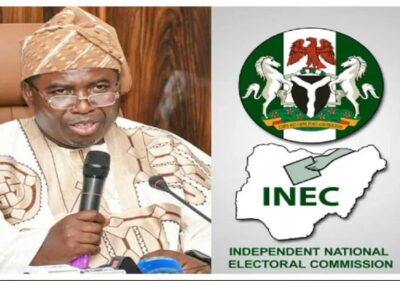 INEC Introduces Automated Verification System As EU, Spain, Denmark Issue Warning On Nigeria’s 2027 Elections
The commission also said it was engaging the National Orientation Agency, civil society organisations and fact-checking organisations as part of efforts to strengthen electoral information management and public confidence.
The Independent National Electoral Commission (INEC) has disclosed that it has established an automated verification system to tackle misinformation and protect the credibility of elections ahead of Nigeria’s 2027 general elections.
The commission also said it was engaging the National Orientation Agency, civil society organisations and fact-checking organisations as part of efforts to strengthen electoral information management and public confidence.
The Chief Press Secretary to the INEC Chairman, Mr Dayo Oketola, who represented the Commission’s Chairman, Prof. Joash Ojo Amupitan, disclosed this during a two-day International Multi-Stakeholder Forum on Disinformation in Electoral Contexts in West Africa held in Abuja.
The forum was convened by Fundación para la Internacionalización de las Administraciones Públicas (FIAP) in collaboration with FactCheckAfrica, the implementing organisation for the programme in Nigeria under the European Union Support to ECOWAS in Peace, Security and Governance (EPSG) Project.
The November 24–25 forum, held at Lake Greenfield Hotel, Kado, Abuja, brought together fact-checkers, journalists, civil society organisations, electoral stakeholders, technology experts and youth representatives from Nigeria, The Gambia and Benin Republic to examine emerging threats to electoral information integrity and develop coordinated regional responses ahead of upcoming elections.
Through the programme, FactCheckAfrica has been working with Banouto in Benin and Gambia Participate in The Gambia to strengthen electoral information integrity, counter disinformation and improve citizens’ access to accurate electoral information.
The forum served as the strategic culmination of these interventions, providing a platform for regional stakeholders to exchange experiences, showcase programme outcomes, launch the Elect Peace regional platform and develop a unified Regional Action Plan on Electoral Disinformation.
The discussions came amid concerns over the spread of coordinated disinformation narratives, platform-driven manipulation and artificial intelligence-generated content, which increasingly challenges existing detection capabilities.
Diplomatic representatives from the European Union, Spain and Denmark called for stronger regional cooperation to address electoral misinformation, warning that its consequences extend beyond national borders and require coordinated responses from governments, media organisations, civil society and other stakeholders.
Speaking at the forum, Mr Massimo De Luca, Head of Cooperation at the European Union Delegation to Nigeria and ECOWAS, highlighted the direct and indirect effects of electoral misinformation.
He noted that its impact could extend to Nigerians living in the diaspora, who may also be influenced by misleading narratives about electoral processes and outcomes.
De Luca stressed the responsibility of government and the media to work towards curbing the spread of misinformation.
The Ambassador of Spain to Nigeria, Mr Félix Costales, underscored the importance of fact-checking in protecting electoral integrity.
While acknowledging the role of government in promoting a safer social media environment, he cautioned against measures that could undermine media freedom and legitimate public discourse.
“The fight against misinformation should not be a weapon against legitimate debates,” Costales said.
The Deputy Head of Mission at the Embassy of Denmark, Mrs Julie Rosenkilde Hannibal, welcomed the participation of young people from Nigeria, The Gambia and Benin, recognising their contribution to regional efforts to counter misinformation.
She reaffirmed Denmark’s support for the EPSG Project and emphasised the importance of locally led approaches to regional challenges.
“Denmark is very proud to be part of the EPSG. We believe in regional solutions to regional challenges. Peace, security, and good governance in West Africa are best strengthened by you, the West Africans, with us proudly standing beside you,” she said.
Hannibal also welcomed the opportunity for participants to showcase campaigns, impact stories, spoken-word performances and digital content developed through their work. She further highlighted the launch of the Elect Peace platform as an important feature of the forum.
Earlier, Founder of FactCheckAfrica, Abideen Olasupo, drew attention to the exploitation of indigenous languages to manipulate public understanding and spread misleading electoral narratives.
He described this form of manipulation as “hyper-local manipulation”, explaining that disinformation actors increasingly exploit local languages and community information networks to reach audiences that may be underserved by conventional fact-checking interventions.
Olasupo highlighted FactCheckAfrica’s work across West Africa to strengthen local-language information integrity and improve citizens’ access to accurate electoral information.
Delivering the keynote address titled “Beyond Fact-Checking: Building Systemic Media and Information Literacy Infrastructures Across West Africa”, Dr Sharon Omotoso, Director of the International Media and Information Literacy Institute (IMILI), highlighted the personal and societal consequences of misinformation, drawing from her experience of being misrepresented in an online publication.
Omotoso explained that the effects of misinformation vary across individuals and can be particularly damaging to women, who may face coordinated gendered disinformation intended to undermine their public credibility and discourage political participation.
She discussed how such attacks can contribute to what she described as the politics of retention or succession, where women are pressured to abandon political ambitions and make way for men.
The scholar also emphasised the need to expand fact-checking capacity across the region and encouraged media organisations to exercise greater care when publishing information about individuals.
She highlighted the importance of verifying names and other identifying details to prevent misattribution and avoidable reputational harm.
Omotoso further raised concerns about the potential politicisation of fact-checking, stressing the importance of editorial independence and the need for media organisations to avoid becoming instruments of political interests.
The forum also featured discussions on AI-generated and synthetic media, verification of misinformation in local languages, technology platform accountability, and the safety of journalists, fact-checkers, women and other civic actors in high-risk electoral environments.
Participants examined the responsibilities of technology platforms and regulatory institutions in addressing disinformation while protecting legitimate expression and civic participation.
A major highlight of the forum was the official live launch of Elect Peace (electpeace.org) by Dataphyte Foundation, a dedicated digital hub connecting civil society organisations, fact-checkers, training resources and open-source verification toolkits across West Africa.
The forum also featured presentations and panel discussions examining lessons from electoral information integrity interventions implemented in Nigeria, The Gambia and Benin in 2026.
Representatives of FactCheckAfrica, Banouto and Gambia Participate shared experiences from their respective countries, highlighting the role of fact-checking, artificial intelligence, media literacy and community engagement in responding to emerging disinformation trends.
A plenary panel on frontline lessons brought together Mustapha Lawal of FactCheckAfrica, Olivier Ribouis of Banouto and Marr Nyang of Gambia Participate to discuss programme implementation, the application of artificial intelligence and regional patterns of electoral disinformation.