Rewriting the Passport Story: How Tunji-Ojo Turned a National Embarrassment into a Reform Showcase
Rewriting the Passport Story: How Tunji-Ojo Turned a National Embarrassment into a Reform Showcase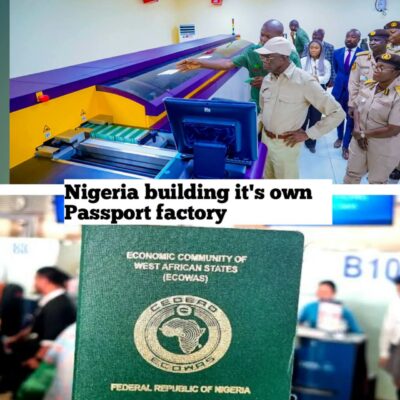
Triangle News International…

For most of the last two decades, getting a Nigerian passport was less an administrative process than an endurance test. Applicants queued at dawn outside immigration offices, paid touts to jump lines, and waited months for a booklet that was often “not available.” For Nigerians abroad, the ordeal was worse: a renewal could mean a long journey to a consulate, a stack of fees, and a wait of more than six months.
That was the system Dr Olubunmi Tunji-Ojo inherited when he became Minister of Interior in August 2023. Three years on, the passport has become one of the clearest examples of what the Renewed Hope Agenda of President Bola Ahmed Tinubu looks like when it reaches the ordinary citizen. The queues have thinned, the backlogs are gone, and the conversation has shifted from scarcity to speed.
The change did not come from a single announcement. It came from a sequence of practical decisions, each one aimed at a specific point of pain, carried out by a minister who describes good service not as a favour but as a right. “What we’ve done is to institutionalise excellence,” he said at one inspection. “This is not a favour; it is the right of every Nigerian to be served efficiently.”
The centrepiece is a building at the headquarters of the Nigeria Immigration Service in Abuja. In September 2025, the minister inspected the newly completed Centralised Passport Personalisation Centre, the first facility of its kind since the Service was founded in 1963. For 62 years, Nigerian passports had been personalised at scattered centres at home and abroad, each with its own machines, its own delays and its own opportunities for abuse.
The numbers explain why that mattered. Under the old arrangement, the machines could produce only 250 to 300 passports a day. The new centre was built to deliver around 5,000 a day, and by May 2026 the minister told the International Civil Service Conference in Abuja that the system could handle up to 10,000 passports an hour under one central point of control. Booklet printing and security personalisation now happen in one secure hub, while application and collection continue at offices across Nigeria and at foreign missions.
Just as notable is how it was paid for. The minister credited the technical partner, Iris Smart Technologies, with delivering the project without a direct draw from public funds. At the same time, the two passport series that had run side by side for years were merged into a single regime, ending a source of confusion for applicants and officers alike. “This centre puts an end to the era of backlogs and delays,” Tunji-Ojo said.
Long before the new centre opened, the minister had already signalled his method. Within weeks of taking office in 2023, more than 200,000 pending passport applications were cleared, a backlog that had become a national joke. He followed it with a promise of two week delivery, then pushed the target down to one week as automation took hold. Since the start of the Tinubu administration, the ministry says it has produced more than 3.6 million passports.
The reform that has won the most affection, however, is the one that reached Nigerians abroad. The contactless passport renewal system, launched in October 2024, lets citizens in the diaspora renew their passports online with biometric verification, without the long journey to a consulate. It began in Canada, extended to Europe in February 2025, and has since been rolled out further across the world.
The response has been striking. Nigerians in the United Kingdom told reporters this year that processing times had fallen from more than six months to between five days and two weeks. One community leader said members had received their passports within five days after completing everything from home, and credited the transformation directly to the minister. The Nigerians in Diaspora Commission, led by Abike Dabiri-Erewa, also praised the ministry, saying Nigerians abroad had long waited for exactly these changes.
The minister has been careful to frame the shift as modernisation with safeguards. His message, repeated at every stage, is that technology is changing the narrative without compromising national security.
With production centralised and delivery times collapsing, attention is turning to the next frontier: making the passport booklet itself in Nigeria. It is an old ambition. Previous administrations announced plans to domesticate production as far back as 2017 and 2018, but those efforts stalled amid debts to foreign suppliers, foreign exchange shortages and questions about local capacity. For years, Nigeria paid partners abroad to supply booklets it could not always afford, and citizens paid the price in scarcity.
The difference now is that the foundation exists. A central, secure personalisation hub in Abuja, a unified passport series and a fully digital application chain are exactly the infrastructure that local booklet manufacturing would plug into. The economic case is easy to state: fewer imports, less pressure on foreign exchange, skilled jobs in security printing and technology, and a facility that could in time serve other African countries that still depend on suppliers outside the continent.
If the ministry delivers on that ambition, it will close a chapter that has frustrated three administrations. Given what has been achieved since 2023, it is no longer an unreasonable expectation.
The passport story sits inside a wider pattern at the Ministry of Interior. The minister has backed the Single Travel Emergency Passport, announced at the launch of the ECOWAS Biometric ID Card in Abuja, to help Nigerians stranded abroad get home with dignity. He has opened a joint committee with the Nigeria Employers’ Consultative Association on expatriate quotas, business permits and border policy, arguing that efficient public services make a country more attractive for investment, tourism and business.
Tunji-Ojo, often described as a techpreneur in government, has consistently tied these results to the Renewed Hope Agenda of President Tinubu, and has been generous in crediting the Permanent Secretary, the Comptroller General of Immigration, officers of the Service and technical partners. That habit of sharing credit is part of why the reforms have stuck. They have been built into institutions rather than hung on one personality.
There is still work ahead. Diaspora Nigerians have asked that the digital system be applied uniformly everywhere, and the promise of local booklet production must now be matched with clear timelines. But the direction is unmistakable. A document that once symbolised everything wrong with public service in Nigeria is fast becoming proof that things can work. As the minister put it, every Nigerian, at home or abroad, deserves government services that are modern and humane. On the evidence of the last three years, that is no longer a slogan. It is a standard.