
You Don’t Have to Become Your Father, But You Must Understand His Legacy – A Lesson for Jimmy Odukoya
You Don’t Have to Become Your Father, But You Must Understand His Legacy – A Lesson for Jimmy Odukoya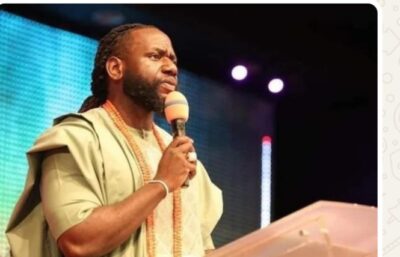
BROTHER JIMMY LEFT A VACUUM THAT REBELLION HAS NOW OCCUPIED!
One thing I find interesting about the situation surrounding Pastor Jimmy Odukoya is how little attention was given to the culture and history of the institution he inherited.
Let us be honest: Pastor Jimmy did not inherit an ordinary organisation. He inherited a church with an established identity, a history, a culture and a membership whose expectations had been shaped over several decades.
His father, Pastor Taiwo Odukoya, built the church in an era when conservative Christian values, holiness, modesty and godly appearance were strongly emphasised. That culture became part of the church’s identity.
For years, members knew one kind of pastor. A quiet, simple, conservative and modestly dressed man of God. That image was not formed in one day. It was built over almost thirty years of spiritual leadership.
Then came Brother Jimmy.
Before his entry into the entertainment industry, he was already part of that conservative church culture. But acting and public entertainment introduced another dimension to his personality and public image.
When he eventually assumed leadership, I think he underestimated one very important thing: You cannot inherit an institution and assume that everybody is automatically ready to embrace your personal preferences.
There is a difference between taking over leadership and successfully transitioning an institution.
I would have expected him to study the culture of the church, understand the emotional attachment members had to his father’s leadership style and approach the transition with greater sensitivity.
He did not necessarily have to become his father. Nobody expected him to be Pastor Taiwo Odukoya. But he needed to understand that the people he was called to lead had spent decades identifying with a particular culture.
You don’t throw away thirty years of institutional identity in one afternoon and expect everybody to clap.
The issue of his appearance, hairstyle and jewellery may appear insignificant to some people, but in a church where conservative values have been deeply cultivated, these things can carry meanings beyond personal fashion.
And then there is the additional dimension of his marriage and his wife’s public appearance. Whether we agree with the members’ expectations or not, it was important to understand the kind of congregation he was dealing with.
Sometimes, what you consider a harmless personal expression may be interpreted by the people you lead as a departure from everything they have been taught to uphold.
I am not saying that long hair is a sin. I am not saying earrings or jewellery are automatically wrong. I am certainly not suggesting that a person’s spirituality should be measured by appearance.
My point is simple: Leadership is not an opportunity to impose your personal preferences on people without considering the environment you have inherited.
The Bible says in 1 Corinthians 6:12:
“All things are lawful unto me, but all things are not expedient…”
That scripture should mean something to everyone who occupies a position of leadership.
Paul understood that there were things he could legitimately do but would willingly surrender for the greater purpose of the Gospel.
That is maturity!
I honestly think Brother Jimmy should have taken a more gradual approach. He could have maintained a more familiar appearance in the early years, made some adjustments to his dressing and presentation, and gradually introduced his own identity as the congregation became comfortable with his leadership.
He needed to win confidence before testing the limits of acceptance.
One mistake leaders make is assuming that because people respect them, they must automatically agree with everything they do. That is not true. Sometimes people keep quiet because of respect, not because they are comfortable.
And when the accumulated dissatisfaction eventually finds an expression, everybody becomes surprised.
The real wisdom of leadership is knowing what to change, when to change it and how to change it without losing the people you are leading.
Even at this stage, I believe there is room for reflection and reconciliation. He can still reconsider some of the decisions and public expressions that have created unnecessary tension.
There is no shame in adjusting your approach. There is no weakness in listening. And there is certainly no loss of identity in exercising restraint.
You don’t have to prove your independence by rejecting everything that existed before you.
Sometimes, the smartest thing a successor can do is preserve what works, understand what the people value and introduce change with wisdom.
My concern is that Brother Jimmy may have mistaken the freedom to express himself for the wisdom required to lead a people with a deeply established conservative identity.
You can be right in your personal convictions and still be wrong in your leadership approach.
Let me end with this African wisdom:
A fowl that wants to enter a house must learn to bend its head. It is not because the fowl is short; it is because the doorway is not tall enough for its pride!
The problem is not that you want to enter the house. The problem is refusing to bend when the situation demands it.
Leadership is not about how much of yourself you can impose on the people. It is about how much wisdom you can demonstrate in carrying them along.
That, in my opinion, is a lesson worth learning from the Jimmy Odukoya leadership situation.