
Meet Busari, coach behind Flamingos’ historic World Cup triumph
Meet Busari, coach behind Flamingos’ historic World Cup triumph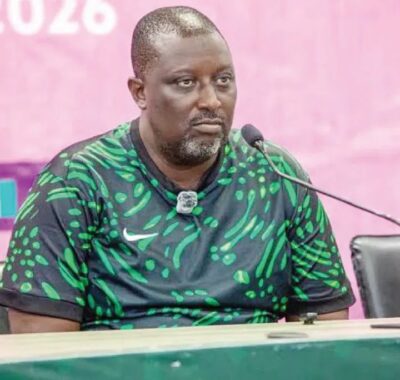
Akeem Ishola Busari has made history in Nigerian football after leading the country’s U-17 women’s national team, the Flamingos, to their first-ever FIFA U-17 Women’s World Cup title, just seven months after his appointment.

Busari guided the Nigerian youngsters to a 2-1 victory over Japan in the final of the 2026 FIFA U-17 Women’s World Cup in Morocco on Saturday, November 7, 2026, making Nigeria the first African country to win the competition.
Flamingos after World Cup triumph against Japan
The achievement came seven months and five days after the Nigeria Football Federation appointed him to lead the team on April 2, 2026.
According to the NFF’s announcement published on its official website on April 2, 2026, the federation’s Executive Committee approved a recommendation by its Technical and Development Committee for Busari’s appointment as Flamingos head coach.
He replaced Bankole Olowookere, who had spent several years with the team and led Nigeria to a bronze medal at the 2022 FIFA U-17 Women’s World Cup in India.
At the time of his appointment, Busari was the head coach of Pacesetter Queens Football Club of Ibadan, a position that the NFF highlighted in its announcement.
His immediate responsibility was to guide the Flamingos through the qualifying campaign for the 2026 World Cup, which was scheduled to be hosted by Morocco.
The NFF said the team was waiting to face the winner of the preliminary qualifying encounter between Niger Republic and Guinea, with the first leg scheduled to take place away from home in the third week of May 2026.
Meanwhile, a report by Blueprint, published on November 6, 2026, titled “NIS DG to Flamingos coach Busari: Bring U17 Women’s World Cup home,’ quoted the National Institute for Sports (NIS) Director-General, Philip Shaibu, as saying that Busari obtained his initial coaching qualification from the institute in Lagos in 1999.
According to Shaibu, Busari returned to the institute for its Higher Programmes between 2003 and 2006, with his final coaching certificates issued in October 2006.
The details provide insight into the coach’s professional training, which began more than two decades before he led the Flamingos to their historic FIFA U-17 Women’s World Cup triumph.
From Pacesetter Queens to the national assignment
Barely eight days after his appointment, Busari began putting together his squad for the qualifying campaign.
In an NFF report published on April 10, 2026, titled ‘Morocco 2026: Busari invites 36 to Flamingos’ camp ahead of second round fixture,’ the NFF announced that the new coach had invited 36 players to the national team’s camp.
The squad comprised five goalkeepers, 10 defenders, 13 midfielders and eight forwards.
Among the invited players were Fidel Pepple and Aminat Abiodun of Pacesetter Queens, his former club, while other players were drawn from clubs across the Nigeria Women Football League and academies.
Make PUNCH part of your everyday experience.
Add us to your Preferred Sources
The NFF also announced on April 10 that the federation’s Executive Committee had endorsed the appointment of Jegede-Idakwo and Omodiaghe as assistants to Busari.
The appointments formed part of the technical team that would work with him to secure Nigeria’s qualification for the global tournament.
Qualification secured in July
Busari’s first major assignment was to take Nigeria through the African qualifying series, and he delivered.
According to the NFF’s report published on July 11, 2026, titled Nigeria qualify for 2026 FIFA U17 Women’s World Cup finals, the Flamingos defeated the Amazons of Benin Republic 5-3 in Lomé to secure their place at the tournament.
Nigeria had won the first leg 3-2 in Ikenne, Ogun State, before completing a 8-5 aggregate victory in the return fixture.
Mary Dustan opened the scoring in the sixth minute in Lomé, while Esther Stephen and Queen Joseph also found the net. Joseph scored her second goal in the 76th minute to seal the 5-3 victory.
The result secured Nigeria’s ticket to Morocco and gave Busari his first major achievement as head coach of the Flamingos.
Preparing for the world stage
With qualification secured, the coach began preparations for the tournament.
On August 28, 2026, the NFF announced that Busari had invited 26 players for the first phase of the team’s final camping programme in Abuja.
The players were directed to report to Serob Legacy Hotel, Wuye, Abuja, on August 30.
The NFF subsequently published Busari’s final 21-player squad on October 6, 2026, ahead of the competition.
The selected players included captain Harmony Chidi, defenders Elizabeth Adesuyi and Esther Stephen, midfielders Mary Dustan and Favour Nkwocha, and forwards Tosin Rafiu, Queen Joseph, Precious Oscar and Oluwakemi Adegbuyi.
The team departed Nigeria for Morocco on October 7, ahead of the tournament, which began on October 17.
A difficult start, a historic finish
The Flamingos did not have the perfect start to their campaign, losing 2-1 to Poland in their opening group match on October 17. vl
However, they recovered with a 2-0 victory over Puerto Rico before defeating defending champions North Korea 3-1 on October 23 to advance to the knockout stage.
Nigeria subsequently defeated Mexico 2-1 in the Round of 16, edged Venezuela 1-0 in the quarter-finals and beat Brazil 3-1 in the semi-finals to book their place in the final.
The victory over Brazil made Nigeria the first African country to reach the final of the FIFA U-17 Women’s World Cup.
In its report ahead of the final, the NFF highlighted Busari’s tactical adjustments and his willingness to change personnel, particularly the decision to give Awawu Bashiru a starting opportunity against Brazil after she had largely featured as a substitute.
Bashiru responded with two goals to help Nigeria defeat the South Americans.
Japan conquered as Nigeria makes history
The biggest moment of Busari’s seven-month journey came on November 7, when Nigeria faced Japan in the final at the Mohammed VI Football Complex in Rabat.
According to FIFA’s match report published on November 7, 2026, Nigeria took the lead in the 39th minute through Bashiru, whose effort from distance slipped past Japanese goalkeeper Kou Kadowaki.
Oluebube Umejiaku doubled the advantage in the 47th minute after receiving a pass from Esther Stephen before lifting the ball over the advancing goalkeeper.
Japan reduced the deficit through Fuki Ito in the 80th minute, but the Flamingos held on to secure a historic 2-1 victory.
FIFA named Umejiaku Player of the tournament, while its report described Nigeria’s triumph as the country’s maiden title in the competition and the first for an African nation.
In an interview published by FIFA on November 7, Busari praised the progress of African youth football following the victory.
“This is a turnaround for Africa,” he said.
“In terms of youth-age football, it’s improving and here we could really come and compete. Being a champion is going to go a long way to really motivate us, and we are sending a signal, a message to the world that Africa is really coming.”
The Confederation of African Football also celebrated the achievement in a report published on November 7, describing Nigeria’s triumph as a historic moment for the continent.
For Busari, the victory represented an extraordinary achievement in his first seven months as head coach of the Flamingos.
From his appointment on April 2 to the final on November 7, the coach spent approximately seven months and five days in charge before delivering Nigeria’s first FIFA U-17 Women’s World Cup title.
He also took the team beyond the bronze-medal achievement recorded under his predecessor, Olowookere, in 2022, to the summit of the global competition.
