
Final-year project h£ll: Graduates expose lecturers’ money, s£x demands
Final-year project hell: Graduates expose lecturers’ money, sex demands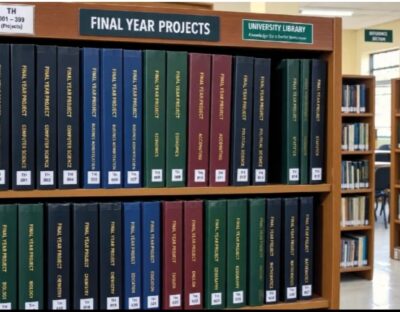
In this report, BIODUN BUSARI examines the harrowing experiences of final-year students haunted by the lecturers supervising their research projects as part of the requirements to graduate.
Segun Adesegun, a graduate of Mass Communication, stared blankly into the air, forcing a brief melancholic smile.
His recollection of the concluding moments of his university life made him wince, hiss, and repeatedly shake his head, like someone who is still nursing an unseen pain.
When Adesegun gained admission into a private university in Ogun State in 2016, little did he know that his two-year course would extend into four academic sessions.
He had completed his Higher National Diploma at a federal polytechnic, but the longing to have a Bachelor of Science fuelled his dream to attend university.
Nothing prepared him for the trauma, frustration and despair he experienced due to the alleged antics of his project supervisor.
“I went to school with trauma every day. Happiness became strange, and it was like dying slowly. My future hung between real living and mere existence, because my supervisor was not just a thorn in my flesh, but also posed a threat to my graduation.
“I had to submit four topics at different times. My supervisor would adjust and still reject them, succeeding in raising my hopes and dashing them at will. The experience was not palatable because I spent money and battled psychological problems. In this era of digital publication and instant technology, he would insist that I print every correction, as many times as he wanted to correct them,” Adesegun told Sunday PUNCH.
After weeks of struggling to get his topic approved, Adesegun faced another hurdle: writing the chapters of his project.
Unfortunately, whenever he completed a chapter, his supervisor would disappear for months. Adesegun and other students under the supervisor were required to print their work and submit hard copies for him to collect.
The graduate said he had also combined his studies with work, adding another layer of difficulty to an already challenging academic journey.
“I was told to submit my certificate, or I’ll lose my job. That was how I resolved to beg. My life was fizzling out before me as I couldn’t grasp anything.
“I lived in fear of the unknown, and uncertainties clouded my future. In my office, I had three months to present my BSc certificate, so it seemed like my life was crashing before me,” Adesegun narrated.
Wasted money, unavailable supervisor
Amid his frustration, Adesegun made some inquiries and found out that his supervisor was also undergoing his PhD programme, which made him unavailable many times to attend to his project.
This was when he involved his Head of Department to help beg him because he needed to submit his Bachelor’s degree certificate in his office.
Recounting his ordeal, the mass communication graduate said writing his final year research project was also unnecessarily cost-intensive, making his experience a miserable one.
“The lecturer would come whenever he liked, and after I might have concluded with chapter one, he would ask me to start all over. Even when I was done, I could not proceed with another chapter because he must approve my next line of action.
“After the administration of questionnaires, writing chapters four and five gulped a lot of money to do photocopies, printouts, and reprints because of unnecessary corrections,” Adesegun said.
After spending a fortune, Adesegun eventually bade the school goodbye in the COVID year.
“It was psychologically stressful, time-consuming, mentally draining, and financially wasteful. I had spent money being a private university student, but I had to tell him that my job was on the line before he could attend to my work in 2020,” he added.
‘I was victimised’
Although Lekan Yakub graduated nine years ago, the trauma he suffered during his final-year thesis, in a government-owned university in Osun State, still haunts him.
Corporately dressed and seated in a swivel chair in his furnished, air-conditioned office, he described what his project supervisor unleashed on him as outright “victimisation.”
“My undergraduate days were a beautiful experience until my final year when I started writing my project. It was victimisation in the hands of my supervisor,” Yakub said.
“As a linguistics student, I was the editor-in-chief of my class because we had to produce a magazine as a group project. It was a task we needed to do under a course called ‘Introduction to Print Media’. So, I was busy with the production of the magazine as I also had my project to handle.
“My HoD was my supervisor, and he knew that I was in charge of the group project. But he chose to frustrate me in the manner he handled my case.”
The linguist disclosed that his supervisor compelled him to print out the entire chapter of the project at any slight correction he made.
Yakub said, “I realised that at the point of submission, if I should go to my supervisor for the submission of chapter two, for instance, he would ask me to print out the whole chapter even if the correction was replacing ‘are’ with ‘were.’’”
“If a chapter had 15 pages, he would ask me to reprint everything because he corrected a word on a page. I could reprint a chapter many times on my supervisor’s order.
“I could reprint a chapter 10 times. It was so mentally frustrating and financially draining that the money I was getting from home was not enough again. I started running around to look for money so I wouldn’t fail. I was practically begging people for money.”
He told Sunday PUNCH that he didn’t defend his project until he submitted all the corrected papers as demanded by the HoD. Yakub said the papers filled up two empty cartons of noodles.
“He threatened not to approve my project for submission unless I brought all the papers to him. Thank goodness that I didn’t dispose of the corrected papers.
“So, when I was going for the submission, I had to buy two empty cartons of noodles to put the corrected papers in. I carried the two heavy cartons to my supervisor’s office. It was so degrading that my fellow students asked me if I was selling papers.
“I looked like a joke to them. There was nothing as traumatising as that incident. I felt humiliated. He was also our editorial advisor for the group project and standing in front of him every time often frightened me,” Yakub recalled.
Deliberate frustration
Yakub said he eavesdropped on a conversation between his HoD and an external examiner over his project, and he concluded the former deliberately hated him.
“That fateful day, all my course mates had travelled home, but I wanted to meet him at the magazine, so I went to his office. But I lingered at the door when I heard my name being mentioned.
“He was discussing me with an external examiner. The examiner asked him why he gave me a C in the project. He told him that I merited an A because he had read the work and I did well.
“To my utter bewilderment, my supervisor said he just wanted to teach me a lesson. The examiner pleaded with him, and he asked him to give me 69, which was a B,” he recounted.
Yakub said the conversation he overheard from the duo compounded his psychological defects at that period as he realised that his supervisor was frustrating him over an unknown vendetta.
“The project should have shot up my CGPA, but my supervisor chose to begrudge and torment me. I thanked God that an external examiner even made a case on my behalf,” he said.
“Although I felt demoralised in the end, I still got the highest grade among the eight of us whom he supervised. Everybody in the class and the department knew that I was hardworking, but he chose to frustrate my efforts.”
“I thought the war was over, but it was far from it, because the project submission concluded with a painful trip to Ibadan,” Yakub further stated.
Before he submitted his thesis, on the day of his defense, Yakub’s supervisor unravelled, baring what he described as hate.
“When it was my turn to go in, he left the panel as the HoD. So, I got in, and examiners asked me to sit. They asked me who my supervisor was, and I told them. They laughed after exchanging glances and continued with their tasks.
“He didn’t come in till I finished my defense. The project was a six-unit course, and my CGPA would have been fantastic if I got an A that I worked hard for, but I got a B because a lecturer hated me for no reason,” Yakub said, in a sad tone.
The last straw of the sad experience for the linguist was when his supervisor asked him to embark on a wasteful journey to Ibadan.
“As if that was enough, after the defense, I needed to submit the project to him in his office, but he asked me to bring it to his house in Ibadan. I quickly got my luggage and headed to Ibadan to submit my project.
“When I got to the city, I called him. You won’t believe what this old man told me. He said, ‘How could he allow me to bring my project to his house?’ He ordered me to take it back to school in Osun State.
“I look at my life in seconds, and to say that I was frustrated was an understatement. He intentionally made me waste money, time and effort. It was even risky. One could have lost one’s life,” Yakub said.
The experience was not totally different for Titilayo Babajide, a teacher who had a Bachelor of Education in English Language from a Lagos university, describing her final year project as “wastefulness.”
When Babajide began her thesis in 2019, she took five project topics to her supervisor, who chose a topic on tense errors for her. But her exhilaration ended halfway.
“After picking his desired topic from the five options I presented, I got to work. I wrote the first chapter, and he approved it. He did that after writing it three times. The frustration began when he asked me to discontinue the topic, when I was almost done with the second chapter,” Babajide said.
“He said he had another topic that I should do. The question I asked myself was, ‘Why a sudden change when he chose the first one himself?’ All the materials I gathered with money, time I invested, and effort put into it went down the drain. I counted it as a waste of resources.”
Babajide started all over, and the new topic made her go to five secondary schools to detect common grammatical errors from students writing essays.
She said, “I started all over. I wrote a new introduction and began chapter two. I was far behind the deadline and fear set in. I was not sleeping in the hostel, but always in school for my project. I still attended classes.
“When the money for going to a cyber cafe ran out”. became financially drained. My elder sister borrowed money from her church member to buy a laptop for me.
“The supervisor wouldn’t approve a chapter without making corrections that were no less than three times. He made them not at a single meeting, and the corrections were not mainly grammatical mistakes but contextual modifications.
“Along the line, I fell ill for two weeks. It was so frustrating that I was afraid of going to the hospital so that I wouldn’t be admitted. I went to a pharmacy and bought medicine as I managed to work on the research.”
In her ordeal, Babajide became traumatised when her mates started submitting their projects while she was stuck with chapter four.
“He would be absent and not helpful when he was present. I approached a lecturer at the Department of Statistics to guide me in the statistical analyses, which was chapter four. That was after I almost gave up and considered having an extra year. It was a period of psychological molestation for me, but I was resilient,” she concluded.
An educational psychologist and university counsellor at Summit University, Offa, Kwara State, Dr Mustapha Sanbe, said the allegations of victimisation are usually dicey issues in tertiary education.
“Some students come with a mindset to taunt lecturers, without prejudice to some supervisors who will cross all ethical boundaries.
“Truly, some demand money, gifts and canal experience, if a female student is involved. In summary, all of this plays out if there is a taker and there is a giver,” Sambe said.
He noted that victimised students have the advantage of reporting cruel dons.
“Don’t forget that so many professors have been stripped of their certifications and statuses because of crossing these ethical boundaries, making their conduct unethical,” Sambe added.
‘Terrified demands’
An entrepreneur, Roseline Obed, said her university’s final year project in 2014 was marked with disturbing moments when her supervisor made “terrifying demands.”
Obed attended a private university in Ibadan, Oyo State. She maintained a good GPA from the first semester and was pursuing graduation with at least a second-class upper division, but things were never the same after the supervisor demanded “sex and money.”
“My project was to examine the difficulty of communication in a rural area. I chose a village in Ibadan as a case study, but from the first chapter. My supervisor would find a fault in all I did,” the woman said.
“He would ask me to report at his office almost every day, sending me errands as he willed. I missed classes sometimes to schedule meetings in his office for briefings on my project.
“He was never pleased with my work, but other lecturers assessed it and said I did well.”
When she was at a crossroads, the lecturer told her to “do the needful.”
“I didn’t know what he meant by ‘do the needful’ until my coursemates told me. They said it was money or sex,” she stated.
Obed said it was at their following meeting that her supervisor asked to pay him.
“After telling me to pay him, I refused. I was physically and mentally tired that day. I had the money, but I believed it was not right. And, when I got to the door to turn the knob for my exit, I was stunned at his words, ‘we can be going out instead,’” she added.
Embracing 2.2 with pride
Obed revealed that she never wanted to have a formal education in the first place. Her desire was to be a successful entrepreneur after secondary education, but her parents insisted that she must go to school, an ambivalent road she reluctantly took but ended with embracing a second-class upper division after her CGPA plummeted.
“My grades crashed to 2.2 because I refused his demands. He failed me, but I proudly embraced it. I never worked with my certificate for one day. I dropped it at home and went straight to my business. My parents forced me to go to school. I like business,” she concluded.
Commenting on this, the National President of the Academic Staff Union of Universities, Prof Chris Piwuna, said there is an Ethics, Grievances and Conflict Resolution Committee that hears such incidents.
“There are always two sides to a story. Sometimes you will get a lecturer who wants a project done in a particular way, and a student who wants it written in their own version,” Piwuna said.
He pointed out that the public also has access to write to the committee on behalf of their wards. He added that the university authorities, if any student is found guilty of levelling false accusations against the supervisors, decide the disciplinary actions.
“We have a range of punitive measures that we mete out to our members found complicit. If it is something that will require institutional reprimand, we send it to the school administration. They will take that action,” he added.
Divergent objectives
A Nigerian engineer who had his master’s at Texas A&M University, David Obilor, told our correspondent that final year research writing in Nigeria and the United States are part of the criteria for graduation but focus on divergent objectives.
Obilor, a US-based engineer having experienced the system of writing a project at the Yaba College of Technology, Lagos, Nigeria, said the Nigerian model emphasises individual academic research adhering to standard multi-chapter thesis structures, whereas the American approach prioritises practical-solving problems.
“A major distinction lies in the degree of industry integration and operational execution, but US capstones are typically team-based and sponsored by corporate partners offering real-world data, challenges, and funding. In contrast, Nigerian undergraduate projects are usually and in most cases, individual, student-funded endeavours,” Obilor said.
He insisted that Nigerian students mostly depend on theoretical models, while US learners engage in rapid prototyping and client management.
“Nigerian projects face constraints in fabrication facilities and private research and development backing; ongoing curriculum updates and government initiatives aim to build stronger industry links and drive market-ready, entrepreneurial outcomes,” he added.
Similarly, a Senior Lecturer at Nottingham Trent University, the United Kingdom, Dr Oyedele Ogundana, posited that theses and dissertations are relevant in preparing the students for employment in their respective sectors of the British economy.
However, he said the nature of the British educational system permits regular reviews of programmes, which is reflected in the thesis writing. He clarified that students are allowed to select any topic of their choice with flexible academic guidance, which may not be available in Nigeria.
“In my department, we reviewed the length of the thesis the students write from 7,500 words to 4,000 words. We have to refine as much as possible, including the use of journals, the requirements, the research and others,” the scholar said.
He disclosed that the significance of the project is to prepare the learners in the areas of capability and time management.
“Nobody does X plus Y is equal to 64 again, without applying the practicality in report writing. The focus is on transferable skills demonstrated in solving problems, building confidence and self-learning. This helps them even if they want to proceed to master’s and doctorate degrees,” Ogundana stated.
Gap in academia and practice
A senior consultant with one of the leading human resource consulting firms in West Africa, Adewole Fasina, projected that the importance of thesis writing in the Nigerian educational system is valid with its objectives, but questioned the disconnect between academia and practice.
The HR expert said the final year project is designed to allow students to apply the knowledge and theories they have acquired over several years of study and investigate a real problem.
“Students may spend significant time completing projects that have little connection to the problems they eventually encounter in the workplace, while employers increasingly focus on what these graduates can do rather than the specific research they conducted.
“This raises the question of whether students could perform equally well at work without completing a traditional thesis.
“In Nigeria, this question becomes even more important given concerns around students outsourcing projects, the cost of completing them, supervisor-related issues, and projects being assigned with limited student ownership,” Fasina noted.