
INVESTIGATION: Despite existing laws, endangered grey parrots sold openly on Nigeria’s social media, e-commerce platforms
INVESTIGATION: Despite existing laws, endangered grey parrots sold openly on Nigeria’s social media, e-commerce platforms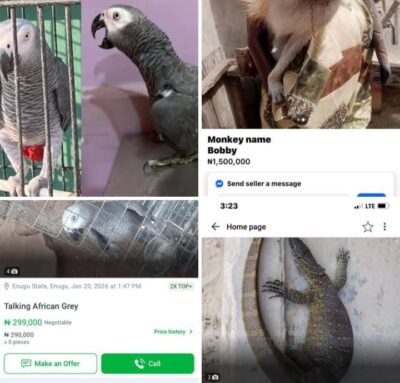
On the left is a rescued grey parrot rehabilitated by Ofua and on the right is Frances— the parrot that was purchased during this investigation
For months, TheCable’s JANEFRANCES CHIBUNDU investigated the online trade in endangered animals — specifically African grey parrots — across Nigeria’s e-commerce and social media platforms, uncovering the scale of the activity and the methods behind this growing illicit market.
An analysis of listings, social media activity, and undercover reporting shows that despite existing laws and platform policies, traders are exploiting loopholes to sustain a thriving illicit market — one that is normalised by demand and weakened by poor enforcement.
I had barely stirred from sleep when my phone lit up with a notification from Jiji — a popular e-commerce platform where Nigerians buy and sell everything, from used sofas and laptops to cars and phones with casual ease. “Need a talking bird?” the notification read. Still groggy, I tapped it. The link opened onto a brightly lit listing page, with a glossy, watermarked image of an African grey parrot perched inside a white metal cage. Draped in sleek ash-grey feathers, the bird turned its head away from the camera, almost as if it understood it was being displayed for sale. “Healthy African Grey Bird Parrot,” the caption read, its life condensed into a negotiable price tag of N150,000 (about $108). The seller, with the name– MO_Farms, listed his location as Agege, Lagos, which I would later learn to be a false address, completed with a phone number and a promise of nationwide delivery.
African grey parrot listed on Jiji
What began as a single click quickly spiralled into a flood of related advertisements. In split seconds, the algorithm took control. Listing after listing surfaced — one offering a grey parrot for N299,000 in Enugu, another advertising a “female African grey” for N200,000. Each post was as casual and transactional as any everyday commodity. A few more swipes revealed even more animals, including monkeys, pangolins, alligators, and cockatoos — wild, endangered animals displayed with the same indifference as a pair of sneakers or a used appliance.
Pangolin for sale
What appeared at first as an isolated listing quickly revealed a broader pattern: endangered wildlife being traded in plain sight. Nigeria is widely recognised as a major source and transit hub for the illegal wildlife trade, often driven by demand for traditional medicine, food, economic gains, and international markets. According to the World Bank, the illicit wildlife trade is valued between $7.8 billion and $10 billion annually, making it the fourth most lucrative form of illegal commerce globally after narcotics, human trafficking, and arms trafficking. Under Nigeria’s Endangered Species (Control of International Trade and Traffic) Act, as amended in 2016, the sale of any wildlife threatened with extinction is prohibited, with offenders liable to fines of up to N5 million, imprisonment for up to five years, or both. However, the rapid shift of wildlife trafficking to social media and e-commerce platforms has exposed significant enforcement gaps in the law, particularly around digital trade and platform accountability. These lapses have prompted legislative action, with a new wildlife protection bill passed by the national assembly and currently awaiting presidential assent, aimed at strengthening enforcement, addressing online trafficking, and updating Nigeria’s legal framework to reflect evolving trends in the illegal wildlife trade. While much of this trade has traditionally relied on physical networks and smuggling routes, endangered species are increasingly being advertised and sold openly online. Platforms such as Instagram, TikTok, Facebook, and e-commerce sites like Jiji host listings for protected wildlife, including the African grey parrot. Although these tech companies claim to have systems that flag and remove such content, findings from this investigation reveal that traders have developed ways to bypass detection. HOW SOCIAL MEDIA FUELS DEMAND FOR ENDANGERED ANIMALS With the rise of online marketplaces, it has become increasingly easy to trade endangered and wild animals on social media and e-commerce platforms. These platforms have enabled wildlife traders to connect more efficiently than ever before. Typically, traders attract customers through public posts and then move conversations to private channels such as WhatsApp to finalise transactions. Curtailing this growing wildlife trade is essential to protect biodiversity and prevent zoonotic disease outbreaks. A recent study highlights that the global trade in parrots is contributing to the spread of a dangerous disease among wild bird populations. The research also found that Nigeria is one of eight countries where the beak and feather disease virus (BFDV) — a viral disease in parrots — has been newly detected. This virus, commonly transmitted by parrots, spreads easily through the buying and selling of these birds as exotic pets, especially through unregulated online markets. Across platforms like Facebook, TikTok, and Instagram, videos of African grey parrots talking, laughing, and solving puzzles routinely go viral. Their charm is irresistible, and their mimicry is almost uncanny. They captivate and linger in the minds of viewers. The African grey parrot (Psittacus erithacus) is a highly intelligent bird species known for its ash-grey feathers, striking red tail, and pale facial mask. It is widely regarded for its exceptional cognitive abilities, including mimicking human speech, recognising patterns, and solving complex problems. Native to the dense forests of Central and West Africa, the parrot species is found in countries such as Nigeria, Cameroon, Rwanda, Kenya, and São Tomé and Príncipe, among others. However, with its increasing demand, the grey parrot is now listed as endangered on the International Union for Conservation of Nature (IUCN) red list due to its decreasing status, fueled by deforestation and the need to own exotic pets.
African Grey Parrot listed as decreasing on IUCN Redlist
In parts of Nigeria, demand for the bird’s distinctive red tail feathers is linked to their use in traditional attire, where they are sometimes seen as symbols of wealth and status. In some communities, feathers are harvested from beneath communal roosting sites and sold, providing a modest source of income for local residents. The grey parrot was transferred from the Convention on International Trade in Endangered Species of Wild Fauna and Flora (CITES) appendix II to I, following concerns over unsustainable trapping and international trade. The move placed the species under the highest level of protection under CITES, an international agreement between countries to limit the global trade of wild animals and plants. In June 2025, the Nigeria Customs Service (NCS) Special Wildlife Office (SWO) intercepted 111 live and 9 dead African grey parrots at the Gurin border crossing with Cameroon. In another operation in April 2025, the agency intercepted 12 live African Grey Parrots en route from Kaduna to Lagos. Ifeanyi Ezenwa, Nigeria coordinator for the World Parrot Trust, told TheCable that the population of African grey parrots in Nigeria has declined by more than 50 percent due to trapping and habitat loss. According to him, conservation efforts by his organisation are focused on tracking the birds’ movements across seasons and locations to identify high-risk areas and design targeted protection strategies. “The reduction in parrot population has gone beyond 50 percent. It has reduced drastically as a result of trapping and habitat destruction, especially the cutting of trees used for breeding,” he said. The conservationist also corroborated TheCable’s findings that traffickers have shifted from open markets to digital platforms and now evade detection using coded language and private channels. “Most of the people involved in parrot trafficking are now doing it online. This may become very difficult to manage if the government does not act,” he said. Ezenwa warned that without stronger regulation and enforcement, the growing online trade in African grey parrots could accelerate population decline and push the species closer to extinction in the wild. ENDANGERED GREY PARTOT SOLD FOR JUST N130,000
Midos Pet TikTok page
TheCable found several accounts on TikTok, including one identified as MIDOS PET, openly advertising African grey parrots for sale, sharing content that appears designed to attract buyers and encourage the birds’ purchase as exotic pets. When we contacted MIDOS PET via direct message on TikTok to initiate a transaction, the seller confirmed that he sells African grey parrots, adding that it was available for ₦250,000 (approximately $181). We also found another account on TikTok @Madugu Farms based in Kano state that sells African grey parrots.
Madugu farms TikTok page
Several videos of African grey parrots showcasing their talents often get users to yearn to own one without a deeper understanding of the birds’ nature. TheCable conducted a sentiment analysis of user interactions on selected TikTok videos and Jiji listings, revealing a clear pattern in how online platforms are shaping demand for exotic wildlife. On TikTok, a review of comments under a video featuring an African grey parrot found that about 65 percent of responses were transactional and dominated by price inquiries, availability checks, and even bulk purchase requests — indicating strong demand and a tendency to treat the bird as a commodity rather than a protected species. Similarly, analysis of feedback on a Jiji listing also revealed an overwhelmingly positive sentiment of about 88 percent, with users sharing testimonials about successful purchases, reliable delivery, and trust in the seller. The findings suggest that both TikTok and Jiji function as demand generators and transaction hubs, pointing to a broader digital ecosystem that normalises and facilitates the trade in exotic animals with little visible concern for legality or conservation. TheCable identified some of the accounts facilitating the trade of endangered African grey parrots on Facebook, Instagram, TikTok, Back on Jiji, I clicked on MO Farm’s profile, like any cautious buyer trying to avoid an online scam. At first glance, the account appeared legitimate. Several reviews praised the seller for “fast delivery” and “healthy birds”. Using the phone number listed on the profile, I reached out. The seller confirmed he had African grey parrots available. After some back-and-forth negotiation, we settled on a price of ₦130,000, with an additional ₦8,000 for delivery. A few hours later, a carton box arrived at my doorstep. It was crudely punctured on all sides, barely enough to let air in. Inside was the bird.
The parrot was delivered in a box by a dispatch rider
Before the purchase, TheCable had already arranged with Mark Ofua, a veterinary doctor and founder of SaintMarks’ Animal Hospital and Shelter, to take custody of the parrot immediately after it was delivered. Ofua operates an animal hospital in the Ajah area of Lagos, which has grown into one of Nigeria’s key rehabilitation centres and shelters for trafficked wildlife.
Ofua with the purchased parrot
When TheCable arrived at the facility, the atmosphere was alive; birds chirped from different corners, dogs barked in the distance, and the space felt like a fragile refuge for injured lives. But the moment the box was opened, that calm gave way to something heavier. The African grey inside did not move like a healthy bird. It recoiled and shrank into itself. Its feathers had been crudely clipped, stripping it of flight and leaving it visibly exposed and vulnerable. Every attempt to approach it only deepened its panic. For a long moment, the parrot remained on Ofua’s examination table in silence, frozen and visibly distressed, its fragile body bearing the signs of rough handling and prolonged stress from the place it had come from. Ofua gently took a step back, allowing it space to breathe. Then, almost softly, he asked if he could name the bird “Frances”, after this reporter, a practice he said is sometimes used in rehabilitation, as a way of marking a new beginning for rescued animals.
Traumatised Frances shies away from human touch
African grey parrots are highly social birds that naturally live in flocks. In the wild, they rely on constant interaction and companionship. When removed from their environment, they can become withdrawn, anxious, and deeply distressed. They are also monogamous, often forming lifelong bonds with a single mate. Separation can leave lasting psychological scars on them. Ofua told TheCable that trafficked animals brought into his facility, like Frances, often arrive in severely abused and traumatised conditions, regardless of species.
Advertisement
Ofua holds Frances
“Initial rehabilitation usually begins with basic care: food, water, and stabilising the animal’s health,” he said. He said many of these rescued animals are handled by untrained traders who subject them to inhumane treatment. In parrots, this often includes the forceful plucking or cutting of feathers, a painful process that renders them unable to fly and leaves them psychologically distressed. “Once captured, these animals become extremely fearful. Recovery can take weeks, months, or even years,” he added. https://youtu.be/cZt_TAr_LSY Wild animals kept as pets can also transmit zoonotic diseases to humans. In parrots, this includes psittacosis (commonly known as parrot fever) and avian tuberculosis, among others. According to Ofua, rescued animals are placed in strict quarantine upon arrival. Blood tests and close observation are conducted to ensure they are not carrying diseases that could pose risks to humans or other animals. From a physical examination, the veterinarian noted that aside from being traumatised, Frances had also been starved. Full rehabilitation, he said, can take a year or more, after which the animal is gradually reintroduced to others of their kind before any attempt is made to release them back into the wild. For parrots, this includes monitoring feather regrowth to ensure they can eventually regain the ability to fly.
Mark Ofua’s animal hospital in Lagos
Ofua explained that before now, his practice had focused on treating domestic animals, and that his shift to treating wildlife was driven by a desire to confront Nigeria’s exploitative relationship with nature. Running a rehabilitation facility comes with significant challenges. The veterinarian told TheCable that the growing wildlife trade has strained his operations, leaving him grappling with limited space, insufficient funding, and a shortage of skilled personnel. He called for increased government support, particularly in providing dedicated facilities and financial backing, noting that conservation is resource-intensive and often sustained by personal sacrifice and partnerships. Ofua also emphasised the importance of community awareness, especially among people living near forested areas, as it could prevent poaching and encourage the reporting of illegal wildlife activities. HOW ILLEGAL WILDLIFE TRADERS BYPASS TECH COMPANIES Several tech companies, including Facebook, Instagram, TikTok, and Jiji, have policies prohibiting the sale of endangered animals on their platforms. According to Meta’s policy titled ‘Sale of Non-Endangered Animals and Endangered Species’, “ads must not promote, donate, or gift products derived from threatened, extinct, or endangered species, including both wildlife and plants.” Meta is the parent company of Facebook, Instagram, and WhatsApp. Similarly, a review of prohibited items on Jiji shows that “trophies and wildlife specimens (including but not limited to ivory artefacts and pangolin parts)” are banned where trade is restricted by law. Yet, despite these safeguards, traders continue to bypass detection systems and sell endangered animals online. To test the loopholes, this reporter created a seller account on Jiji and attempted to list an African grey parrot. When the correct name, “African Grey Parrot”, was used, the listing was immediately rejected and flagged as prohibited content. However, a workaround soon emerged. This reporter contacted Mo Farms, the vendor who sold the grey parrot, whose real name is Musa Okeshola, posing as a social media manager for another pet store seeking guidance on how to advertise on Jiji. During the conversation, Okeshola revealed how he bypassed the platform’s detection system. According to him, instead of using flagged keywords, he deliberately altered product descriptions. “I don’t put ‘parrot’. I write ‘African grey bird’ or ‘pet’ in the category section. If not, they will keep flagging it,” Okeshola told TheCable.
Owner of MO Farm
MO Farm confirmed he has no paperwork for the birds it sells
MO Farms admitting to selling African Grey birds via WhatsApp conversation
Bank transaction for the bird purchase
He added that sales on Jiji have been “okay”, noting that he has attracted a number of customers through the platform’s free advertising feature. He also disclosed that while Jiji occasionally flags listings, rephrasing keywords allows them to slip through moderation systems. Okeshola later attempted to recruit this reporter as a social media manager, an offer that was declined. “How good are you with social media? And how has the conversation been?” he asked. “Why I’m asking is because I’m looking for someone to manage my social media accounts. I sell mainly on Instagram. I also sell on Jiji, but Jiji tends to flag ‘African grey bird’, so sometimes we try to rephrase the words.” Following this tip, TheCable replicated the method by replacing “African grey parrot” with “African grey bird”. Within 15 minutes, the listing was approved on Jiji. Within 30 minutes, a buyer had expressed interest. The ease with which restricted wildlife can be listed and sold, despite existing policies and AI detection tools, highlights persistent gaps in platform enforcement and raises questions about the effectiveness of current safeguards. Meanwhile, the undercover advert was subsequently deleted. The investigation also found that wildlife traders often use phrases like “Talking grey bird ready for rehoming”, “bird for adoption” to evade platform detection systems. Numerous posts on Instagram, Facebook, and TikTok featured such descriptions. Also, we observed that instead of traditional captions, many traders now embed these phrases directly into their videos, making it harder for automated systems to flag prohibited content. On platforms like TikTok, Facebook and Instagram, a simple search for “African grey parrot for sale” or other endangered animals often returns a message stating: “No results found.” It also adds a notice that such phrases may be associated with illegal wildlife trade, explaining that the platforms are committed to preventing wildlife trafficking and keeping their community safe. However, traffickers are aware of these moderation systems and often avoid using keywords that could trigger detection. Some of the accounts we encountered, such as Midos Pet, did not openly advertise animals “for sale” on their pages. Instead, transactions were initiated more discreetly.
Midos Pet on TikTok advertising an endangered grey
Potential buyers who made inquiries in the comments were directed by the seller to send him a private message to continue the conversation. TheCable contacted Anuhu Mani, the officer-in-charge of the Special Wildlife Office of the Nigeria Customs Service, but he did not respond to calls or text messages. When TheCable presented its findings to Jiji, the e-commerce platform said it maintains a zero-tolerance policy on the listing of protected wildlife species. Vitalii Sharovarov, Jiji’s chief marketing officer, told TheCable that the company deploys both automated and human moderation systems to detect and remove prohibited listings. “Jiji operates a high-volume marketplace where new listings are submitted continuously. While our automated and human moderation systems are designed to detect and remove prohibited content as quickly as possible, some violating listings may remain visible for a short period before removal. This is a challenge common to all user-generated content platforms globally,” Sharovarov said. Jiji also acknowledged that some bad-faith users attempt to evade moderation by using coded language, euphemisms, or misspellings, as well as by moving conversations off-platform. According to Sharovarov, Jiji’s systems are regularly updated to identify such patterns through keyword tracking and image-based analysis. “Our moderation team continuously updates its keyword dictionaries and applies both text-based and image-based analysis to identify such attempts. We continuously study emerging evasion patterns and adapt our systems accordingly. Combating evolving circumvention tactics is an ongoing effort, and we treat it as a priority,” he added. The e-commerce platform said it cooperates with Nigerian law enforcement agencies and may escalate serious or repeated violations where necessary. According to the company, its moderation framework includes automated screening at the point of listing, manual review of flagged content, routine sweeps of live listings, and penalties ranging from takedowns and account suspension to permanent bans. We also contacted the Federal Competition and Consumer Protection Commission (FCCPC) over the online sale of endangered wildlife. The commission, which is responsible for protecting consumers and regulating unfair trade practices, did not respond to multiple emails sent to it as of press time. TheCable also reached out to TikTok and Meta for comment, but neither responded.
Danny Murphy, technical advisor of Focused Conservation, told TheCable that one of the most persistent challenges in investigating online wildlife trafficking is verifying the authenticity of listings and identities.
He explained that traffickers frequently rely on stock images and videos of animals they do not possess, using them to appear legitimate while acting as intermediaries for actual sellers.
According to him, this makes it difficult for investigators to establish direct links to the primary traffickers rather than surface-level brokers.
On the use of digital evidence, Murphy said material from social media platforms is “rarely used in court proceedings in Africa beyond what is gathered during proactive investigations”, suggesting limited reliance on platform-held data in formal prosecutions.
He noted that investigative standards are improving due to technical support and mentoring provided on the ground, as well as the “dedication, tenacity and bravery” of officers at the Nigeria Customs Service Special Wildlife Office.
According to him, traffickers are also adapting by distancing themselves from direct sales, increasingly using agents and trusted couriers to avoid exposure and reduce traceability.
“New, stronger legislation awaits final sign off by the Nigerian president, dramatically increasing custodial sentences and penalties in general. This will make a very positive impact on our investigation,” he added
As the world marks World Parrot Day on May 31, Murphy expressed optimism that the enforcement of stronger laws would improve conviction outcomes and strengthen Nigeria’s overall response to wildlife trafficking.
This article was produced in partnership with Wild Africa.