
Hey, Trump, You’re F!red!’: Iranian Military Spokesman Mocks U.S. President With Signature Catchphrase
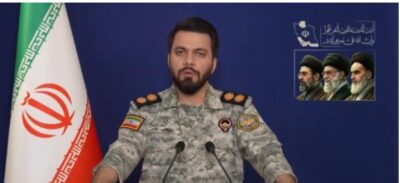
‘Hey, Trump, You’re Fired!’: Iranian Military Spokesman Mocks U.S. President With Signature Catchphrase
‘
Ebrahim Zolfaghari, spokesman for Iran’s Khatam al-Anbiya Central Headquarters, delivered the taunt in a video message in English, echoing a phrase famously associated with Trump.
A spokesperson for Iran’s powerful military command has openly mocked United States President Donald Trump, issuing a direct and provocative message as tensions over the Strait of Hormuz continue to rise.
Ebrahim Zolfaghari, spokesman for Iran’s Khatam al-Anbiya Central Headquarters, delivered the taunt in a video message in English, echoing a phrase famously associated with Trump.
“Hey, Trump, you’re fired! You’re familiar with this sentence. Thank you for your attention to this matter,” Zolfaghari said.
“You’re fired” was the signature catchphrase used by Donald Trump to eliminate contestants on the reality television show The Apprentice, which premiered on NBC in 2004.
Also, during his campaign, Trump told his supporters, “You have to stand up and you have to tell Kamala Harris that you have had enough, that you can’t take it anymore. She is the worst Vice President. Kamala, you are fired! Get out of here! You are fired! Get out!”
The phrase became a significant pop culture phenomenon, defining Trump’s persona as a cut-throat business leader before he entered politics.
Episodes of The Apprentice ended with a “boardroom” showdown where Trump would listen to explanations for a team’s failure before pointing his finger and declaring, “You’re fired!” to the selected contestant.
In 2004, Trump filed a trademark application for the catchphrase “You’re fired!”.
The phrase became so popular that it defined the show’s 11-year run, including its later iteration, The Celebrity Apprentice.
The Iranian military Commander’s statement using the ‘You’re fired’ phrase against Trump comes amid a growing standoff between Tehran and Washington following a 48-hour ultimatum issued by Trump, demanding the full reopening of the Strait of Hormuz, a critical global oil transit route.
In a post shared on Truth Social, Trump warned that failure to comply would trigger devastating US military action against Iran’s energy infrastructure.
“If Iran doesn’t FULLY OPEN, WITHOUT THREAT, the Strait of Hormuz, within 48 HOURS from this exact point in time, the United States of America will hit and obliterate their various POWER PLANTS, STARTING WITH THE BIGGEST ONE FIRST! Thank you for your attention to this matter,” he wrote.
Iranian officials have since responded with threats of “punishing retaliatory strikes,” warning that any attack on its facilities would be met with coordinated assaults on American and Israeli assets across the region.
The Islamic Revolutionary Guard Corps (IRGC) said the U.S. or Israeli energy, IT, and desalination infrastructure would become immediate targets if hostilities escalate.
“Do not doubt that we will do this,” the Guard declared in a statement broadcast on state television.
Iran also warned it could move to completely shut down the Strait of Hormuz if attacked, an action that could have severe consequences for the global economy.
The waterway handles roughly 20 percent of the world’s oil supply, estimated at between 17 and 20 million barrels per day.
The ongoing conflict, now stretching into its fourth week, has already disrupted maritime activity in the Gulf, with limited vessel movement reported in the strait despite Tehran’s claims that it remains open.
State-linked Iranian media further claimed that air defence systems intercepted and shot down a reconnaissance drone described as “Israeli-American” over Tehran before it completed its mission.
Meanwhile, Iran’s Foreign Minister, Abbas Araghchi, blamed U.S. military actions for worsening instability and disrupting shipping routes in the region.
With oil prices surging to between $110 and $115 per barrel, marking a sharp increase of over 50 percent, the crisis is beginning to send shockwaves through global markets, raising fears of a broader regional war involving the United States, Israel, and key Gulf states.