
OLOKEMEJI: A Nigerian forest, once stripped bare, provides new livelihoods
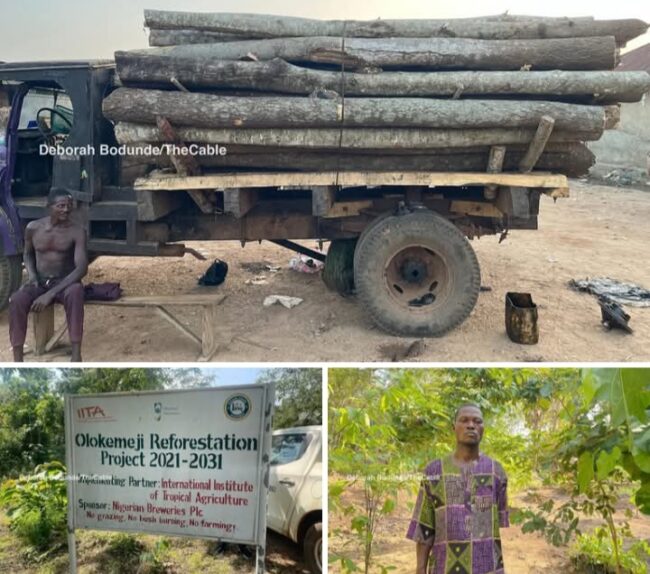
OLOKEMEJI: A Nigerian forest, once stripped bare, provides new livelihoods
Kehinde Shina, a former logger, used to make a living from the Olokemeji Forest Reserve in Ogun state, when trees were tall, thick, and valuable enough to fill timber lorries. In the 1990s, felling 10 to 15 mature trees could fill four or five trucks bound for sawmills in Abeokuta, the state capital, and within a month, he could earn between ₦30,000 and ₦40,000.
More than two decades later, the same forest has brought Shina back under its canopy for a different kind of work. At 52, he spends his days planting seedlings, fruit trees, medicinal species, and other economic plants across cleared plots of land. The work is slower and quieter, but it comes with something his earlier livelihood didn’t offer: the knowledge that these trees may provide for his children in the future.
He stopped logging in 2000 when the physical demands of the forest made the work unsafe. Farming followed, then reforestation labour when the International Institute of Tropical Agriculture (IITA) recruited local workers.
Kehinde now earns over ₦70,000 a month for keeping trees alive, supporting a household of eight, and watching his son tend hives in the same forest he once cut down.
Kehinde Shina, a former logger turned forest restoration worker
“There’s money in what I’m doing here, too. They don’t owe us, and the income is stable,” he said.
“I have a wife, and what I’m making is just enough to send my six children to school for now.”
THE OLD FOREST ECONOMY
Olokemeji Forest Reserve, located in Odeda LGA of Ogun state, was established around 1900 and is one of Nigeria’s oldest forest reserves.
Once valued for its mix of rainforest and savannah ecosystems, decades of logging, farming encroachment, charcoal burning, and weak enforcement have left large portions of the reserve degraded, thinning both its ecological and economic value.
Fasola Jamiu, the Baale of Olokemeji, described a period when much of the community depended on timber extraction, even as the forest itself deteriorated.
He said logging formed the backbone of economic activity around Olokemeji, extending beyond the forest reserve into surrounding villages such as Alagbagba, Alape and Oniropo, where trees were also sourced to meet demand.
“There were so many households dependent on logging,” Jamiu said. “We lost our trees, and the rivers dried. We couldn’t get fish from there.”
He noted that many of the loggers were not residents of Olokemeji, but outsiders operating under official permits.
“It was the government through the ministry of forestry that gave loggers permits to log trees,” the village chief said.
From the state’s perspective, forest degradation also carried economic consequences. Bashiru Adeniyi Okanlawon, the divisional forest programme officer in charge of the reserve under the Ogun Ministry of Forestry, linked encroachment directly to revenue decline.
A lorry loaded with felled trees at Olokemeji Forest Reserve
Okanlawon estimated that forest revenue dropped by about 10 percent before restoration efforts began, largely due to “tree loss caused by settlement expansion and farmland clearing”. While logging continued to generate income, the pool of harvestable trees like Afzelia and Mahogany steadily diminished.
He acknowledged that illegal exploitation had not disappeared entirely, but said enforcement had improved in recent years.
“Since I resumed, the rate at which illegality has been perpetrated has reduced drastically, though there’s no way you cannot find one or two [illegal activities],” the forestry official told TheCable.
THE RESTORATION INTERVENTION
In 2021, a forest restoration project led by IITA, with funding from Nigerian Breweries and oversight from the Ogun state ministry of forestry, was launched to reverse Olokemeji’s decline and restore 618 hectares of the degraded reserve.
The initiative combines reforestation with livelihood interventions, aiming to protect the Ogun River watershed while reducing dependence on extractive activities such as logging and expansive farming inside the reserve.
According to project staff, the intervention was designed to move away from timber-focused reforestation toward a system that integrates ecological recovery with everyday economic use.
Ajayi Ademola, project supervisor at the IITA Forest Centre, explained that the tree-planting strategy prioritised indigenous, fruit-bearing, medicinal and agroforestry species rather than commercial timber alone.
Species introduced include locust bean (iru), African star apple (agbalumo), bush/wild mango (ogbono), oil bean (ugba), African breadfruit (ukwa), and a range of medicinal and leguminous plants.
These non-timber forest products (NTFPs) already have established economic benefits in Nigeria’s food markets. Agbalumo is widely traded across the south-west and south-east during the dry season, and it also provides seasonal income for households, while iru underpins a largely women-led value chain that remains one of the most reliable rural income sources.
Ogbono, now among Nigeria’s most expensive food commodities, has seen rising prices that reinforce its value as a long-term tree crop. Ukwa, a high-demand delicacy, contributes significantly to household food security during its fruiting season, and ugba functions as a year-round cash crop in southern Nigeria due to its steady ceremonial demand.
“The idea is that in the next five years, they will have a large collection of fruits and seeds that people can harvest and sell,” Ademola said, describing the intent behind species selection.
Reforestation project signpost at the entrance of Olokemeji Forest Reserve
Alongside tree planting, the project incorporated livelihood components aimed at reducing dependence on logging. One of the most deliberate design choices was the recruitment of former loggers into restoration work.
Ademola said about four ex-loggers were engaged as permanent staff, while more than 25 others are employed seasonally during planting periods.
He added that exposure to conservation work had influenced career paths for some participants, including a former logger who later enrolled to study forestry at the Federal University of Technology, Akure, Ondo state.
Beyond employment, the project introduced other non-timber income activities, particularly beekeeping and small-scale farming. Ademola said 25 households were selected and trained in beekeeping, with hives installed within designated forest areas.
“Some of them have started selling their honey,” he noted. “That is one of the pluses of what we are doing.”
Beekeeping is one of the highest-value rural enterprises because it requires little land. According to a study on the “economics of honey production” in Nigeria, beekeeping has a profit efficiency of nearly 50 percent, meaning for every ₦1 spent, the farmer keeps ₦0.50 as pure profit — much higher than cassava or maize.
Selected farmers were also trained at IITA’s headquarters on vegetable production using improved seed varieties and sustainable soil practices. Ademola said the training emphasised higher-yield crops that require smaller plots of land, alongside the use of nitrogen-fixing trees to support soil fertility.
“Instead of cutting down trees, we taught them how to plant leguminous trees that will fix nitrogen into the soil,” he said.
Youth engagement was built into the intervention as a longer-term behaviour-change strategy. The project supervisor said conservation clubs were established in three local schools, with activities including tree-planting exercises, forest tours and participation in environmental commemorations.
“Children are very good tools for reaching their parents. We are now sending them back to their parents as agents of change,” he said.
Olasupo Olukunle, who also works with IITA, said the first planting phase has been completed, covering 309 hectares and involving more than 300,000 seedlings across over 70 native species.
“The second phase will begin in April 2026,” Olukunle said. “They won’t cut down those trees because they’re getting value and food from them.”
He said the livelihood design extends beyond beekeeping and vegetables into agroforestry systems intended to function under a forest canopy. These include shade-tolerant crops such as wrapping leaves, uziza, hybrid walnuts, and planned mushroom cultivation in later phases.
A beehive used for honey production inside the forest reserve
In 2023, the project gained even more momentum. IITA Forest Center won a grant from TerraFund for AFR100 to reforest an additional 300 hectares. This means the total restoration footprint in Olokemeji has expanded from the initial 618 hectares to approximately 918 hectares.
Nearly five years into the project, most of those economic trees are still young. The forest is growing, but its financial returns remain largely prospective.
NEW LIVELIHOODS AND MODEST INCOMES
For many residents around the Olokemeji Forest Reserve, the economic promise of restoration has not yet translated into large earnings. However, it has led to fewer desperate choices, more predictable income, and skills that extend beyond survival labour.
Maria Ajibode, 29, joined the forest restoration project in January 2023. Before then, her income came from irregular jobs that offered no stability and little opportunity to plan ahead.
“Before I started working with IITA, I could make up to ₦30,000 to ₦40,000 in a month from working odd jobs,” she said.
The work was inconsistent, and savings were difficult. Ajibode lives with her parents, both elderly farmers, and described her pre-project earnings as barely sufficient for daily needs.
After joining the project, she was trained in beekeeping, honey production and provided with beehives. She also received guidance on market timing and pricing.
Ajibode said the training has expanded her skills beyond beekeeping. She plants trees and vegetables, processes garri and starch, and applies these skills independently at home.
“They help me in selling the honey at the right time, around December or January,” she said.
Maria Ajibode
Ajibode now earns a monthly income as a field worker on the project and produces honey on her own, using part of the proceeds to support small-scale farming. She said the work has allowed her to save money for the first time.
“Now that I’m working with them, when I make money, I use it to plant crops and vegetables,” she said. “I’ve also been able to save ₦350,000.”
She added that the training exposed her to basic financial planning and record-keeping, skills she said were previously out of reach.
“They train us on profitable businesses: how to buy land, fence it, and sell it at a higher price later,” she said.
“They also advise us that if we have money, we can buy cocoa and sell it during its season. When I leave my parents’ house, I’ll be able to support myself.”
On the other hand, Olajide Ijaola’s experience shows how restoration work supplements existing livelihoods rather than replacing them.
Ijaola is a farmer who cultivates cassava and maize. Through the Olokemeji project, he received four beehives and training in honey production. He said each hive produces about five litres of honey, sold no less than ₦6,000 per litre.
“I can get five litres of honey from one beehive. I’m seeing honey and money from the beehives that IITA gave me,” he said.
From a single hive, he estimated earnings of more than ₦50,000 per production cycle. Since beginning honey sales in 2024, Ijaola said the additional income has eased pressure on his household finances.
“The quality of my life has improved,” Ijaola said, adding that the extra earnings have helped him keep his eight children in school.
According to the Baale of Olokemeji, youths, women, farmers, and people previously tied to forest exploitation have been involved through paid work, training sessions, and organised workshops.
While fruit and medicinal trees form part of the restoration design, Jamiu noted that non-timber activities such as beekeeping have provided more immediate points of participation.
“I have my own beehives as well,” the village chief said, estimating that five kilogrammes of honey could earn more than ₦35,000 once harvesting begins in a few months.
Beyond income-related activities, he highlighted other community-level benefits tied to the project, including boreholes, training on vegetable farming, and repeated engagement with both adults and students.
WHY THE MONEY ISN’T HERE YET
According to Saka Oladunni Jimoh, a professor of forest management at the University of Ibadan, the slow pace of economic returns from Olokemeji is rooted in how forests grow, recover, and generate value.
Jimoh said the indigenous economic trees planted as part of the forest restoration efforts take several years to mature before they begin to fruit consistently. Until then, there is nothing to harvest, sell, or price.
Seedlings in nursery bags on the Olokemeji restoration site
He explained that without mature trees, there can be no serious valuation of income. Survival rates, growth patterns, and productivity levels are still being observed.
The professor added that any attempt to calculate profits now would rest on assumptions rather than evidence.
“For now, we will not be able to say specifically how much these trees are contributing to the economy. The trees are still young and are not fruiting yet,” Jimoh told TheCable.
What the forest is already delivering, he noted, is ecological stability. Young trees are binding the soil, reducing erosion, limiting siltation in nearby rivers, and gradually restoring ecosystem functions that had collapsed under decades of logging and land clearing.
He said these benefits are harder to monetise, but they form the foundation upon which future income depends.
That is also why non-timber activities such as beekeeping feature prominently at this stage of the project. Unlike fruit trees, honey production does not require long maturation cycles.
Jimoh said startup costs are relatively low, returns are quicker, and market demand already exists.
“Bee farming is a money spinner. With about ₦100,000 to ₦200,000, one can start,” he said.
Beyond honey sales, he pointed to wax and propolis as additional income streams. More importantly, bees play a functional role in restoration itself. As pollinators, they increase the chances that fruit trees will eventually yield, linking short-term livelihood support to long-term forest productivity.
LIMITS, PRESSURES, AND UNFINISHED WORK
Despite visible changes on the ground, the transition unfolding in Olokemeji is still exposed to pressures that could slow or reverse its gains.
One of the most persistent threats has been cattle grazing. Newly planted seedlings are vulnerable to trampling and browsing by roaming herds. In earlier stages of the project, fires were also recorded on restoration plots.
The project supervisors at the IITA Forest Centre said the team has had to negotiate directly with Fulani herders operating in the area.
“They sometimes set fire to our plots,” Olukunle of IITA said. “We sat with the Seriki Fulani and reached a conclusion on what we can do to stem this strike.”
Alongside grazing, logging pressure has not disappeared entirely from the reserve. Olukunle pointed to a persistent governance dilemma within Olokemeji: restoration activities are ongoing, yet logging continues in parts of the forest under government-issued permits.
“I can’t say they are illegal loggers because anytime we confront them, they say they were permitted by the ministry of forestry,” he explained.
Beyond ecological and security pressures, there are social limits to the project’s reach.
Kehinde Olasunkanmi, a 25-year-old farmer living near the reserve, farms cassava, maize, yam, garri, and vegetables. She estimated her monthly income at about ₦36,000.
Olasunkanmi, who became a widow in 2022, is not part of the restoration project and is largely unaware of its activities.
“I don’t know about IITA and the work they’re doing,” she said.
Unlike participants who receive wages, training, or equipment through the project, the livelihood of the mother of three remains entirely dependent on subsistence agriculture.
While the project has absorbed former loggers, trained beekeepers, and seasonal workers, women-led households and small-scale farmers outside organised networks may remain untouched by the benefits of intervention.
According to Jimoh, this gap is common in conservation-linked livelihood programmes.
Drawing on experience, the professor noted that alternative income schemes often struggle to outlive project funding cycles.
“When the project ends, people go back to their normal activities,” he said.
Jimoh argued that training alone is rarely sufficient. Without diversified income options and start-up support that are embedded in households rather than tied solely to project sites, the pressure to return to forest exploitation can resurface.
“You are giving them fish without teaching them how to catch the fish,” he added.
The Olokemeji reforestation project was designed as a ten-year intervention, running from 2021 to 2031.
What has changed so far is not the scale of profit, but the relationship between people and the forest.
This article was produced in partnership with Wild Africa.