
60 Years After: Why Nzeogwu’s coup was inevitable — Major-Gen Haruna, rtd
60 Years After: Why Nzeogwu’s coup was inevitable — Major-Gen Haruna, rtd
The Brigadier-General and his pregnant wife were both gunned down. The pregnant wife was said to have stood in front of her husband, Brigadier Samuel Ademulegun, the GOC 1st Division, pleading for mercy. The young Army Major wanted the keys to the armoury. Ademulegun refused to surrender the keys. Boom! It did not matter that the pregnant wife was pleading for her husband’s life. They were felled in a hail of bullets.
It was the early hours of Saturday, January 15, 1966. It was the residence of the Ademuleguns. Both husband and wife were already in bed upstairs when a forceful bang forced the bedroom door open.
“Timothy, what the devil do you think you are doing?” (see Gbulie” “Nigeria’s Five Majors”). Ademulegun was by far a senior officer to Major Timothy Onwuategwu, so it was within his rights to ask. Unfortunately, the devil had visited the household that hour of the morning. The Major told Ademulegun that he was “under arrest”. According to the Major’s version of events in his book, Ademulegun reached for a drawer beside his bed, and as he did so, Onwuategwu shot him dead. This happened in Kaduna.
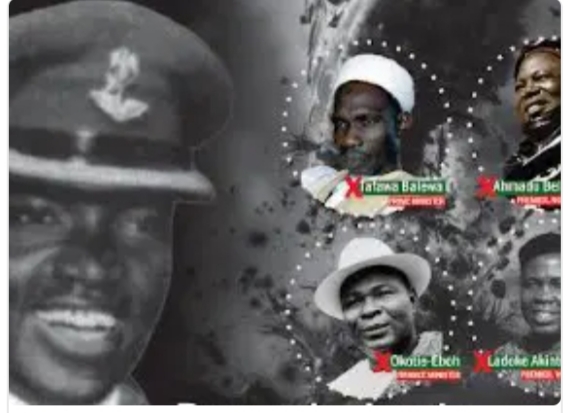
Meanwhile, the leader of the coup, Major Kaduna Chukwuma Nzeogwu was pre-occupied with his pursuit of the Premier of the Northern Region and Sardauna of Sokoto, Sir Ahmadu Bello, in the same Kaduna. He succeeded in gunning down the Premier.
Contrast that with those two incidents with this: When Nzeogwu met Hassam Usman Katsina shortly after the coup, Nzeogwu directly asked Katsina “are you with us or against us?”. Seeing that Nzeogwu was holding a gun, Katsina wisely replied “you know I am with you”. That was how Katsina was spared.
In Lagos, according to a report at www.gamji.com by Max Siollun, this happened: “The LAGOS branch of the coup was led by Major Emmanuel Ifeajuna. As well as being a degree holder before his military career, Ifeajuna had been an international athlete who held the commonwealth high jumping record. The key officers assisting Ifeajuna in Lagos were Majors Wale Ademoyega, Don Okafor, Chris Anuforo and Humphrey Chukwuka.
“At around 2am Ifeajuna and some lieutenants left the 2nd Brigade HQ and made their way to Prime Minister Abubakar Tafewa Balewa’s residence.
They overpowered (but did not kill) the police officers standing guard there, and Ifeajuna kicked down the door of the Prime Minister’s bedroom before leading him out at gunpoint. It appears that while the arrest of the Prime Minister was part of the plot, his murder may not have been and Ifeajuna and some of his co-conspirators may have exceeded their orders in killing him. In the aftermath of the coup, Nzeogwu rattled off a list of names that were on the Majors hit list. He mentioned the usual unsurprising suspects such as Bello, Azikiwe, and Akintola. Balewa’s name was conspicuously absent. Balewa was not killed until it was clear that the coup was doomed to fail. Balewa asked for, and was given time to say his prayers before he was shot by Major Ifeajuna. It was clear that not all arrested persons were to be killed. Some politicians (such as Sir Kashim Ibrahim and Michael Okpara) were arrested but released unharmed.
“Many of the army’s senior officers were attending a party in honour of the Lagos based first Brigade’s commander: Brigadier Maimalari. Some of the officers attending that party (including Maimalari himself) were to meet the grim reaper less than 24 hours after that party. Ifeajuna’s murder of his commanding officer Maimalari was probably the single greatest act of treachery on the night of the coup. In the absence of the vibrant and instant news media of today, an information chasm existed as the Government (for fear of increasing tension in the country) made little or no comment about the events of January. Thus rumours and conspiracy theories about victims’ whereabouts, and miraculous manner of death/survival thrived.
A riot almost broke out when an attempt was made to replace Brigadier Maimalari’s commanding officer name plate at the 2nd Brigade Headquarters in Lagos. Maimalari was widely regarded as an excellent soldier that was headed for the top. His toughness was such that many northern NCOs refused to accept his death and instead believed that Maimalari had made a miraculous escape from the January Majors and was still alive. This had a tiny semblance of truth, Maimalari managed to escape from the first attempt to arrest him by Major Don Okafor by jumping over a wall behind his house, but as he was escaping on foot, he came across the car of his Brigade Major: Emmanuel Ifeajuna. Maimalari recognised Ifeajuna (who was Maimalari’s Brigade Major), and did not realise that Ifeajuna was part of the coup plot.
Erroneously believing that Ifeajuna could be trusted, Maimalari waved down the car, and was promptly shot dead by Ifeajuna. Maimalari’s murder was a great loss to the northern soldiers who respected him, and to Nigeria as a whole. So famed was Maimalari’s toughness that the northern soldiers who murdered Maj-Gen Ironsi and Lt-Col Fajuyi six months later in a revenge coup actually “interrogated” the two men and demanded that they disclose the whereabouts of Brigadier Maimalari (whom they believed was still alive).
“The commanding officer of the Ibadan based 4th battalion, Lt-Col Abogo Largema, was a guest at the Ikoyi hotel on the night of the coup. Ifeajuna arrived at the hotel and forced the desk clerk at gunpoint to inform Largema that he had a “phone call”. When Largema emerged from his room to take the bogus “phone call” call, Major Ifeajuna and a subaltern emerged from their hiding place in the corridor and shot Largema dead.
“Other officers who were considered as pro-Government or who could prevent the coup were also killed. The army’s GOC Major-General Ironsi was tipped off about the coup by a telephone call from the Army’s Adjutant-General: Lt-Col James Pam. Shortly after ending the telephone call with Ironsi, Pam was abducted from his house and shot dead by Major Chris Anuforo. Pam was the son of the chief of Jos and was widely liked within the army, and regarded as a very capable officer. He was also a father of six. The Major’s decision to kill him mortified his colleagues. Anuforo was most hasty in the use of his firearm on the night of January 15.
He personally shot dead Lt-Cols Pam and Unegbe, Colonel Kur Mohammed and the Finance Minister Chief Festus Okotie-Eboh. Okotie-Eboh was widely disliked during the first republic for his corruption, and the former British colonial officer Sir James Robertson once referred to him as “a cheerful rogue” and “a byword for making money on the side”. Okotie-Eboh’s arrest was particularly aggressive and eyewitnesses say that the soldiers who arrested him tossed him into their army Land Rover “like a sack”. He was shot dead by Major Anuforo despite pleading for his life. Balewa, Kur Mohammed and Okotie-Eboh were initially kidnapped, but killed later when it became clear that the coup was not going to succeed.
IBADAN
“The coup caught many of the army’s high command by surprise as many of them were away from their posts. Lt-Col Francis Fajuyi was on leave and command of the Lagos battalion was in the process of being transferred from Lt-Col Hilary Njoku to Lt-Col Gowon who was returning from a course overseas. In Ibadan the Premier of the western region Chief Samuel Akintola had been forewarned that soldiers were coming to get him. Akintola had heard rumours of a coup and had travelled to Kaduna to warn the Premier of the northern region Ahmadu Bello. Frustrated that his warnings failed to elicit the required degree of urgency from Bello, Akintola returned to Ibadan and armed himself with a rifle. His deputy Chief Fani-Kayode was first arrested by the coupists. After this arrest, Kayode’s wife informed Akintola of what had happened. Shortly afterward a detachment of soldiers led by Captain Emmanuel Nwobosi arrived at Akintola’s residence. Upon sighting the soldiers, Akintola opened fire – lightly wounding a few of them including Captain Nwobosi. After bravely fighting for his life and engaging the soldiers in a gunfight, Akintola was shot dead by Nwobosi and his men.”
Like the story of June 12 presidential election of 1993 that has many shades, the accounts of the first coup in Nigeria’s history is replete with diverse perspectives and narratives. Only those who participated in it can present the most authentic version of what transpired on that day of infamy. Unfortunately, dead men don’t talk. But some of the actors later wrote their versions of what transpired before they died.
Today, January 15, 2026, marks the 60th anniversary of the first military coup in Nigeria. The stories of that coup have different lives, depending on who is reliving them or who is presenting the perspective. Yet, a few things that have stuck and which have been difficult to obliterate from the consciousness of many are legion. Apart from the very bloody nature of the coup, perhaps the most debilitating is the notion that the coup was an attempt by military officers of Igbo extraction to dominate their colleagues from other parts of the country and also take over the government.
But some military officers who were around at that time, one of whom is Brigadier-General Godwin Alabi-Isama, insist that Major Chukwuma Kaduna Nzeogwu did not lead a tribal, Igbo coup. He gives his reasons in the interview overleaf. Again, unfortunately, with eight out of the nine actors who participated in the coup, only Major Ademoyega awas not Igbo. Also, at a time when the officer corp of the Nigerian Army had 37 Igbo Officers, 10 Yoruba officers, and 8 Northern, Hausa-speaking officers, and a coup led by predominantly Igbo officers had killed many northern senior officers and politicians save one Igbo officer who was killed ( Lt-Col Arthur Unegbe who was said to have refused to surrender the keys of the armoury).
The coup failed, but General Aguiyi Ironsi, the most senior military officer of that time, took over.
The consensus, however, is that a bloody coup occurred and changed the history of Nigeria forever. Unfortunately, there was a counter coup on July 28/29 of that same year. After these two coups of that same year, there have been six more. The rest is history.
Vanguard News