Between Comfort and Crisis – The Unequal Reality of Hostel Life in Nigerian Universities
Between Comfort and Crisis – The Unequal Reality of Hostel Life in Nigerian Universities

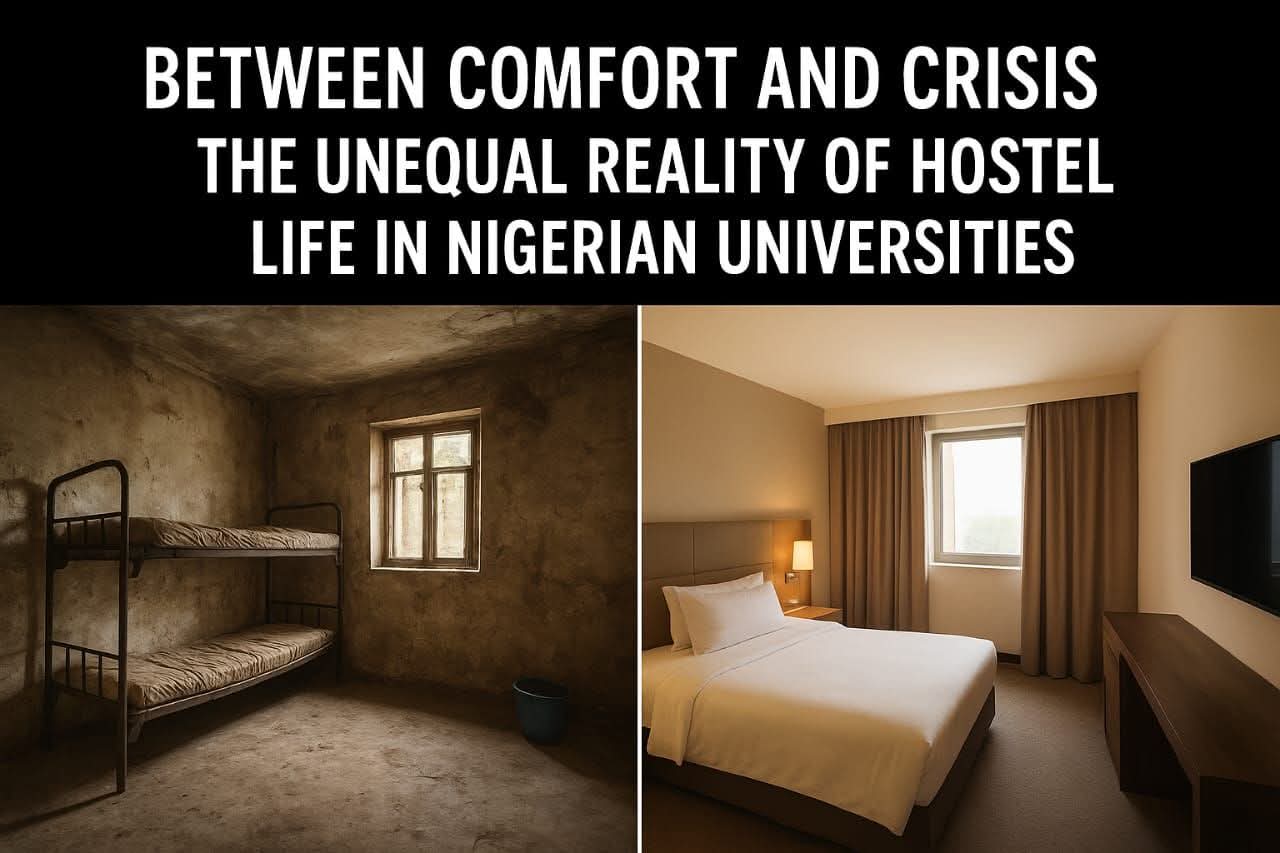
Hostel accommodation across Nigerian universities tells a story of deep contrasts, between public decay and private luxury, between affordability and dignity. In public universities, students often endure overcrowded rooms, erratic water and power supply, and unhygienic facilities that threaten both health and morale. In contrast, private universities, such as Nile and Pan-Atlantic, offer air-conditioned hostels, 24-hour security, and modern conveniences, but at costs exceeding ₦500,000 per session. This widening gap reflects not only economic inequality but also a troubling neglect of student welfare in the public sector. The hostel experience, once a cornerstone of campus community life, has become a reflection of Nigeria’s broader infrastructure crisis.
Public university hostels, which accommodate barely 30% of students, are typically characterized by peeling walls, leaking roofs, and bathrooms shared by dozens. Basic sanitation is often absent, forcing students to fetch water or use unsafe waste disposal methods. These conditions have direct consequences, recurrent outbreaks of diseases like typhoid and malaria, as reported in several campuses including Federal University Oye-Ekiti and University of Benin. By contrast, private universities, backed by investor funding and stricter maintenance policies, provide cleaner, safer environments where learning thrives. Yet these facilities remain inaccessible to most Nigerians, as tuition and housing costs far exceed average income levels.
Security represents another defining fault line. In many public institutions, students live in constant fear of theft, assault, and cult-related violence. Weak campus surveillance, poor lighting, and broken fences create opportunities for criminal intrusion. The situation is compounded by off-campus accommodation, where students often face even greater risks, including robberies and sexual harassment. Private universities, on the other hand, typically maintain strict security systems, CCTV cameras, gated access, and dedicated guards. The difference is not merely about comfort, but about safety, dignity, and the right to learn without fear.
Affordability is where the tension becomes most visible. While public hostels charge as low as ₦30,000 to ₦50,000 per session, scarcity and corruption inflate costs, bed spaces are often resold for up to ₦200,000 in black-market deals. Private hostels, meanwhile, charge from ₦150,000 to over ₦1 million annually, offering optional meal plans and cleaning services. The economic gap mirrors Nigeria’s inequality, where the children of the wealthy study in luxury while the poor endure hardship that undermines their academic potential. Off-campus rents have also risen sharply, with students in cities like Lagos and Abuja spending between ₦250,000 and ₦400,000 yearly on low-quality housing.
Still, the sector holds opportunity. Analysts estimate that less than 40% of Nigeria’s 2.5 million tertiary students have access to safe, quality housing, representing an untapped investment opportunities. Public-private partnerships (PPPs), such as the Build-Operate-Transfer (BOT) model, can bridge this gap. Private hostels near universities like UNIZIK and FUTA have shown strong returns on investment, up to 20% per annum proving that student housing can be both profitable and socially beneficial. Forward-looking investors are now experimenting with student villages, eco-friendly, tech-enabled hostels featuring Wi-Fi and co-working spaces, aligning profitability with modernization.
At the core, the issue of student housing is not just a policy or investment issue, it is a test of Nigeria’s priorities. The government must treat hostel renovation as an urgent infrastructure project, not an afterthought. Universities must enforce standards for hygiene, security, and capacity while engaging the private sector transparently. Students and parents, too, must demand accountability and make informed choices about accommodation. A university education should expand minds, not expose bodies to danger. Closing the gap between public neglect and private reserve will require vision, funding, and empathy, but doing so is essential if Nigerian higher education is to reflect the nation’s aspirations, not its inequalities.
©️ Adebamiwa Olugbenga Michael