
Kehinde and Taiwo Ogundipe: The Twins Who Shared One W!fe
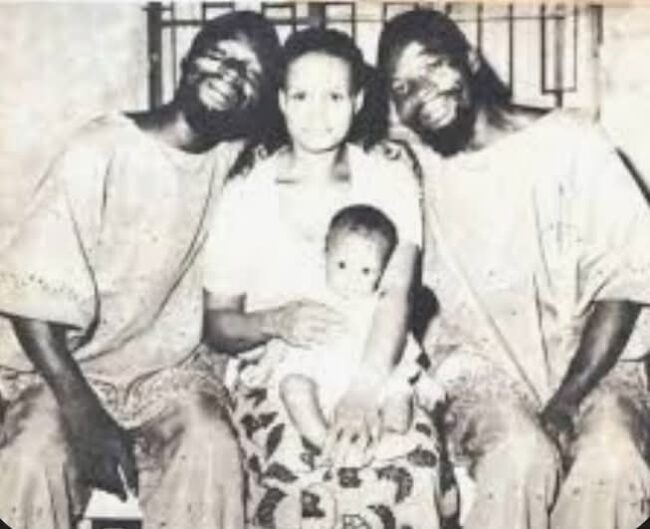
Kehinde and Taiwo Ogundipe: The Twins Who Shared One Wife
In 1978, Drum magazine stunned its readers with a story that blurred the boundaries between culture, spirituality, and social convention. It was the account of identical Nigerian twins, Kehinde and Taiwo Ogundipe, whose lives were so intertwined that they chose to marry the same woman—and raise a child together.
At the time the story broke, their wife, Patricia, had already given birth to a baby boy named Noah. The revelation provoked fascination, disbelief, and heated debate across Nigeria and beyond. Yet for the Ogundipe twins, their decision was neither scandalous nor experimental. It was, in their view, a natural expression of who they were.
“Our decision to get married to one wife,” the twins explained, “was to prove to the world, and Nigerians in particular, that just as one man can marry many wives, twins can justify their oneness by owning things in common. God made us to be one in whatever we do.”
Kehinde and Taiwo believed deeply in the spiritual unity of twins. Rooted in cultural interpretations common in parts of Yoruba cosmology, twins are often regarded as possessing a shared soul or destiny—two bodies animated by one spiritual essence. For the Ogundipe brothers, this belief was not symbolic; it was practical and all-encompassing. They dressed alike, spoke alike, worked together, and made life decisions jointly. Marriage, to them, was no exception.
Patricia’s role in the arrangement drew as much attention as the twins themselves. Calm and composed in interviews, she appeared fully aware of the unconventional nature of her marriage, yet resolute in her acceptance of it. She did not describe herself as a victim of coercion or tradition but as a willing participant in a union she understood and embraced. In a society where polygamy was already familiar, her marriage simply reversed the arithmetic—one wife, two husbands.
The birth of their son, Noah, further complicated public curiosity. Questions arose: Who was the biological father? How would the child be raised? The twins dismissed such concerns as irrelevant. Noah, they insisted, belonged equally to both of them. Parenthood, like marriage, was shared.
Predictably, the story unsettled many. Religious leaders questioned its moral standing, legal scholars debated its legitimacy, and ordinary Nigerians argued over whether culture could justify such an arrangement. Yet others saw the Ogundipe twins as living proof that African societies had long accommodated complex family structures before modern legal and religious frameworks attempted to simplify them.
Decades later, the story of Kehinde and Taiwo Ogundipe remains one of Nigeria’s most unusual human-interest narratives. It continues to challenge assumptions about marriage, individuality, and the limits of cultural expression. More than a curiosity, their lives invite a deeper reflection on how identity, belief, and tradition can intersect in ways that defy easy judgment.
In the end, the twins were not trying to shock the world. They were simply living out what they believed to be the truth of their existence: that they were not two men walking separate paths, but one life, shared completely—even in love.