I met, married my husband within four months – 99-year-old first female professor, Ogunsheye
I met, married my husband within four months – 99-year-old first female professor, Ogunsheye
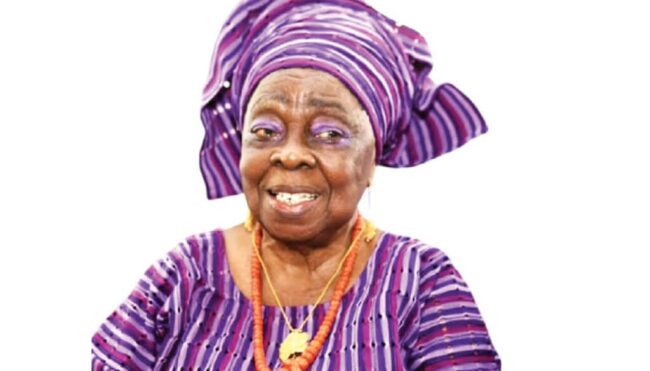
Nigeria’s first female professor and veteran librarian, Prof. Adetowun Ogunsheye, shares her childhood experience, academic career journey, and other life issues with BIODUN BUSARI
How was your childhood experience?
I had an exciting childhood. I enjoyed every bit of it. I had parents who were educated, and they also valued education. My father wanted both male and female children to be educated.
He had a stint as a teacher at the CMS Grammar School. My mother also went to the Old Girls’ Seminary, which was opposite the Grammar School in Lagos.
My parents had seven children, and I am the eldest. My father was also a sportsman. He played lawn tennis, and he held the tennis tournament award for three years. It was something the family was proud of. My parents took us wherever they went. So, we got to see countries.
We travelled with them to places, and that in itself was an educational experience. One of the remarkable things about my father was that he was very keen on girls’ education. This helped me while growing up.
What was your experience like as a student of Queen’s College, Yaba, Lagos?
Most of my teachers were expatriates. They were English men and women. Of course, they were missionaries. They were brilliant teachers who imparted knowledge passionately.
However, there were favourites like Miss Baker in the domestic science room. We were always joking about her. She used to say, ‘You scrub along the grain.’ This became a joke among us. Everybody in my class talked about ‘you scrub along the grain.’
We were very joyful. I remember that the government quarters were behind the government house. So, we had an interest in finding out or discovering what was happening among the staff back then. I had Miss Peel, who was a mathematician.
We got on very well because mathematics was my favourite subject. I had a gift for remembering what I saw. I was a visual type of person. Once I saw anything, it stayed with me.
For instance, when I saw ‘nine’ in mathematics, I would visualise how to split it into three by three. The moment I saw that, it stuck with me. I applied this kind of method a lot. I did enjoy having her as my teacher because of the way she taught me.
Why did you choose geography and library science as courses of study?
I attended the University College, Ibadan, now the University of Ibadan. But I went to Newnham College under Cambridge University in the United Kingdom to study geography for my first and second degrees.
Discover more
bed
Education technology tools
Campus security systems
Bed
Educational
Construction materials for hostels
University housing solutions
Transportation services for students
University branded merchandise
Lagos tourism services
After that, I chose library science as another master’s degree in the United States, when it occurred to me that we librarians were the keepers of records. We still are. I realised that before I became a librarian. In fact, it was my topic for my inaugural lecture titled, ‘The Records of Civilisation.’
I talked about how the literature of each generation was kept. The library is just a concept where books are kept. The important thing is the records themselves that were kept. Another thing that informed my decision to study the course was that I didn’t do science in school. We only did domestic science.
Did your parents influence your choice of study?
My father was keen on law, and he read all the laws of the country. As such, he was very interested in having us, his children, become lawyers. More so, it was obvious at that time that he also wanted me to become a doctor. But I didn’t have the chance to do it. Instead, I did geography.
I was interested in landforms and geology, and the rest. Also, I was interested in making maps. I was a cartographer for the university. I set up the map division at the university.
So, I was in charge of the maps. These were the things I enjoyed doing, but none of them was influenced by my parents. They were just supportive.
How did you feel when you became the first female professor?
I was elated. I was delighted. I just thank God that I was chosen because it was not by power, but by the gifts that God gave me. Moreover, diligence played its part in my success story.
Did you encounter challenges at that time?
There were challenges for me as a woman, but people did not discriminate against women during my time. It was believed that women should take second place. Perhaps, in a family situation, a woman should take second place. She’s happier in that place.
Personally, I got the gift that God has given us women. The woman has a gift to fit that role beautifully at home, and I did mine. I managed my home very well. Women should not fight it.
I was happy doing my job because I belonged to the custodians of information in Nigeria. I am still one. So, challenges weren’t threats to me. They didn’t pose a threat to my career progression.
Who supported you to achieve your goal?
I had the support of everyone around me. I was not discriminated against. Mostly, the support of my father was instrumental because he was interested in my education. I was the eldest. There was no doubt about it, I had some privileges.
Nobody played me down or was allowed to run me down. I tried to maintain my status in the family, which was unusual. There was a time when some extended members of the family thought my father was giving us too much attention. He allowed us to sit at a table. We ate together at a table. We discussed things together, and he was very happy for me.
Why do you think reading culture has decreased in this digital age?
That’s because there are so many distractions. Digital information is good, but it can’t take the place of reading. People don’t know that they still have to read the information on digital gadgets. For goodness’ sake, you still have to read them. It doesn’t matter what format you put them in.
Whether it’s digital or in a historical format, you still have to read them. If you don’t read them, you cannot acquire them. This reading habit also depends on whether you read as a child. If you have parents who read to you when you were a child, you will always want to continue reading too.
I would urge parents to make it their duty to read to their children. You can share knowledge with a child in whatever form it may be presented. But in whatever form, he has to read. They are being distracted by a lot of music and a lot of drama.
What were the special memories you hold dear during your time at the university?
First of all, the fact that you must accept that you would devote part of your time to getting informed yourself. I hold that dear. Learning was everything for me. Whether you call it information science or library studies, you must be informed. Getting informed was and is still important. I always looked forward to getting new information that helped my life and career.
How was mentorship during your time?
We didn’t have mentorship during our time; we got it from life. Life had a way of teaching and moulding us. But it was there in the background as you received and passed on information. Whether it was in the form of writing a story for a child or taking a child on a school walk, you would learn.
We looked at what our parents did and learnt from them. We took note of our environment to know what type of flowers or plants grew around us. My father used to do gardening with us. My mother did all sorts of things, including baking to make money.
She made enough money for us to have in the house. She also sewed. I don’t know how she managed all the time. But whatever was necessary, she passed on. She made herself available for discussion with her children. She gave us time. I was learning from them.
How did you meet your husband?
I met him through a friend. It was a friend of my husband who introduced us to each other. After I met him, I just believed and trusted that this was my partner. Then, we got married within four months of meeting. It was that quick.
We were both Christians, and I think it was a divine intervention. It was not my will or my feelings or my emotions at all. My husband, Ayo Ogunsheye, was a great educationist at that time, too. He was travelling around Nigeria, talking beyond and outside the walls of the university. He wrote quite a lot of books, too.
Looking back now, what is that one thing you think you should have done differently?
I don’t think I have any regrets. In a sense, I was very much a religious person. I prayed, and I was a good Christian child because that was the way I was brought up. I didn’t take anything for granted.
I enjoyed learning; I enjoyed writing stories for either my younger folks or my children when I became a mother. I was the first dean of the Faculty of Education at the University of Ibadan. I am fulfilled. I have many records. So, I thank God for my life. I was happy and am happy about my life.
What do you enjoy most about Nigeria at your old age?
I insist on listening to the news early in the morning because I like to be informed. But nothing really exciting is happening now. All I hear is the news of banditry, insecurity, and the like.
What are the secrets that keep you hale and hearty at 99?
I have a gift for wanting to know what is happening. It doesn’t matter the kind of information; as long as it is useful, I go for it. Also, I hope in God for my strength. All I can say is that my Christian background, education, and information about life have been helpful.