
Food prices drop further in Nigeria markets

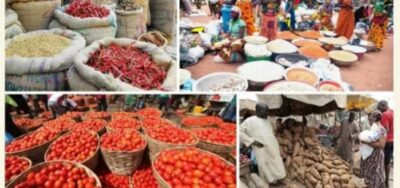
Food prices drop further in Nigeria markets
Food and agriculture stakeholders in Ogun, Oyo, and Kwara States have expressed delight at the drop in food prices, praising the Federal Government for its policies and interventions.
In Tuesday’s survey of the News Agency of Nigeria, the respondents, however, cautioned that some loose ends needed to be tidied up to sustain the price reductions across the board.
At the Lafenwa, Kuto, and Olomore markets in Abeokuta, the survey revealed a significant drop in the prices of rice, beans, garri, groundnut oil, and yams.
It also showed that the prices of perishable items like peppers, onions, and tomatoes had dropped.
According to the survey, a ‘kongo’ of garri now sells for N400 as against N1,800 in August, while a bag of the commodity now costs N28,000, compared to N40,000 in August.
A 50kg bag of rice now sells for N51,000 from N68,000, while ‘Oloyin’ beans dropped from N70,000 to N60,000.
A 5-litre gallon of groundnut oil, which was sold for N16,000, now costs N13,000, while a 25-litre keg of King’s oil reduced from N70,000 to N66,000.
A medium basket of onions has dropped from N20,000 to N12,000, while a small basket of the same commodity has reduced from N10,000 to N5,000.
Similarly, a big bag of scotch bonnet pepper now goes for between N35,000 and N40,000, dropping from N60,000 and N65,000, respectively.
The small bucket of bonnet pepper, which previously sold for N15,000, now costs N6,000, just as a bag of tomatoes dropped from N70,000 to N50,000.
Meanwhile, six big tubers of yams, earlier sold between N17,000 and N20,000, now sell for N12,000, while medium sizes are sold between N4,000 and N6,000.
Some of the traders attributed the reduction to the recent decline in the exchange rate and reopening of land borders.
This, according to Sikirat Soyeye, a grain seller at Lafenwa market, has eased importation and improved the availability of food items, especially rice and groundnut oil.
“Our businesses have improved; since food items are now cheaper, people are now buying more.
“The reduction in the dollar rate and border reopening have really helped,” she said.
Soyeye, however, appealed to the government to sustain the stability of the naira, adding that traders now record higher sales and patronage.
At the Kuto Market, Tinuke Ayomide, a perishable goods seller, said the reduction in the prices of pepper and onions was due to the current harvest season of the items.
Ayomide, however, urged the government to strengthen security, particularly in the northern parts of the country where most food items originate, to ensure a steady reduction in commodity prices.
Similarly, a tomato seller at Olomore market, Mr Haruna Ibrahim, said the commodity recorded a slight price reduction, but compared with other items, it was still expensive.
Ibrahim also attributed the drop in perishable food prices to seasonal harvests.
A buyer, Ayomide Adedeji, expressed delight at the development, urging the government to sustain the trend through consistent policies.
“Food prices should not rise again, and the government must keep fuel prices stable.
“When the dollar comes down, things become cheaper, so the government must ensure exchange rate stability and continue to support local farmers,” she said.
The Ogun Secretary, All Farmers Association of Nigeria, Abiodun Ogunjimi, said the current price reduction reflected a mix of seasonal harvests, reduced transport costs, and improved supply from farms and borders.
Ogunjimi, however, warned that without deliberate government policies, the gains might be temporary.
“To sustain this positive trend, the government should invest in local food production, reduce import duties on essential goods, and provide incentives for farmers.
“Our government should also look into improved storage facilities, rural infrastructure, and price monitoring systems to prevent future inflation and ensure food affordability for Nigerians,” Ogunjimi said.
Meanwhile, the Ogun Commissioner for Agriculture and Food Security, Bolu Owotomo, said the reduction in food prices was due to effective government policies, even as the harvest season is ongoing.
According to Owotomo, the state government has intensified efforts to enhance food productivity and minimise post-harvest losses through various targeted initiatives and interventions.
He added that the state had done exceptionally well in the cassava industry and aquaculture sector, with thousands of farmers benefiting from capacity-building programmes.
The commissioner noted that the government had steadily expanded its input distribution to boost food productivity and was also still building processing facilities across the state.
“We’re not only stopping at providing processing centres, we are also linking our farmers to off-takers so that they won’t have to be the ones to be looking for markets themselves; we already have off-takers registered.
“It’s our joy that the government’s policies and interventions are having a positive impact on food prices in the state.
“Adequate state government interventions have really helped in the reduction of food prices,” said Owotomo.
In Ibadan, Alarudeen Aminu, a Reader in the Department of Economics, University of Ibadan, says the price reduction is largely driven by the nationwide harvest season.
He said food prices traditionally fall to their lowest during harvest periods across Nigeria’s agro-ecological zones.
“This year’s trend aligns with historical patterns, except in periods of drought, flood or other disruptions affecting food production,” he said.
He explained that increased local supply has forced imported food items to a downward readjustment.
“If there is excess supply, the price will fall to clear the market. That is what we are observing now,” he said.
Related News
Police rescue fake soldier from mob in Ogun
Police arrest notorious Ogun cultist, recover gun
First Lady urges collective action to protect children from sexual abuse
The economist, however, stressed the need for coordinated government intervention to sustain the price reduction beyond the harvest period.
He said federal, state and local governments must invest more in domestic food production to stabilise prices.
According to him, expanding dry-season farming is critical as many farmers have already cultivated vegetables, tomatoes and early yam seedlings using FADAMA.
He urged governments to provide quality seedlings and launch radio and community campaigns to boost participation in off-season farming.
He also urged the governments to identify and support genuine farmers, particularly small-scale holders who supply the bulk of food consumed locally.
Aminu called for stronger rural security to encourage farmers who have abandoned farmlands due to attacks.
He emphasised that rural infrastructure, such as roads, bridges and basic amenities, must be prioritised, noting that such investment is largely the responsibility of the state and local governments.
He, therefore, recommended the revival of a structure similar to the defunct Directorate of Food, Roads and Rural Infrastructure and the Universal Basic Education model.
According to the economist, the structure is to be jointly funded by the federal and state governments.
However, a consumer, Taiwo Ajebamidele, urged the FG to provide more storage and preservation facilities to help control post-harvest surplus and wastage.
“The government can also buy off the surplus harvest from farmers to save their loss now, and resell it off-season.
“Although foodstuffs, especially grains and cassava, are now surplus, the off-season time will come.
“However, with good storage and preservation, the preserved ones will be available for sale at cheap prices since they are from the government,” he said.
He also called on the government to reduce the pump price of petrol, which, in turn, would drop transportation costs.
The economy, he says, revolves around petrol.
A housewife, Mary Oguntade, said that while foodstuffs had become cheaper, people’s purchasing power was still weak.
According to Oguntade, though garri, beans, tomatoes and pepper are now selling at lower prices, they may still increase off-season.
She, however, said that the prices of fish, meat, eggs, chicken, palm oil and vegetable oil were still high.
Aduke Adebimpe, a rice merchant at Bodija market, affirmed that the price of rice had crashed.
According to her, a bag of 50kg, which sold between N60,000 and N64,000 in October, now sells between N54,000 and N56,000 across various markets in Ibadan.
“The Indian rice flooded the Nigerian markets from the Benin Republic, pushing prices of both imported and local rice down sharply.
“Another factor in price reduction is the strengthening of the Naira against the Dollar and CFA, thus making dollar‑priced imports cheaper,” she said.
She advised that the duty waiver on the importation of rice be sustained to make rice sell as low as N10,000.
A garri seller, Caroline Joseph, said the price of the commodity has dropped drastically as a bag of cassava, which sold between N10,000 and N15,000, now sells at N9,000.
Joseph said that a big bowl of garri, sold for N8,000, now sells at N4,000.
She, however, cautioned that the price reduction was seasonal, explaining that with the incoming dry season, the price of garri and cassava flour would increase again.
A consumer, Kabir Alebiosu, said that while the prices of rice, beans, and garri had reduced, there was no money to buy other necessary things to cook the foodstuffs.
Alebiosu said that the people’s purchasing power was still low; therefore, urging the government to do more to improve economic policies.
This, he said, would help the civil servants to, at least, feed their families.
In Ilorin, the Iyaloja-General of Kwara, Muhibat Olumon, while commending the government, pledged continuous support to the FG for stabilising the prices of food commodities.
She explained that, as the leader of marketers in Kwara, her team hold regular meetings with middlemen across the state to prevent the inflation of food commodities.
According to her, the market must be sanitised of traders who take advantage of people by inflating prices and coming around to blame the government.
She pledged, on behalf of other traders, to be faithful in their businesses and to remain their brothers’ keeper.
The Public Relations Officer, Tomatoes Dealers Association in Kwara, Nurudeen Alowonle, told NAN that a bag of tomatoes sells between N9,000 and N10,000.
According to him, a 25kg bag of bell pepper (atarodo) now sells between N7,000 and N10,000 in Ilorin.
The survey revealed that a bag of rice has dropped from N70,000 in October to N53,000.
A bag of Elubo (New), which sold for N140,000 in the last two months, now sells for N120,000, while the (Old) Elubo sells for N160,000.