

US Launches Third Straight Night Of Airstr!kes On Iran As Trump Escalates Military Actions On Strait Of Hormuz
US Launches Third Straight Night Of Airstrikes On Iran As Trump Escalates Military Actions On Strait Of Hormuz
Diplomatic efforts mediated by Oman reportedly failed over the weekend after both sides accused each other of violating previous understandings on freedom of navigation and regional security.
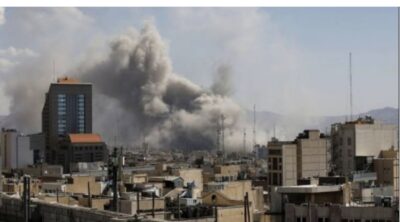
The United States military has launched a third consecutive night of airstrikes against Iran, marking a further escalation in the rapidly expanding conflict between Washington and Tehran over security in the Strait of Hormuz, one of the world’s most strategic oil shipping routes.

In a brief statement posted on its official X account on Monday evening, the U.S. Central Command (CENTCOM) confirmed that the latest operation began at about 4:45 p.m. Eastern Time under the direct orders of President Donald Trump.
“At 4:45 p.m. ET today, U.S. Central Command began launching the third consecutive night of strikes against Iran, at the Commander in Chief’s direction,” the military command said.
CENTCOM added that the offensive was aimed at weakening Iran’s military capabilities while preventing further attacks on commercial shipping in the Gulf.
“These strikes will continue imposing a heavy cost on Iranian forces and degrade their ability to attack innocent civilians and commercial shipping in the Strait of Hormuz,” the statement read.
The latest bombardment comes amid a dramatic collapse in indirect negotiations between Washington and Tehran over the future of the Strait of Hormuz.
Diplomatic efforts mediated by Oman reportedly failed over the weekend after both sides accused each other of violating previous understandings on freedom of navigation and regional security.
Since then, military exchanges have intensified, with Iran claiming responsibility for attacks on U.S.-linked military facilities in Bahrain, Kuwait and Oman, while Washington has continued a sustained aerial campaign targeting Iranian military infrastructure.
Investigative reporting service
President Trump has also significantly hardened his rhetoric in recent days.
In a telephone interview with Fox News, he declared that the United States had “hit them very hard” after accusing Iran of repeatedly violating military agreements.
“Most of their equipment is gone. Their anti-aircraft gun, we hit them very hard last night,” Trump said.
He further suggested that the United States could permanently assume responsibility for policing the Strait of Hormuz.
“We’re just going to hit them very hard and we’re going to keep the Strait… maybe we will become the guardian of the Strait,” Trump said, arguing that countries benefiting from the vital waterway should reimburse Washington for providing maritime security.
According to previous CENTCOM statements, U.S. forces have carried out hundreds of precision strikes over the past several days against Iranian missile launch sites, drone facilities, naval assets, radar installations, air defence systems and command centres in an effort to reduce Tehran’s ability to threaten maritime traffic.
The US military has maintained that its operations are intended to ensure the continued flow of commercial shipping through one of the world’s busiest energy corridors.
Iran, however, has accused the United States of violating its sovereignty and insists its military actions are defensive responses to American and allied attacks. Iranian officials have repeatedly warned that continued U.S. military operations could trigger wider instability across the Gulf region.
The Strait of Hormuz carries roughly one-fifth of the world’s seaborne crude oil exports, making any disruption capable of sending global energy prices sharply higher.
For Nigeria, Africa’s largest crude oil producer, prolonged instability in the Gulf presents both opportunities and risks.
Higher international crude oil prices could temporarily increase Nigeria’s oil export earnings and improve government revenues, potentially boosting foreign exchange inflows.
However, analysts warn that escalating conflict could also push up the cost of imported refined petroleum products, aviation fuel, fertiliser, food commodities and shipping insurance, placing additional pressure on inflation and transportation costs in Nigeria.
The conflict could also affect global supply chains and increase freight charges for goods imported into Nigerian ports, further complicating the country’s economic recovery amid persistent foreign exchange challenges.