
Anambra, Kaduna, Plateau lead Nigeria in open government reforms
Anambra, Kaduna, Plateau lead Nigeria in open government reforms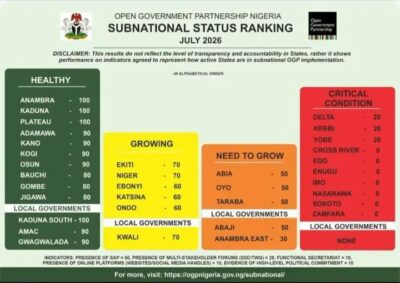
Anambra State has emerged as one of Nigeria’s top-performing states in the latest Open Government Partnership Nigeria Subnational Status Ranking, attaining a 100 per cent “Healthy” status for its implementation of open government reforms.
The July 2026 ranking placed Anambra in the highest category alongside Kaduna and Plateau states, each scoring 100 per cent under the OGP’s subnational performance assessment.
The ranking, released by the Open Government Partnership Nigeria, measures states’ performance on agreed indicators reflecting their level of implementation of open government principles, including transparency, accountability and citizen participation.
Other states in the “Healthy” category include Adamawa, Kano, Kogi and Osun, which were rated at 90 per cent, while Bauchi, Gombe and Jigawa each scored 80 per cent.
Abia, Oyo and Taraba states were listed under the “Need to Grow” category, while Delta, Kebbi, Yobe, Cross River, Edo, Enugu, Imo, Nasarawa, Sokoto and Zamfara were ranked under “Critical Condition”.
The latest Open Government Partnership Nigeria Subnational Status Ranking represents the highest possible standing a state can attain under the platform’s rigorous nine-point framework for measuring how genuinely open, accountable and citizen-driven a government is.
Reacting to the development in a press statement issued on Wednesday, the Chief Press Secretary to the Anambra State Governor, Prof. Chukwuma Soludo, Christian Aburime, described the ranking as an independent validation of the administration’s commitment to transparent, accountable and citizen-centred governance.
Aburime said the assessment was based on verifiable evidence rather than claims, noting that Anambra’s 100 per cent score reflected its consistent implementation of institutional reforms under the Soludo administration.
He pointed out that Anambra’s clean sweep across the OGP’s criteria suggested a leadership culture in which transparency is treated as an imperative rather than an occasional public relations exercise under the leadership of the state governor.
The statement read, “As far as ‘open government’ is concerned, Anambra’s rating is a well-earned scorecard, arrived at through the same demanding lens applied to every state that has signed on to the OGP, a lens that asks not what a government claims, but what it can prove. Of course, the OGP does not hand out its ratings lightly.
“Anambra’s approach to public administration has consistently carried the imprint of Soludo’s own instincts as an economist and institution-builder: a preference for structure over spectacle, and for systems that outlast any single administration.
“The OGP rating is best understood not as an isolated award but as the natural output of that instinct applied consistently across the machinery of state.
“Political will, the OGP’s first and arguably most decisive criterion, is not something that can be manufactured for an assessment cycle. It shows up in whether a Governor allocates real resources to open-government reforms, whether senior officials treat the agenda as central rather than cosmetic, and whether the commitment survives contact with the ordinary pressures of governing.”
According to him, the same instinct is visible in the state’s recent record on service delivery.
“For instance, the administration’s investments in primary healthcare have positioned Anambra among the leading states in healthcare performance within the South-East, drawing acknowledgement from international partners including the World Health Organisation, UNICEF, and Medecins Sans Frontieres. It is a small but telling illustration of the same underlying discipline: build the institutional plumbing first, and outcomes follow.
“A 100 per cent Healthy OGP status is also, in effect, a certification that a government’s openness is structural rather than seasonal. It tells investors that regulatory and fiscal processes are more predictable. It tells development partners that resources channelled through the state are more likely to be tracked and accounted for. It tells citizens that the mechanisms for holding the government to account are not aspirational but operational.
“For a state long associated with commercial dynamism, industrious citizenry, and cultural depth, this rating adds a further, quieter distinction: Anambra now stands among the small number of Nigerian states whose governance architecture has been independently verified as sound from the inside out.
“Yet, it would be a mistake to treat this rating as an endpoint. The OGP framework itself is built around continuous cycles, new commitments, fresh rounds of co-creation, ongoing implementation, precisely because open government is a discipline that must be renewed, not a trophy that can be shelved. What the July 2026 ranking confirms is that Anambra, under Governor Soludo’s leadership, has built the institutional habits necessary to keep meeting that standard.
“In a highly political environment like ours, where the temptation to prioritise visibility over verification is ever-present, Anambra’s achievement is a reminder that credibility, once built on measurable process rather than rhetoric, tends to compound. The state has, under Governor Soludo, shown its healthy excellence, and the results are now in the open. And Anambra is continously on the rise,” the statement added.