

Records Show Council FG Called ‘Fictitious’ Received N1.1Billion Under Buhari, Gets N1.3Billion In 2026 Budget
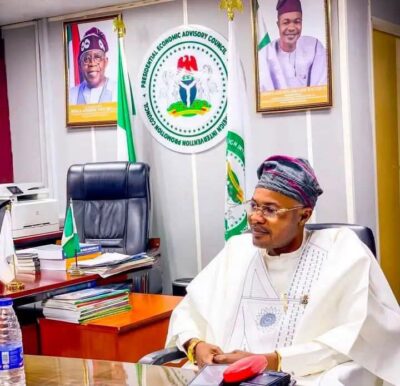
Records Show Council FG Called ‘Fictitious’ Received N1.1Billion Under Buhari, Gets N1.3Billion In 2026 Budget
The earliest payment, dated May 10, 2021, shows that N538.26 million was disbursed in favour of the Presidential Economic Advisory Council.
Payment records reviewed by SaharaReporters show that the State House released about N1.117 billion to the Presidential Economic Advisory Council (PEAC) between 2021 and 2022 under the administration of the late President Muhammadu Buhari, years before the current administration described the council as fictitious.
The records indicate that the funds were released for the council’s activities and operations through the State House.
The earliest payment, dated May 10, 2021, shows that N538.26 million was disbursed in favour of the Presidential Economic Advisory Council.
The payment was processed through the State House Headquarters Transit Account with the narration: “Payment in favour of Presidential Economic Advisory Council (PEAC).”
On June 3, 2022, the State House made a payment of N215 million to cover the council’s activities and operations for the 2022 fiscal year. Later the same day, another sum of N215 million was approved, making it the second N215 million payment on June 3, 2022, for the same purpose.
Govspend
Another sum of N209.43 million was subsequently paid, carrying the same payment narration: “Payment for the State House to cover the activities and operations of the Presidential Economical Advisory Council (PEAC) for the year 2022.”
Based on the payment records reviewed by SaharaReporters, the total amount released to the council between 2021 and 2022 stood at about N1.117 billion.
The payment records have attracted renewed attention after documents showed that the administration of President Bola Tinubu also made fresh budgetary provisions for a council bearing the same name.
The approved 2026 Appropriation Act allocated more than N1.3 billion to the Presidential Economic Advisory Council.
A breakdown of the budget indicates that N802,978,783 was earmarked for personnel costs, N200,000,001 for overhead expenditure, and N300 million for capital projects.
govspend
The allocation is contained in the Presidency’s section of the 2026 Appropriation Act released by the Budget Office of the Federation.
Despite both the historical payment records and the 2026 budgetary allocation, the Presidency has insisted that the Presidential Economic Advisory Council is “fictitious”.
govspend
In a statement on Wednesday, signed by presidential spokesperson Bayo Onanuga and titled, “The Matter of Adeniyi Adeyemi Matthew and the fictitious Presidential Economic Advisory Council,” the Presidency denied the existence of the council.
“We are aware of the public interest in the matter of a man called Adeyemi Adeniyi Matthew, who has been parading himself as the director-general of a fictitious Presidential Foreign Intervention Promotion Council cum Presidential Economic Advisory Council,” he said.
“The office of the Chief of Staff to the President first blew the whistle on the existence of the illegal agency, following complaints from officials of the Nigerian Investment Promotion Council that another government agency appeared to be functioning at cross-purposes with it.”
Meanwhile, Adeyemi has insisted that he is the Director-General of the Presidential Foreign Intervention Promotion Council and Presidential Economic Advisory Council.
Adeyemi recently accused Chief of Staff to the President, Femi Gbajabiamila, of bribery, alleging Gbajabiamila demanded N400 million and an additional N200 million to facilitate his appointment as head of a government agency.
Adeyemi alleged that Gbajabiamila demanded 48% of his agency’s take-off grant of N27.4 billion. He further claimed that Gbajabiamila received N400 million through a proxy to secure him the appointment, with an outstanding balance of N200 million.
He challenged the Presidency to conduct an independent panel, demanding that Gbajabiamila produce all official documents signed since taking office for forensic examination.
However, the Presidency on Wednesday mounted a robust defence of Gbajabiamila, releasing a detailed account of investigations it claimed exposed Adeyemi as the operator of a fictitious presidential agency months before he accused the presidential aide of corruption.
The State House said records from the Office of the Chief of Staff, the Ministry of Foreign Affairs, the Office of the National Security Adviser, the Office of the Secretary to the Government of the Federation and the Nigeria Police Force showed that Adeyemi was never appointed by President Bola Tinubu or any government authority but allegedly forged official documents to present himself as Director-General of the non-existent Presidential Foreign Intervention Promotion Council (PFIPC).
Despite that position, the 2026 budget provides detailed line-item allocations for the council’s day-to-day operations. Under its overhead expenditure, N43.58 million was budgeted for miscellaneous expenses, while N15.61 million was set aside for honorarium and sitting allowances.
The estimates also include N10.18 million for refreshments and meals, N10 million for welfare packages, N3.64 million for annual budget expenses and administration, N3.22 million for publicity and advertisements, and N928,306 for postage and courier services.
The capital component of the budget is similarly detailed. Of the N300 million earmarked for projects, N182.5 million, more than 60 per cent of the capital allocation, was proposed for “Logistics for Preparation of Hosting World Investment Summit 2026.”
The remaining capital votes are dedicated to investment and negotiation-related training programmes.
The budget provides N17 million each for an Intensive Course on Trade Negotiation Skills (World Trade Organization) and the Harvard Program on Negotiation (PON).
It also earmarks N12.5 million for Best Practices and Strategies for Public Investing and N11 million for Strategic Negotiation for Investment Professionals.
In addition, the council is proposed to spend N10 million each on Investment and Portfolio Management, Certified Investment Management Analyst (CIMA) certification, Negotiation and Leadership, Advanced Negotiation Strategies, Influencing and Negotiation Skills, and Strategic Investment Management, completing the N300 million capital allocation classified under research, development and other non-tangible assets.
Overall, the budget provides for N1.003 billion in recurrent expenditure, covering personnel and overhead costs, alongside the N300 million capital vote, even though the Presidency has publicly maintained that the council has no legal existence.
The inclusion of the council in the 2026 Appropriation Bill has raised fresh questions about how an entity the Presidency now describes as fictitious obtained an official budget code, detailed personnel provisions, recurrent expenditure and capital projects in the proposed federal budget.