

Report: Weak sanctions, poor prosecution fueling illegal mining, illicit flows
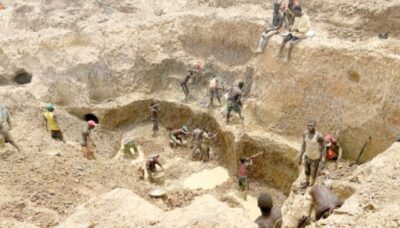
Report: Weak sanctions, poor prosecution fueling illegal mining, illicit flows
Poor prosecution outcomes and weak sanctions are fuelling illegal mining activities in Nigeria, allowing illicit financial flows to thrive despite increased arrests and enforcement actions, a new report has shown.

The report, titled ‘Enablers of Illicit Financial Flows in Nigeria’s Mining Sector,’ was jointly published by the Africa Network for Environment and Economic Justice (ANEEJ), the Nigeria Extractive Industries Transparency Initiative (NEITI), and the ministry of solid minerals development, with funding support from the UK Foreign, Commonwealth and Development Office (FCDO).
It highlights how practices such as trade misinvoicing, production under-declaration, smuggling, and opaque ownership structures are enabling large-scale revenue leakages, depriving the country of foreign exchange earnings and tax revenues.
The publication found that while arrests and seizures by the Economic and Financial Crimes Commission (EFCC) have increased between 2023 and 2025, the number of successful convictions and asset forfeiture orders remains sharply disproportionate, creating what the researchers describe as a “systemic enforcement gap that emboldens both domestic and foreign criminal actors”.
According to the findings, exporters routinely underprice mineral shipments, particularly lithium, gold, and tin, in collusion with foreign buyers, exploiting weak customs valuation systems to shift profits offshore and evade royalties.
“Export values for minerals frequently exceed domestic production, indicating systematic underpricing, inflated export declarations, or false reporting used to transfer value illicitly,” the report said.
It added that discrepancies between company-reported production and national export data point to widespread manipulation, with some firms exporting volumes that surpass their declared output.
‘UNDER-REPORTING, SMUGGLING, AND CASH ECONOMY DRIVE LOSSES’
The report identified production under-declaration as a major channel for IFFs, with mining operators, including artisanal and small-scale miners, deliberately understating output to reduce royalty payments.
Data from audits show “significant mismatches between production reported by operators and export records,” particularly for minerals such as gold, tin, and coal.
In one instance the report cited a company in 2021, which reported gold and tin production associated with about N114.3 million in royalties, only to declared export values of just N44.83 million, representing under-declaration.
“In addition, the widespread use of informal buying agents and middlemen allows illegally mined minerals to enter formal export channels,” the report said.
“Many of these entities appear in export records despite having no mining licences or production history.
“This indicates that informal aggregators are consolidating minerals from undocumented sources and laundering them into the formal system.”
According to the report, cash-based transactions further complicate oversight, minerals are often sold directly at mine sites or along transport routes without documentation, weakening traceability and enabling money laundering.
The report warned that such practices “facilitate anonymity and allow proceeds to be easily concealed, transferred, or moved across borders without detection”.
In addition, the report said smuggling remains prevalent, especially for high-value minerals like gold and lithium, which are transported through porous borders into neighbouring countries.
Enforcement records cited in the report show large-scale operations, including seizures involving multiple trucks of minerals and dozens of suspects, pointing to coordinated smuggling networks rather than isolated activities.
FOREIGN DOMINANCE, WEAK DATA SYSTEMS, AND OWNERSHIP OPACITY
The report also flagged the dominance of foreign buyers, particularly in pricing and export arrangements, as a key risk factor.
Mining companies and buying centres reported that pricing negotiations are largely dictated by foreign actors, creating “information asymmetry and pricing power imbalances” that enable under-valuation and capital flight.
At the institutional level, the report said fragmented data systems across government agencies, including mining regulators, customs, and financial authorities, limit the ability to reconcile production, export, and revenue figures.
This lack of coordination creates “institutional blind spots that illicit actors deliberately exploit”.
The report also highlighted a major gap in foreign exchange flows, noting that “repatriation of export proceeds from the solid minerals sector remains negligible or insignificant, despite recorded export activity”.
According to the report, beneficial ownership opacity further compounds the problem as mining licences are often held through shell companies and special purpose vehicles, making it difficult to identify the true owners.
“This opacity enables regulatory capture, weakens enforcement, and facilitates money laundering and profit shifting,” the report added.
‘CRIMINAL NETWORKS, SECURITY RISKS INTENSIFY IFF THREATS’
Beyond commercial practices, the report identified strong links between illegal mining and organised crime.
Enforcement records show large-scale operations involving multiple suspects and truckloads of minerals, according to the report, suggesting coordinated smuggling networks rather than isolated activities.
The publication said that in some regions, armed groups and bandits have infiltrated mining communities, imposing levies, controlling access to sites, and even participating directly in extraction and trade.
Proceeds from the activities, the report added, are often used to fund criminal operations, including arms procurement and logistics support.
The report described this as a “high-risk nexus between natural resources and terrorist financing,” particularly in artisanal mining zones where oversight is weakest.
Despite increased enforcement actions, including arrests and seizures, the publication said prosecution outcomes remain limited.
“The low number of convictions reduces deterrence and encourages continued engagement in illicit practices,” the report added.
Also, the publication called for urgent reforms to strengthen oversight, recommending digital tools to track production and mineral movements, as well as closer coordination among regulators and law enforcement.
It also proposed a multi-agency task force to tackle smuggling and data gaps across the value chain.
“Improved data consistency will allow reconciliation of production, export, and revenue data,” the report said.
In the medium-term, the report recommended priorities include formalising at least 5,000 artisanal mining cooperatives, developing a national mining sector data integration platform, and deploying digital traceability tools across all licenced buying centres.
Over the long term, the study calls for a nationwide blockchain-based mineral traceability system, satellite and drone-based surveillance of mining zones, and enhanced regional cooperation West Africa.