

Nnamdi Kanu’s Defence Team Warns Justice Omotosho Against Delivering Ruling Before Hearing Motion To Arrest Judgment
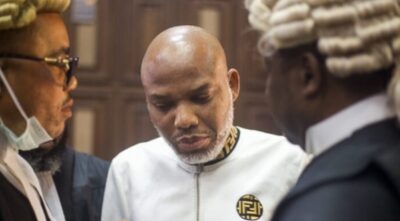
Nnamdi Kanu’s Defence Team Warns Justice Omotosho Against Delivering Ruling Before Hearing Motion To Arrest Judgment
According to the defence, the Motion to Arrest Judgment is “not political theatre” but a legitimate procedure in Nigerian criminal jurisprudence.
The legal team representing the detained leader of the Indigenous People of Biafra (IPOB), Mazi Nnamdi Kanu, has cautioned Justice James Omotosho of the Federal High Court, Abuja, against proceeding with judgment in the ongoing trial without first hearing a Motion to Arrest Judgment filed by the defence.
In a public briefing note issued on Tuesday by Onyedikachi Ifedi, Esq., for the Mazi Nnamdi Kanu Global Defence Consortium, the team argued that the motion, filed on November 10, 2025, is a lawful and binding judicial process grounded in Nigeria’s Constitution and criminal procedure laws.
According to the defence, the Motion to Arrest Judgment is “not political theatre” but a legitimate procedure in Nigerian criminal jurisprudence.
The team explained that it exists to prevent a court from delivering judgment where “jurisdictional or foundational defects remain unresolved.”
Quoting Section 36(1) of the 1999 Constitution, the statement stressed that the right to fair hearing is “non-derogable and universally binding,” and that delivering judgment while such a motion is pending would amount to “a verdict without legal life.”
“To ‘arrest’ judgment is to compel obedience to the Constitution, to ensure that no judgment is delivered in breach of the right to fair hearing,” the statement read.
“It is a lawful, binding, and time-honoured judicial safeguard against miscarriage of justice.”
The consortium disclosed that despite the filing of several motions challenging the court’s jurisdiction and the validity of the charges, Justice Omotosho has indicated his intention to deliver final judgment on November 20, 2025.
“These motions directly question the subsistence of any valid charge and the validity of the plea entered on March 29, 2025,” the statement said.
“To proceed to judgment without determining them would be to pronounce upon nothingness, a legal absurdity.”
The briefing also rejected claims that Kanu refused to enter his defence, describing such assertions as “false and misleading.”
The defence argued that Kanu’s cross-examination of prosecution witnesses constituted a full exercise of his right to defence under Nigerian criminal procedure.
“Having dismantled the prosecution’s case under cross-examination, Kanu has no obligation to call witnesses in defence of a charge that itself is a nullity,” the legal team maintained.
They further contended that the charge against him was based on the repealed Terrorism (Prevention) (Amendment) Act 2013, which was supplanted by the Terrorism (Prevention and Prohibition) Act 2022.
“He cannot defend himself against a mirage,” the note stated.
If the court proceeds to judgment without ruling on the pending motion, the defence team warned, such a verdict would be void ab initio under established authorities such as Madukolu v. Nkemdilim (1962) and Newswatch v. Attah (2006).
“He will have acted without jurisdiction, as the competence of the court remains under challenge,” they warned, adding that ignoring the motion “would amount to judicial self-help.”
The Global Defence Consortium called on the Federal High Court to hear the motion before proceeding, urging the Nigerian Bar Association, civil society, and the international community to defend the right to fair hearing as guaranteed under Section 36 of the Constitution and the African Charter on Human and Peoples’ Rights.
“Justice Omotosho stands at a defining juncture: to affirm the supremacy of the Constitution or to risk being recorded in history as the judge who pronounced judgment over silence,” the legal team declared.
The defence team said that the Motion to Arrest Judgment filed by Kanu’s team “is a lawful and constitutionally compelled act of self-defence.”
“Until that motion is heard and determined, no valid judgment can issue in FHC/ABJ/CR/383/2015,” the legal team said.
“To proceed otherwise would be to trample upon the very foundation of Nigeria’s constitutional order, the non-derogable right to be heard.”