
When Silence Speaks – Nigeria’s Opposition Adopts a Cautious Pause Amid U.S. CPC Designation

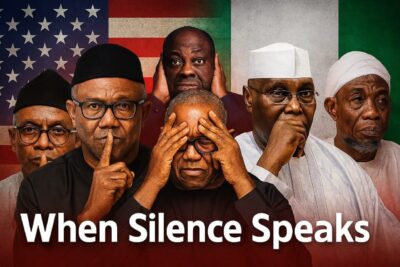
When Silence Speaks – Nigeria’s Opposition Adopts a Cautious Pause Amid U.S. CPC Designation
In a political landscape where opposition voices typically dominate the national conversation with passion and persistence, a surprising quiet has emerged. Figures who have long shaped Nigeria’s opposition space, Atiku Abubakar, Peter Obi, Nasir El-Rufai, Dele Momodu, Rotimi Amaechi, Rauf Aregbesola, and activists such as Bolaji Abdullahi, Aisha Yesufu, and Oby Ezekwesili have noticeably tempered their public critiques of President Bola Ahmed Tinubu and the ruling APC. The shift coincides with the United States’ designation of Nigeria as a “Country of Particular Concern” (CPC), highlighting alleged religious persecution and hinting at sanctions or international scrutiny. Where once the nation was treated to near-daily commentary, the opposition now seems to favor a more measured, cautious approach, a pause that has not gone unnoticed.
The CPC designation reframes Nigeria’s challenges from domestic governance and policy issues to an international human rights and religious freedom context. Speaking out in this environment requires careful calibration, critiques must balance advocacy for accountability with national and international sensitivities. Analysts suggest that this quieter approach reflects strategic caution, resource constraints, and the natural recalibration that often follows sudden shifts in the political and international landscape. It is a reminder that even the most vocal critics must weigh the stakes when the arena expands beyond national borders.
The Tinubu administration has firmly rejected the CPC label as “false, baseless, and divisive,” emphasizing Nigeria’s constitutional guarantees of religious freedom and noting that insecurity affects communities of all faiths. For the opposition, the moment represents a delicate balancing act, continuing to hold government accountable while avoiding perceptions of aligning with foreign interests. The irony is subtle but clear, those who previously filled headlines with commentary and critique are now choosing discretion, a quiet that speaks as loudly as words once did.
This temporary silence carries implications for democratic engagement. Public debate and accountability remain essential, yet the realignment of discourse toward strategic reflection highlights the challenges of navigating high-stakes political and international pressures. Citizens, meanwhile, observe the contrast, robust critique has given way to thoughtful pause, a delicate lesson in the art of timing and messaging. The quieter tone does not diminish the issues at stake but reframes them within a context that blends prudence with principle.
Observers note that moments of heightened scrutiny often reveal both strengths and vulnerabilities in political culture. The opposition’s cautious approach underscores the complexity of balancing domestic advocacy with international attention, while the government’s firm but measured response demonstrates the interplay between sovereignty and diplomacy. In this theater, silence is not necessarily absence, it can signal strategic consideration, self-restraint, or even a quiet acknowledgment of global realities.
In the final analysis, Nigeria’s current moment is a lesson in political complexity. Constructive engagement, strategic communication, and principled critique remain vital, even if expressed with restraint. The gentle irony of the opposition’s pause underscores the evolving dynamics of accountability and governance, in politics, sometimes saying less is as telling as speaking loudly, and the most attentive observers may read the silence as clearly as any statement.
©️ Adebamiwa Olugbenga Michael
Political and Social Analyst, Lagos